12 Farmhouse Kids Room Ideas for a Charming & Cozy Space
Farmhouse is the design style children never outgrow, because it was never designed for adults in the first place — it’s the style of well-loved things. Patchwork quilts stitched by hand, buckets that gather dents, wood that earns its scratches, iron beds that have carried generations of sleepy children. A farmhouse kids’ room isn’t a theme; it’s an inheritance. The palette is simple — warm white, natural wood, black iron, a touch of galvanized silver — and everything in it gets better with use. Where other styles fight a child’s daily life, farmhouse absorbs it: the scuff on the whitewashed wall becomes patina, the folded quilt at the bed’s foot becomes part of the story, and the room quietly teaches the child that beautiful things are meant to be lived in, not looked at.
The farmhouse kids’ room succeeds on one principle: material honesty. Real wood, real cotton, real iron, real quilts — nothing pretending to be something cheaper. Twelve ideas below, each one adding a layer of honest country craft, and each one chosen because it will photograph like charm and perform like furniture. Build the room slowly, the way old houses were built, and you’ll end up with a space that feels like the best kind of memory: warm, sturdy, and made to last longer than childhood itself.
Whitewashed Shiplap Wall
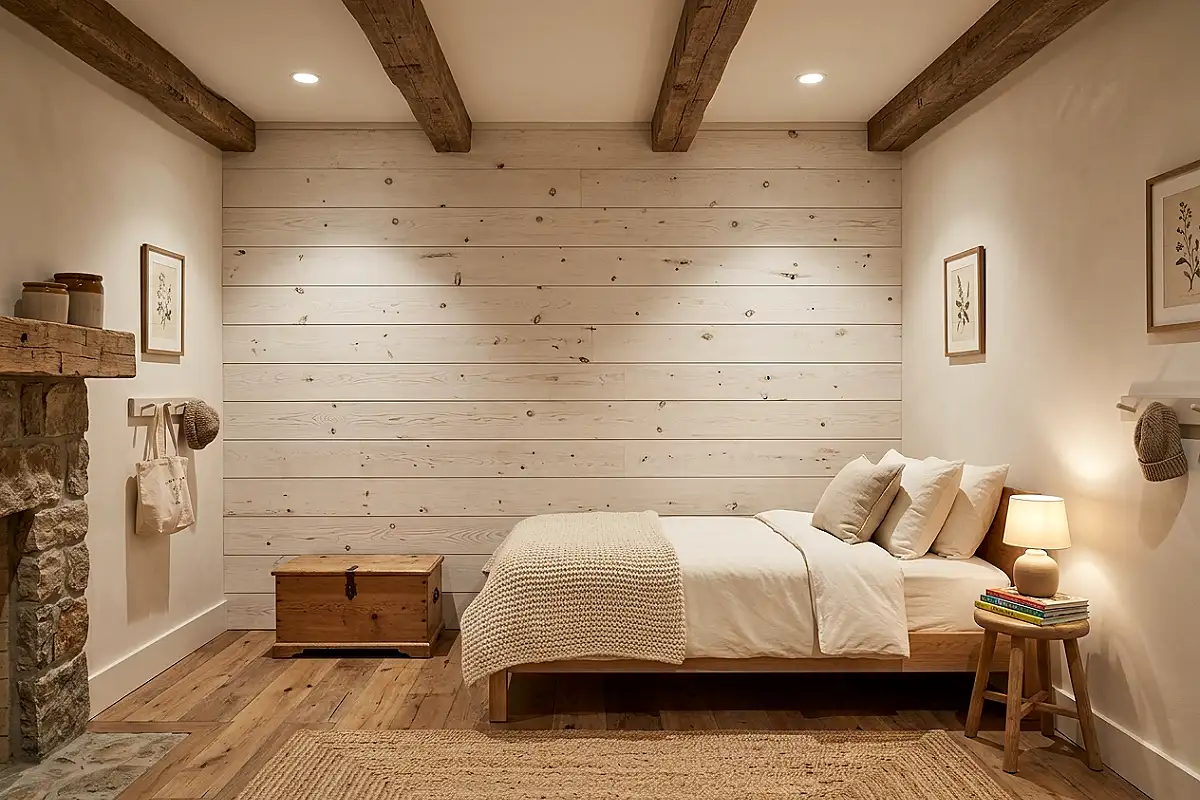
The farmhouse signature: shiplap — narrow wooden boards overlapping at their edges — running horizontally across the bed wall, brushed with a thin whitewash that lets the wood grain show through like morning light through paper. Shiplap gives the room its instant farmhouse bones: the horizontal lines stretch the wall visually, the whitewash keeps everything luminous, and the texture makes even the plainest room feel like a porch of a beloved old house. Run the boards horizontally across the widest wall, and keep the whitewash thin — the goal is boards that still look like wood, not boards painted white. One shiplap wall is enough; the room’s other walls stay warm white, and the contrast is the entire architecture of the style.
Pro Tip
Start shiplap rows from the top of the wall, not the bottom — floors are rarely level, and starting at the ceiling lets any width adjustment happen at the floor line where it disappears behind furniture instead of appearing as a crooked line across the wall.
Reclaimed Wood Name Sign
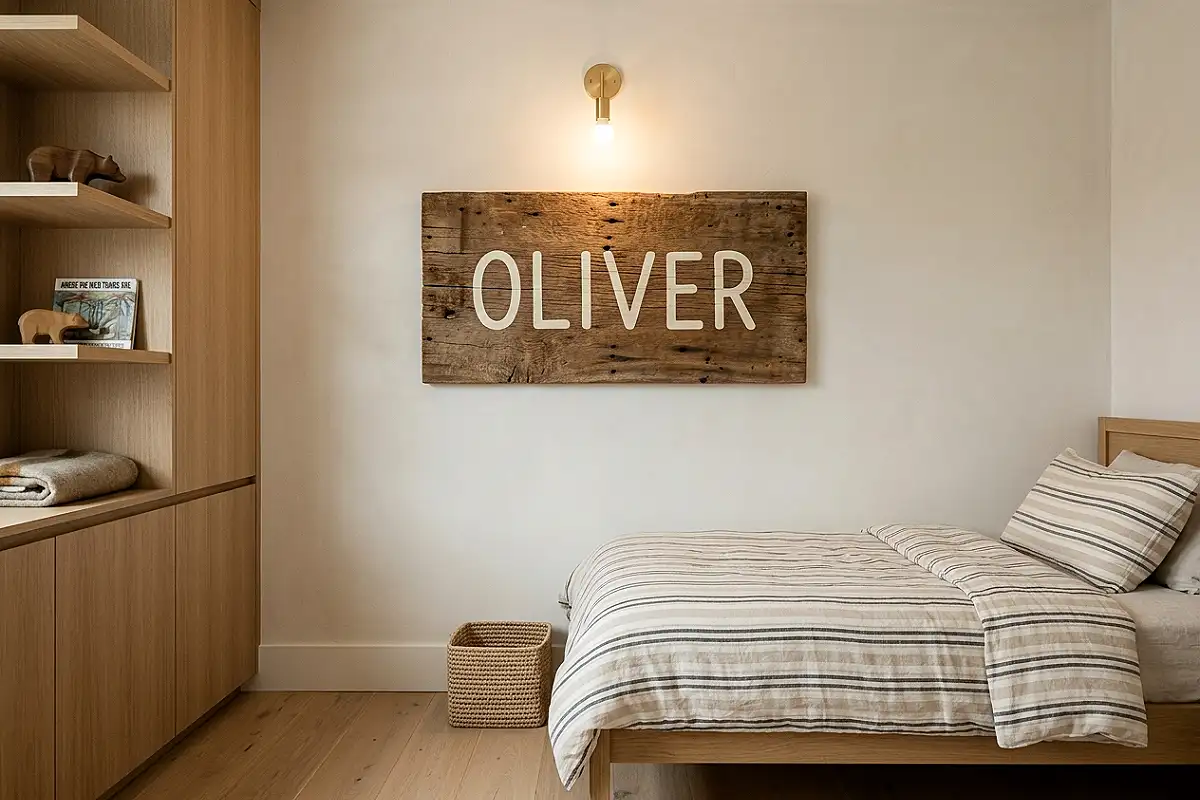
The room’s greeting, carved in wood: a sign of reclaimed barn wood or pallet timber — sanded to softness, lightly oiled — with the child’s name painted in simple lettering across its length, hung above the bed or beside the door. Wood name signs make farmhouse personal in the most honest material it has: the wood already carries its history — nail holes, grain scars, weather marks — and the painted name makes the room undeniably the child’s. Choose boards at least an inch thick (thin signs warp and read as craft project rather than furniture), keep the lettering to one clean sans-serif or simple serif in soft white or black, and skip the flourishes — farmhouse typography says its message plainly and moves on. It’s the smallest heirloom a room can hold: wood older than the child, with their name on it.
Pro Tip
Sand reclaimed wood lightly and finish it with a wipe-on oil, never bare — old barn wood hides dust and splinters in its surface, and a sealed face keeps the sign smooth for small hands while preserving the patina that makes it beautiful.
Patchwork Quilt Bedding
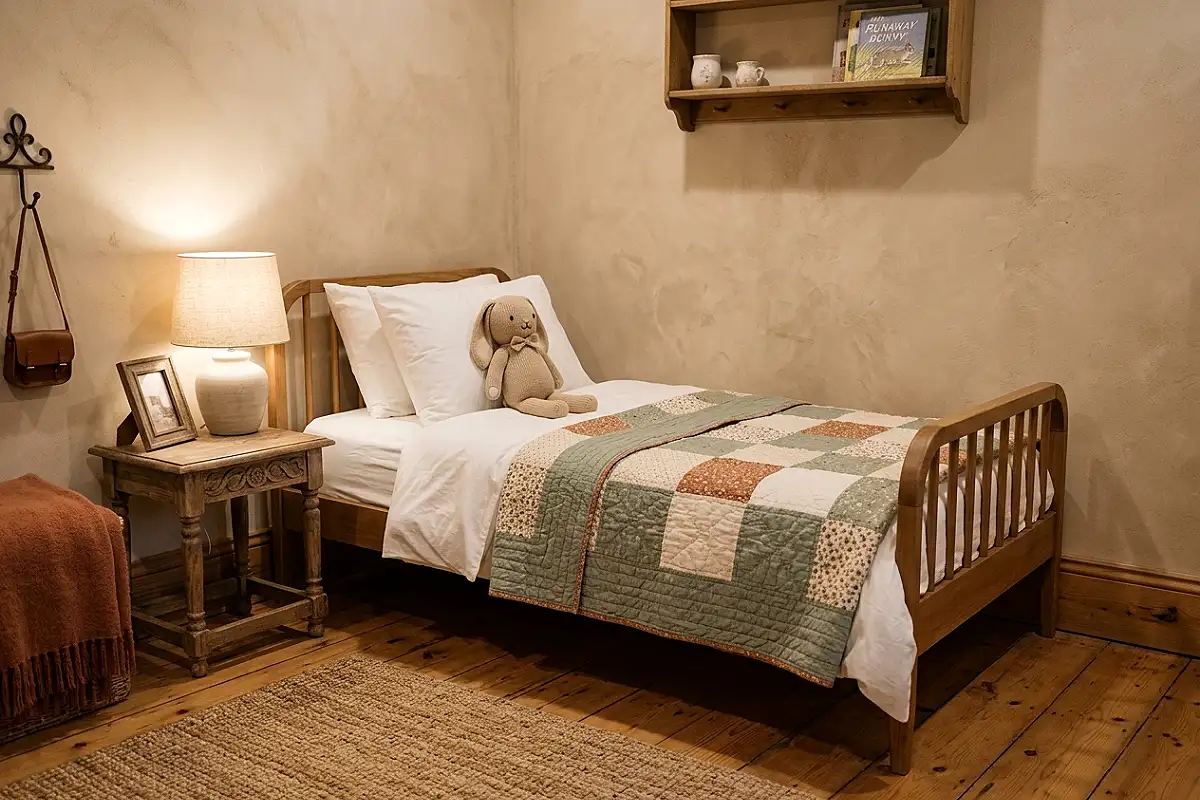
The bed’s stitched story: a patchwork quilt — squares of soft cotton in the room’s palette, stitched in a classic nine-patch or log cabin pattern — folded at the foot of the bed and pulled up on cold mornings. Patchwork quilts are farmhouse’s most emotional object: each square can come from old clothing, inherited fabrics, or the grandmother’s stash, and the quilt becomes a family document written in thread. Choose quilts with tightly stitched seams (loose quilting sheds filling and flattens fast), prefer cotton over polyester blends — cotton ages soft, polyester ages shiny — and pair the quilt with plain white sheets so its pattern stays the room’s only textile conversation. No other bedding tells a story; the patchwork quilt tells twelve.
Pro Tip
Wash patchwork quilts on gentle cycles in cold water, and dry them flat or line-dried — the agitation of a hot dryer breaks down the quilt’s batting and stresses the stitch lines, while flat drying keeps a handmade quilt square and snug for decades.
Galvanized Toy Buckets
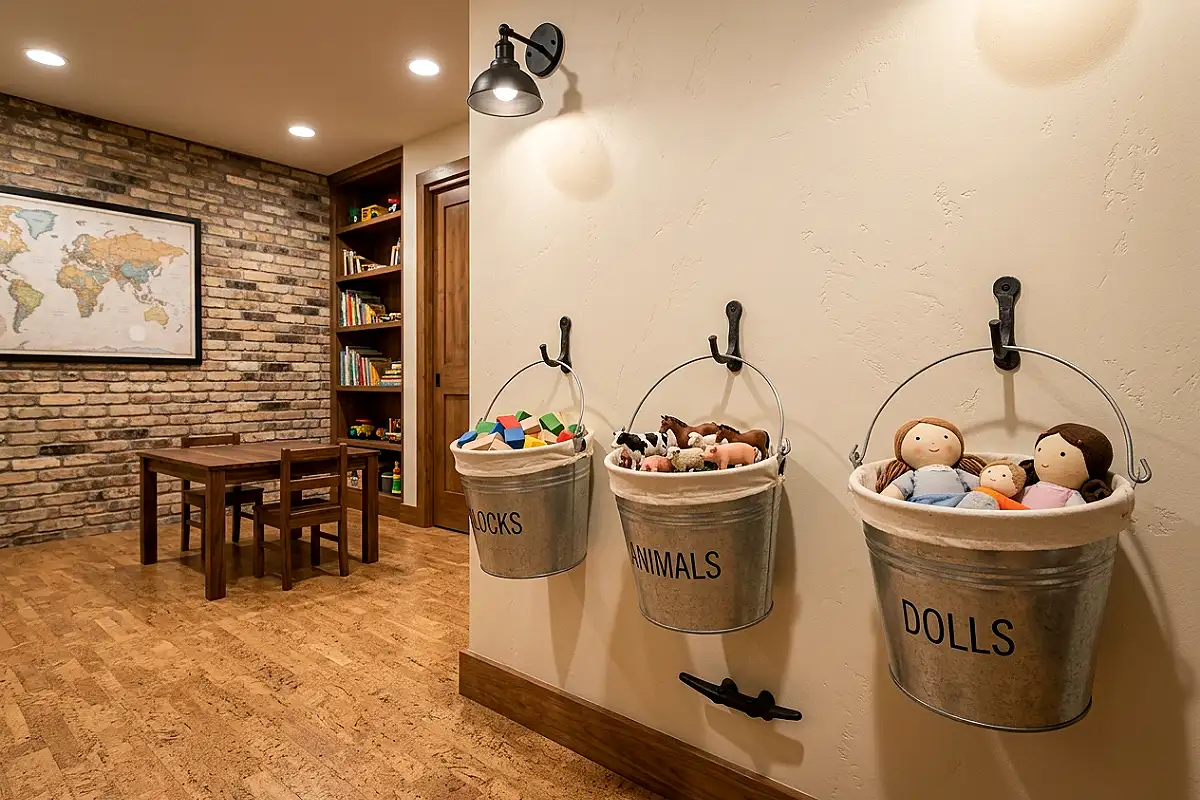
The cleanup’s country solution: a row of galvanized metal buckets — dimpled, matte silver, with rolled rims — hanging from black iron peg hooks at the child’s height, each bucket carrying one toy family: cars, blocks, dolls, whatever survives a galvanized bucket’s honest capacity. Galvanized buckets give the room’s storage its farmhouse voice: the metal is utilitarian by origin — these are the containers that carried produce and feed for generations — and hanging them at peg-hook height makes tidying a throwing-in gesture a small arm can manage. Choose buckets with rolled rims (cut rims bite small fingers), keep the row to three or four buckets — enough for the toy families, not enough to look like a supply closet — and let the dimpled metal be the room’s one silver note against all the wood and white.
Pro Tip
Line galvanized buckets with cotton fabric sacks — galvanized metal’s interior can have rough seam points that snag small toys and tiny fingers, and a simple fabric liner protects both while making the bucket’s contents easier to see and grab.
Vintage Iron Bed
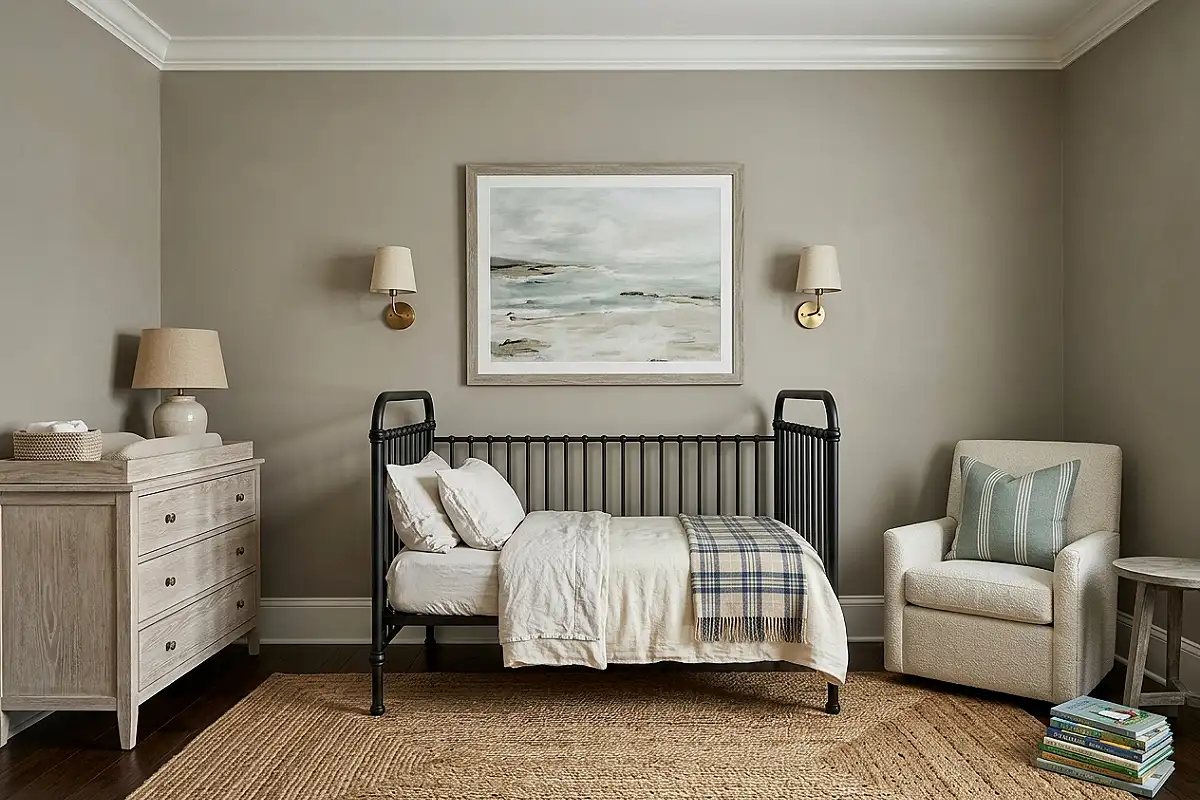
The bed that has carried every generation: a vintage-style iron bed — tubular iron spindles, gently curved headboard, in black or soft bronze — anchoring the room’s center with a century of furniture history. Iron beds are farmhouse’s most romantic object: the spindles make perfect reading-backrests, the metal stays cool and solid, and the bed reads as inherited rather than bought — even when it’s brand new. Choose an iron bed with a center support leg (tubular frames without mid-span support develop a center sag that grows yearly), pick black over chrome — black reads farmhouse, chrome reads hospital — and dress it with the patchwork quilt and nothing else, letting the spindles’ geometry be the bed’s whole decoration. The bed photographs like a porch in July, and it will still be there when the child is thirty.
Pro Tip
Check iron bed joints for rubber washers or tighten caps at purchase — vintage and flat-pack iron beds squeak through loose metal-to-metal joints, and adding small rubber washers at every joint connection turns a nightly symphony into permanent silence.
Enamelware Shelf with Hooks
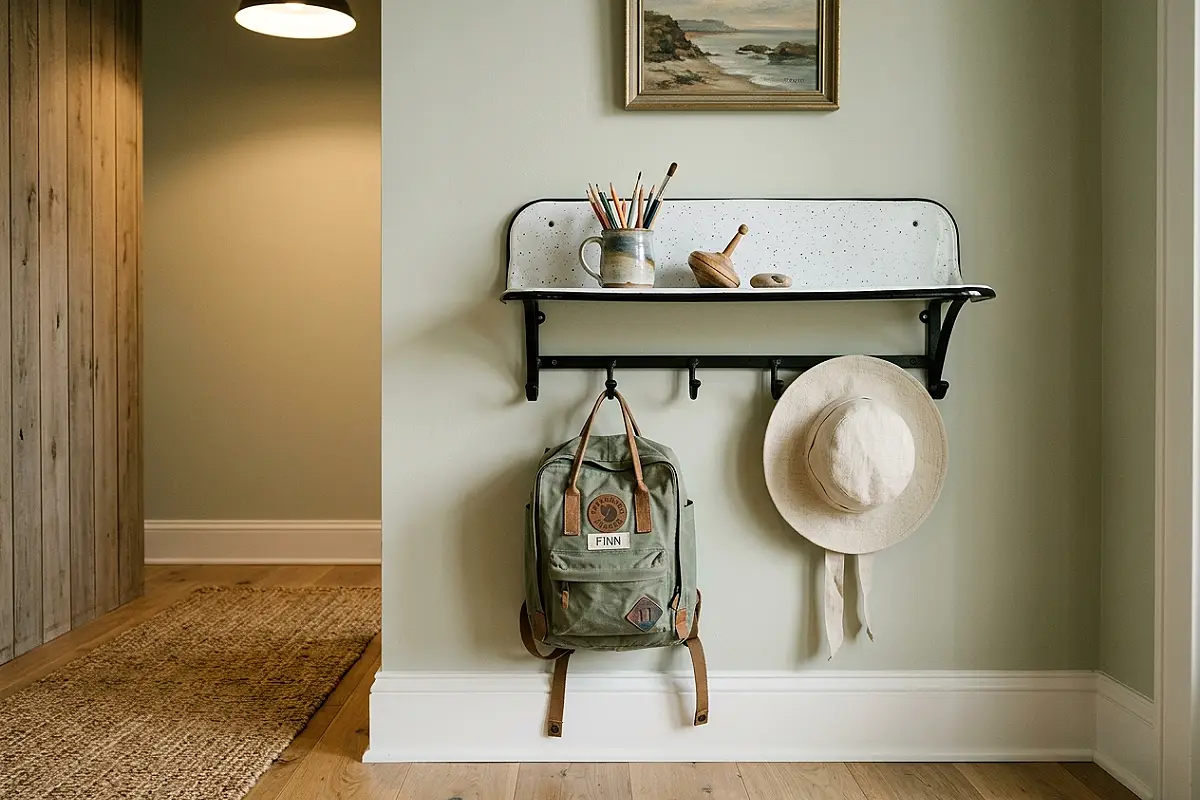
The country wall display: a slim enamel-coated shelf — white or cream with a rolled rim, speckled with age — mounted at the child’s height, its underside carrying small iron hooks holding jackets, caps, and tomorrow’s outfit. Enamelware is farmhouse’s most tactile material: the glossy baked surface, cool to the touch, slightly imperfect at its edges, has lined farmhouse kitchens for two centuries. Choose enamel shelf units with welded hooks (bent-wire hooks bend under jacket weight), keep the shelf’s contents to a few ceramic cups and one small plant — the shelf itself is the decoration — and position it by the door so the morning routine runs through it naturally. Enamelware ages by chipping instead of failing, and in a farmhouse room, every chip is just another year of the story.
Pro Tip
Mount enamel shelves with brackets rated for the shelf’s full expected load, not decorative brackets — enamel is heavy relative to its slim profile, and under-bracketed shelves tilt forward the first week a backpack hangs from their hooks.
Beadboard Lower Walls
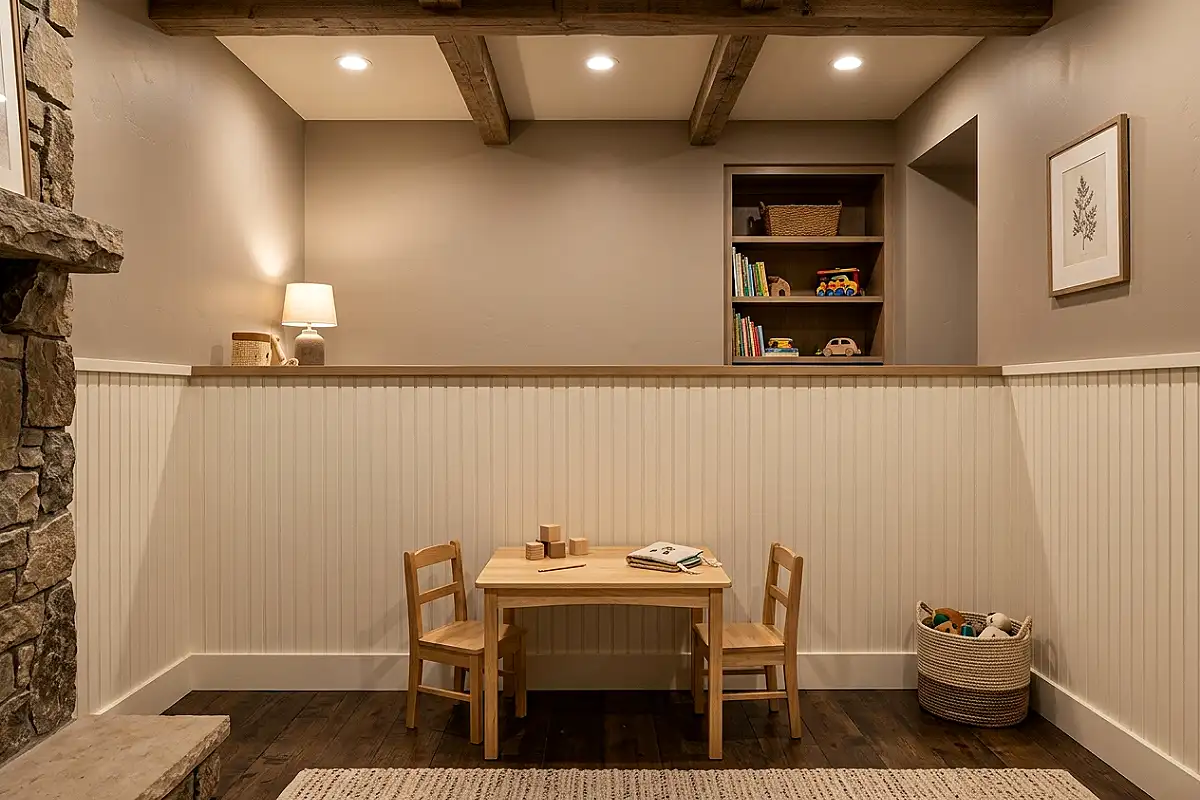
The room’s country wainscoting: beadboard — narrow vertical boards with the signature rounded bead between each — running up the lower third of the walls, painted warm white, with a simple flat cap rail on top. Beadboard gives farmhouse rooms their protective layer: the lower wall can take crayon, chair-backs, and decades of small collisions, and the beadboard reads as craft rather than covering. Paint it the same warm white as the upper walls or one tone deeper (deeper beadboard grounds the room; matching beadboard stretches it), run the boards vertically, and stop the cap rail at a clean 32 to 36 inches — the height where chairs meet walls. Beadboard is the farmhouse room’s armor, and like all good armor, it stays invisible until the day it earns its keep.
Pro Tip
Prime beadboard before painting, especially MDF versions — MDF beadboard drinks paint unevenly and blisters at its joints when unprimed, and a shellac-based primer keeps the finish smooth through every future crayon cleanup.
Ladder Blanket Rack
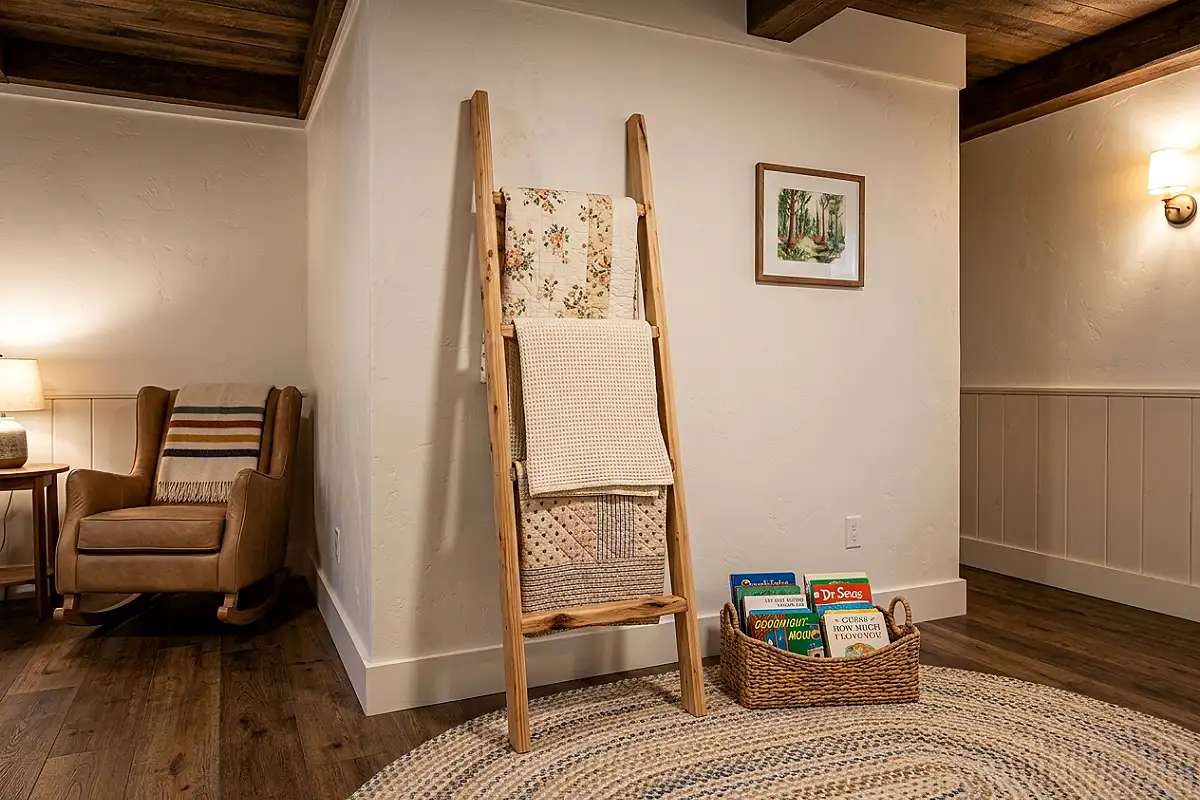
The room’s coziest corner furniture: a wooden blanket ladder — four or five wide rungs, leaning against the wall at a gentle angle — with quilts and folded throws draped across its rungs like laundry on a clothesline at the homestead. Ladder racks give the room its easy texture layer: quilts on display, always reachable, always looking casual, and the ladder’s leaning posture makes the corner feel lived-in rather than staged. Choose a ladder with rungs at least two inches wide (thin rungs crease quilts and slide them to the floor), anchor it with a small wall bracket at the top (leaning ladders walk away from walls and tip under small climbers), and keep the drapes to three throws maximum — the ladder is a display, not a storage unit, and restraint is what makes it charming. It’s the farmhouse room’s most photographed three square feet.
Pro Tip
Set the ladder’s base about ten inches from the wall, not flush — a ladder flush against the wall leans at too steep an angle for quilts to drape visibly, while the ten-inch offset gives the throws room to fold and hang like they belong there.
Café Curtains
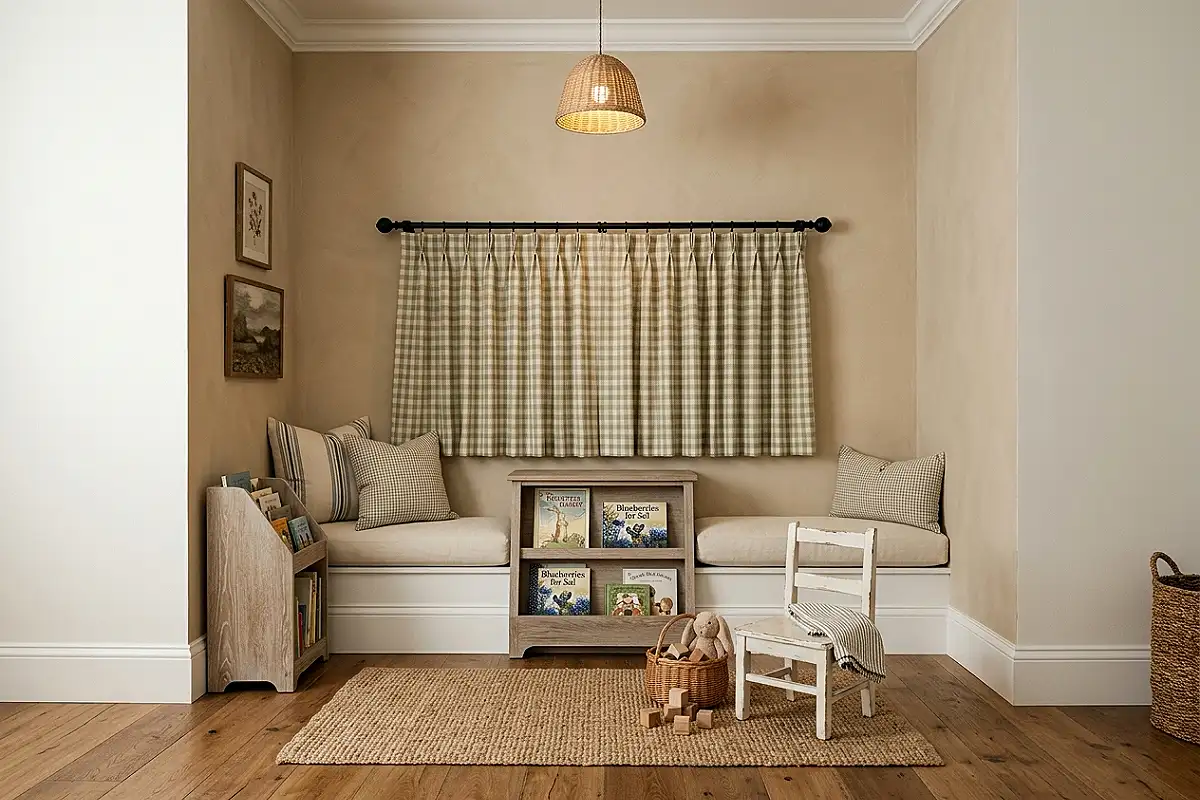
The window’s country dress: café curtains — linen or cotton panels covering only the window’s lower half, hung on a slim rod at mid-frame — letting morning light flood the top while the lower glass stays soft and private. Café curtains are farmhouse’s most quietly charming window treatment: they keep the room bright all day, they hide the morning’s general untidiness from the street, and their short length means no puddling fabric for small feet to trip on. Choose natural linen over polyester (linen’s weight makes the hem hang straight; polyester floats), keep the panels unlined for the lightest look, and match the rod to the room’s black iron family. The top half of the window stays bare glass — that’s the whole trick — and the room stays luminous in a way full-length drapes never achieve.
Pro Tip
Hem café curtains with a weighted cord in the bottom hem — short curtains catch every breeze and flap from window openings, and a hidden weighted cord keeps the panels hanging straight and calm in rooms where windows open daily.
Seed Packet Gallery
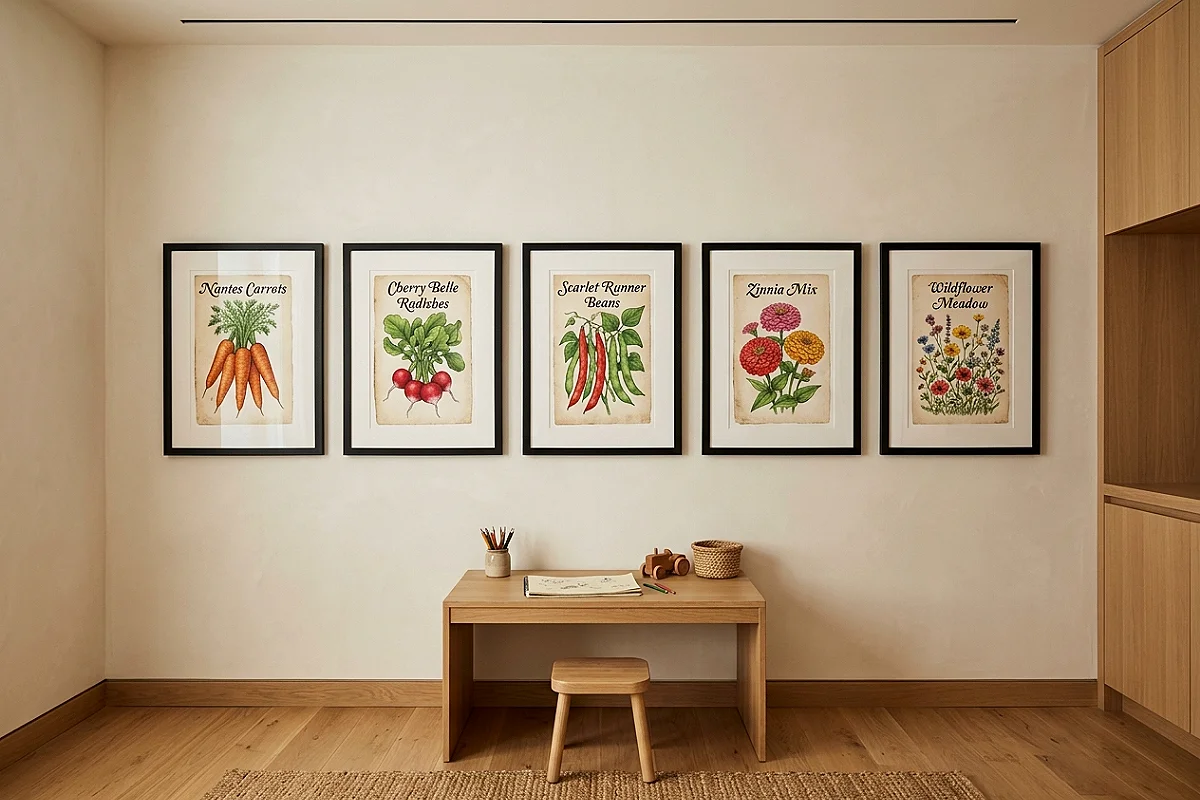
The wall’s garden, framed: a row of vintage seed packet prints — antique packets for tomatoes, radishes, wildflowers, their illustrations glowing in saturated greens and reds — framed identically and hung in a tight line above the desk or beadboard cap. Seed packet prints give the farmhouse room its color without a single modern decoration: the packets are pure country craft history, the illustrations are botanical art of the sweetest kind, and every packet whispers of gardens and growing things. Choose prints sized to match (the uniformity makes five small prints read as a set), frame them in simple black or natural wood to keep the vintage paper the hero, and hang the gallery where the child’s desk faces it — the packets double as the room’s gentlest science lesson. They’re also nearly impossible to find ugly; two centuries of seed companies competed to make these little envelopes beautiful.
Pro Tip
Mount seed packet prints on acid-free mat board before framing — vintage paper yellows and foxes when it touches acidic cardboard, and an acid-free mount preserves the packets’ paper integrity for the decades they’ll hang on that wall.
Barn Door Toy Closet
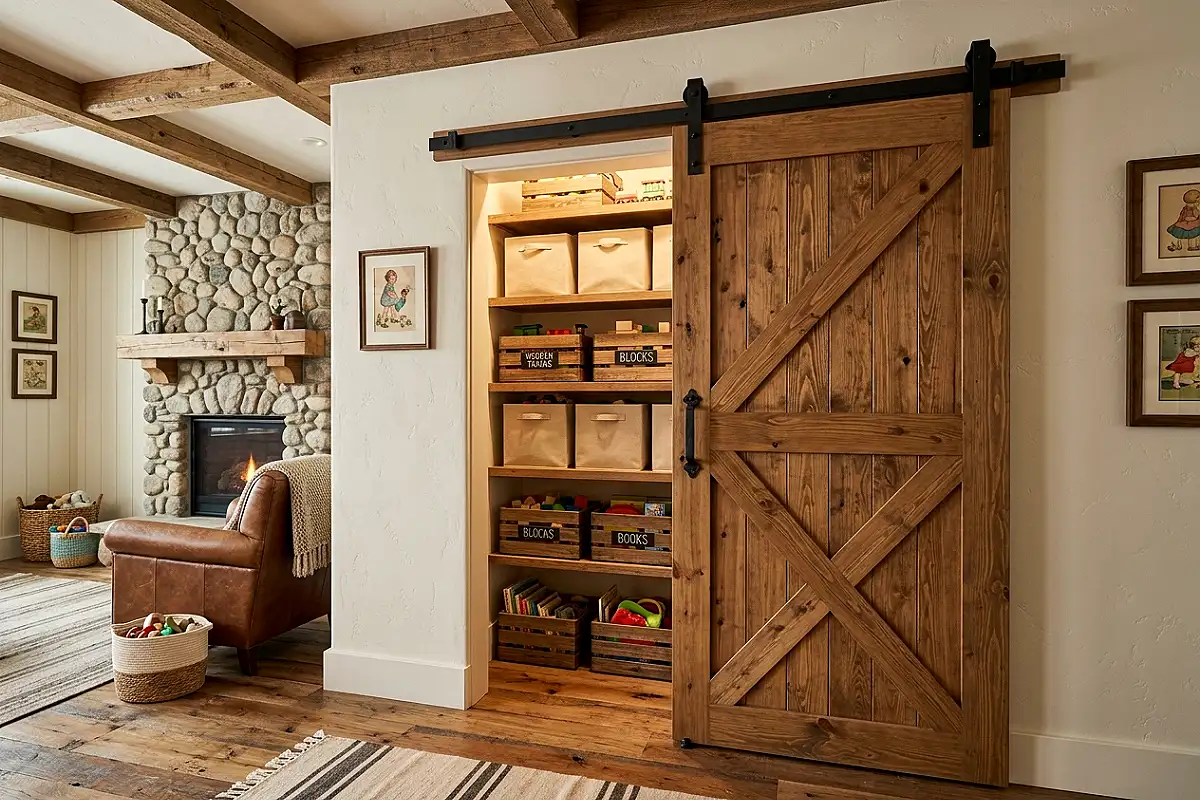
The storage that closes like a barn: a closet — the toy closet, the linen closet, the anything closet — fitted with a sliding barn door on a black iron track, its wood panel carrying the room’s whole storage problem behind country charm. Barn doors solve the farmhouse room’s ugliest necessity — doors that swing open eat floor space, but sliding barn doors turn the storage wall into the room’s best furniture. Choose a door of solid wood (hollow-core barn doors sound hollow when slid and sag within a year), fit the track with a floor guide at the door’s base (guides stop the sliding sway that knocks shelves), and pick a door panel with visible grain and black iron hardware. The moment the door slides shut, the room’s mess becomes the room’s architecture. No other storage solution photographs half this well.
Pro Tip
Mount barn door tracks into studs along their full length, not drywall anchors — a solid door plus its hardware runs forty to sixty pounds, and anchor-mounted tracks peel away from walls the first week a child slides the door with enthusiasm.
Farm Tools Wall Art
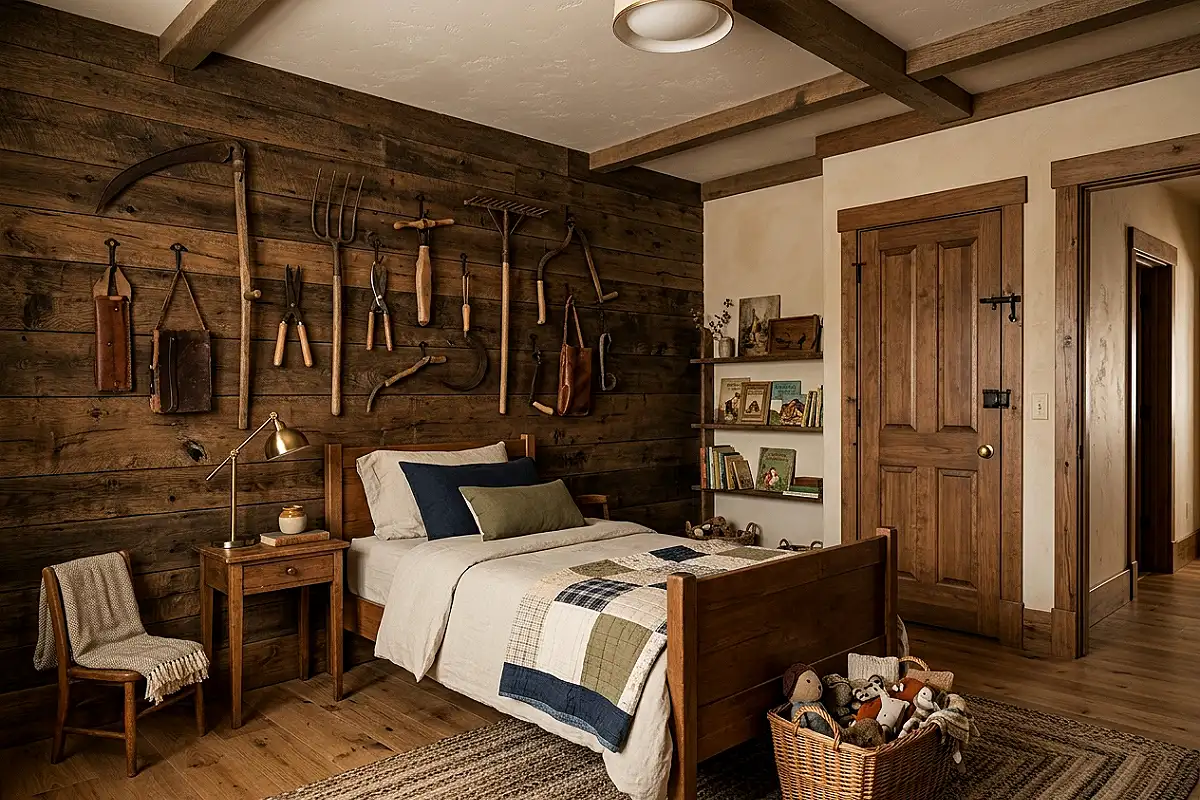
The wall’s working history: a collection of antique farm tools — a small hand rake, an old trowel, a rusted cultivator head, a wooden yoke — mounted flat against the wall in a loose arrangement, framed like the functional art it became. Farm tools give the farmhouse kids’ room its deepest authenticity: these objects were made to work the earth, and hanging them turns a child’s wall into a small agricultural museum. Choose tools that are genuinely old (the rust patterns and wear marks can’t be faked convincingly) and genuinely clean — brush away loose rust, wipe surfaces, but never polish; the patina is the point — and mount each piece with two small concealed brackets so the tools sit flush and safe. It’s the most grown-up object on this list, and children love it most, because every tool comes with a story about what it used to do.
Pro Tip
Seal antique tools with a light coat of clear matte lacquer — active rust on wall-mounted tools sheds onto walls and bedding, and a thin lacquer pass stabilizes the patina permanently while keeping the tools’ aged character fully visible.
Twelve Honest Pieces, One Room That Grows
The farmhouse kids’ room is the style that never asks a child to grow up — it only asks them to live honestly. The shiplap wall, the iron bed, the quilts on the ladder, the buckets at peg height: every piece works the way it looks, and every one of them will still be useful, still be beautiful, still be carrying its part of the story, years after the toys have moved on. Build it with real materials, close the barn door each night, and the room becomes what farmhouse always promised: a small, sturdy piece of the good life, made for growing.
Frequently Asked Questions
Isn’t farmhouse style already dated?
The trendy version is — the over-decorated, sign-every-wall version peaked years ago. Authentic farmhouse isn’t a trend; it’s rural craft tradition, and like quilts and iron beds, it doesn’t date. The discipline is restraint: real materials, few pieces, no novelty signage, and the room reads as timeless instead of thematic.
What colors define a farmhouse kids’ room?
Warm white, natural wood tones, soft black iron, galvanized silver, and one or two muted accents — sage green, faded red, or butter yellow. The palette mirrors the countryside: the color of whitewash, timber, and weathered metal, never the bright primaries of toy packaging.
Does farmhouse work as a gender-neutral style?
Farmhouse is inherently gender-neutral — it’s a working-craft style, and its palette (wood, white, iron, galvanized) carries no gender at all. Adjust only the accents: sage and wheat for one reading, faded red and denim blue for another. The bones stay identical.
Can farmhouse work in a small kids’ room?
Yes — farmhouse is one of the most small-room-friendly styles, because its signature pieces are linear and low: shiplap stretches walls horizontally, beadboard protects lower walls without consuming space, and ladder racks and barn doors use vertical or sliding storage. The only caution is tool collections: keep wall art to one arrangement, not a crowd.
How do I make the room authentically farmhouse rather than trendy?
Buy fewer, better pieces and prefer the genuinely old or the genuinely handmade: real quilts, real iron beds, real reclaimed wood, real galvanized buckets. Skip the novelty word signs, the distressed-paint shortcuts, and anything labeled “rustic farmhouse chic.” If a piece has a story of actual use, it’s authentic; if it only looks used, it’s trend.
Is a farmhouse kids’ room affordable to build?
Reasonably — farmhouse’s best pieces are modest in cost: beadboard and shiplap are DIY-friendly, galvanized buckets are inexpensive, and café curtains cost little. The honest splurge is the bed and the quilts, and vintage iron beds and handmade quilts can be found at farm auctions and estate sales for far less than their retail charm suggests.