
18 Bedroom Office Ideas with Stylish Space-Saving Furniture
Working from your bedroom doesn’t have to mean sacrificing the calm, curated feeling you’ve worked so hard to create in that space. The best bedroom offices I’ve come across share one thing: they feel intentional. The desk doesn’t apologize for being there — it belongs, woven into the room’s palette, proportions, and personality as naturally as the headboard or the nightstand.
Whether you’re working with a true spare corner or carving out a nook in a studio apartment, these 18 ideas will show you how to build a workspace that’s productive without being sterile, compact without feeling cramped, and beautiful enough that you actually want to sit down and get things done.
The Hidden Murphy Desk
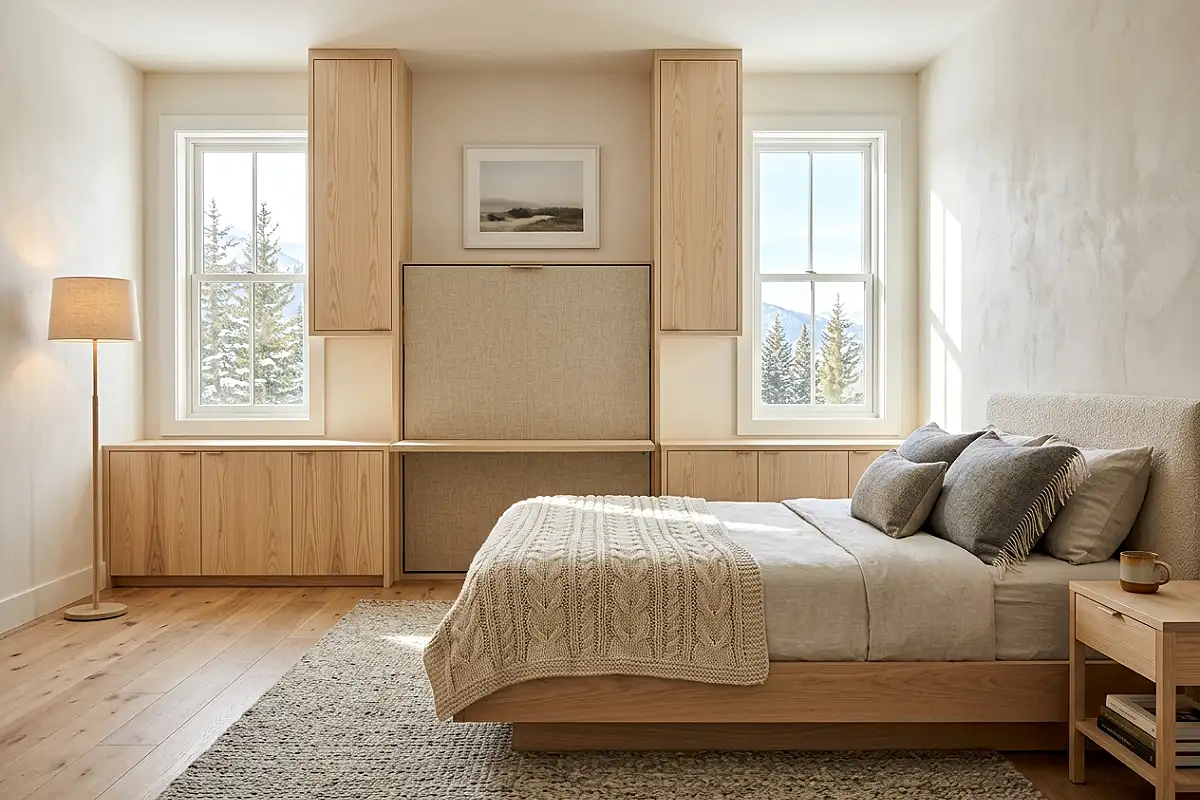
There’s something deeply satisfying about a workspace that simply disappears. A wall-mounted Murphy desk — the kind that folds flush against the wall and latches shut with a magnetic click — turns your bedroom back into a sanctuary the moment the workday ends. Look for versions finished in matte white lacquer or warm oat linen, both of which read as furniture rather than office equipment. When open, the interior face becomes your working surface; when closed, it can double as display space for a small framed print or a trailing pothos in a terra-cotta pot. Pair it with a slim, stackable stool that slides underneath when not in use — the IKEA FJÄLLBERGET in ash veneer is a practical pick, while the Hay About A Stool AAS32 brings a polished Scandi edge if you want something that holds its own as a design object. Float the unit at eye level between two windows so it catches natural light when open, and becomes a clean architectural interruption when closed.
Pro Tip
Line the interior of the folded desk with a sheet of self-adhesive cork board. It gives you a pinboard for notes and reference material that hides entirely when the desk is latched shut — zero visual clutter in the room.
Closet-Converted Command Center
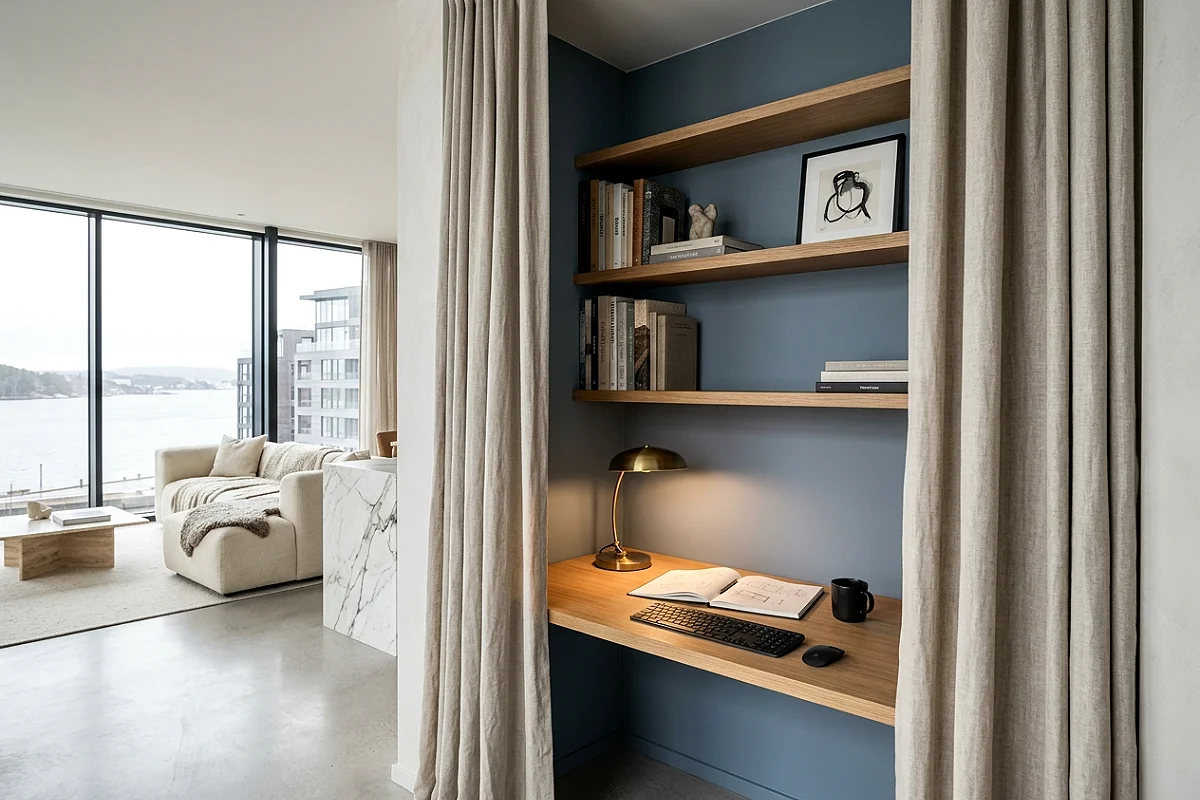
A reach-in closet with its doors removed is one of the most underrated real estate moves in a bedroom. Strip out the hanging rail and add three or four floating shelves in stained oak or painted MDF — stagger the depths so the bottom shelf runs deepest and becomes your true desk surface. At around 24 inches deep, it’s generous enough for a monitor, keyboard, and a small lamp without feeling like a cramped cubby. Frame the opening with the original door casing and hang a pair of linen drape panels that can be drawn fully closed at day’s end, making the entire office vanish behind fabric. A warm-toned pendant or a plug-in sconce mounted inside the closet adds task lighting that doesn’t require any rewiring. Choose a cord-management spine (the Cable Box by Yamazaki in black steel is particularly discreet) and keep it anchored to the back wall so no tangle is visible from the doorway.
Pro Tip
Paint the interior of the closet a shade two tones darker than your bedroom walls — a deep sage, dusty slate, or warm mocha. That contrast creates a cozy “room within a room” effect and makes the space feel purposefully designed rather than improvised.
Floating Corner Shelf System
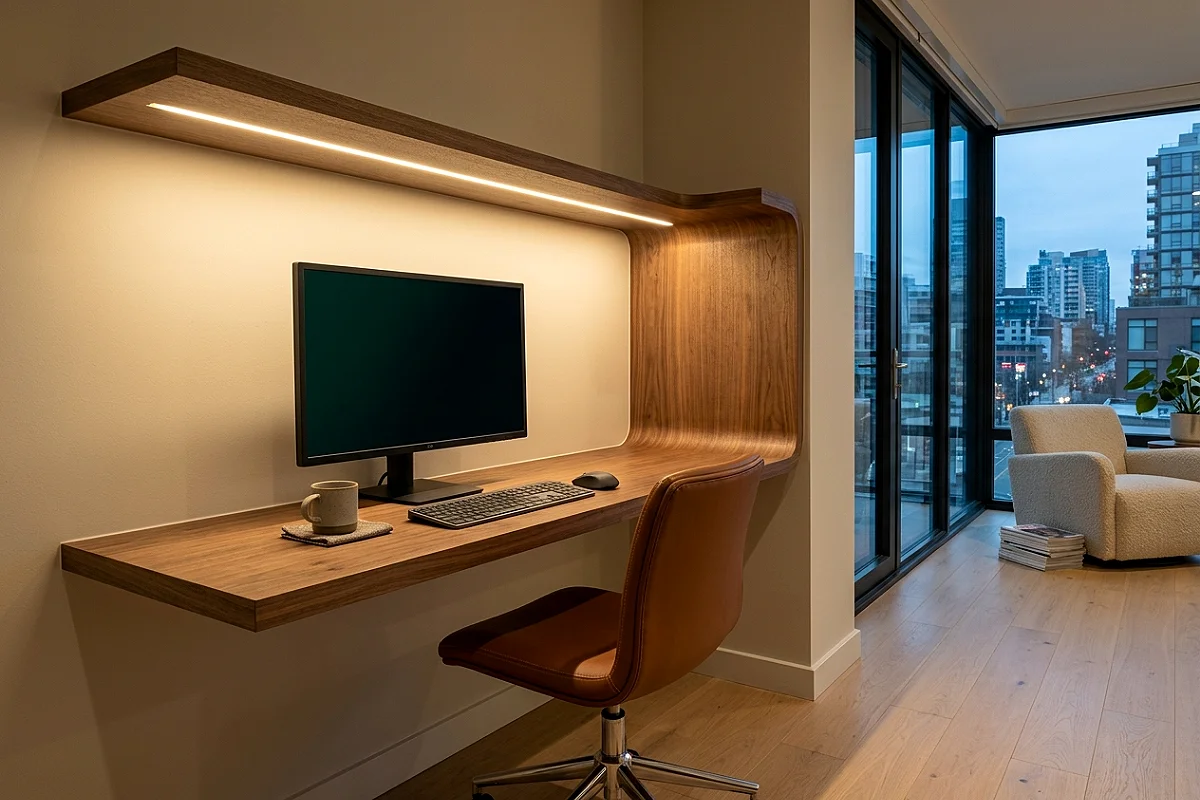
Rather than anchoring a traditional desk to one wall, wrap a continuous floating shelf around an entire corner of the room. The L-shaped configuration gives you significantly more surface area than a single-wall desk — one arm for the monitor and daily work, the other for reference books, a printer tucked low, or a small plant collection. Opt for shelves in solid walnut or smoked oak at 16–18 inches deep; they’re substantial enough to feel intentional but slim enough not to overpower a smaller room. Keep the wall above the shelves reserved for a single large framed artwork or a grid of small prints — resist the urge to pile things up, because the clean wall is what makes the corner feel spacious rather than cluttered. A low-profile task chair in cognac leather or a woven bouclé pull neatly under the shelf and doubles as a reading chair when the laptop’s put away. This setup reads beautifully in rooms with high ceilings and works especially well in apartments where floor space is precious.
Pro Tip
Run a slim LED strip light along the underside of the upper shelf arm — warm white, around 2700K. It throws excellent task light downward without the harshness of overhead fixtures and adds a subtle ambient glow that makes the corner feel like its own designed zone.
Bed-End Secretary Desk
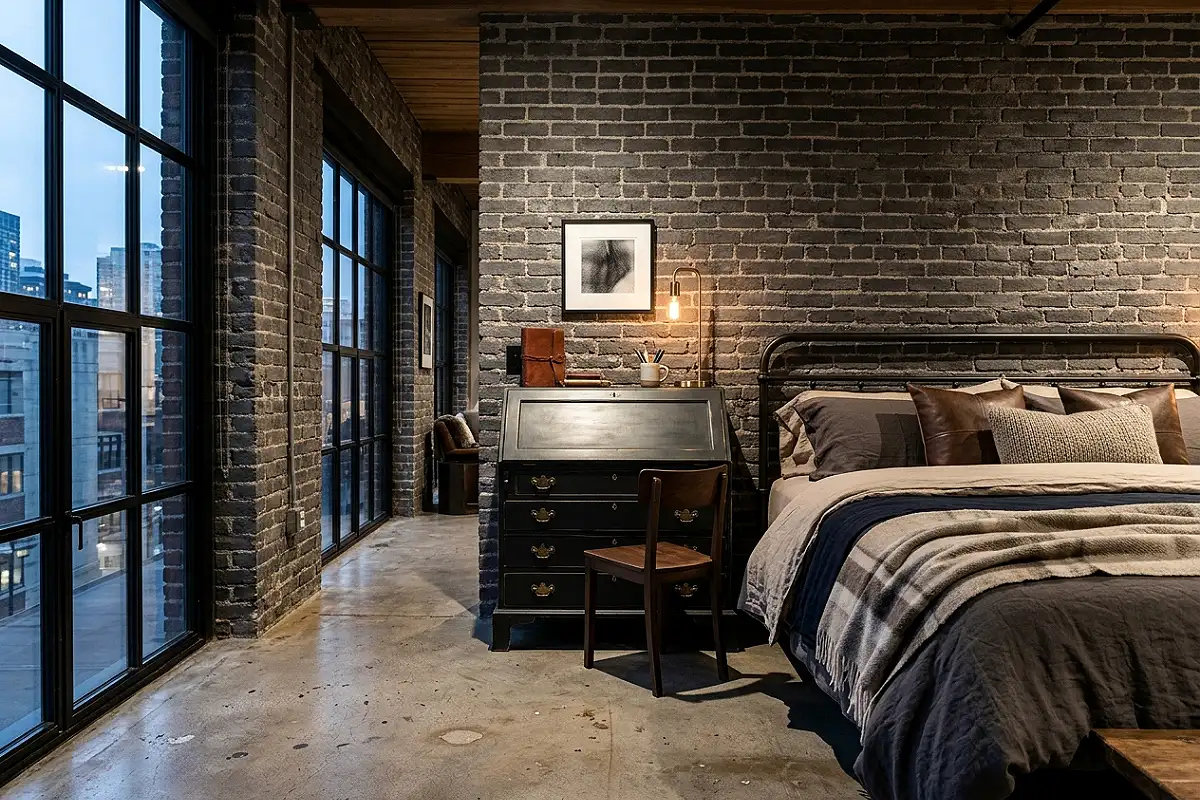
Positioning a narrow secretary desk at the foot of the bed is a classically elegant solution that almost no one tries anymore, which is exactly why it works so well now. The key is proportion: the desk should sit at roughly the same height as the bed frame’s footboard — or be low enough to sit flush beneath a footboard rail — so the visual line of the bed carries cleanly through. A secretary-style piece, with a fold-down writing surface and small interior cubbies above, gives you storage for stationery, chargers, and notebooks within arm’s reach. In a room with a lot of white or pale linen, try a secretary in painted sage green or dusty black to give the foot of the bed a grounding, almost headboard-like presence. When the writing surface is folded up, the piece reads entirely as a decorative cabinet. A vintage find from an estate sale often has the perfect dimensions; alternatively, the IKEA SEKRETÄR series offers a starting point that’s easy to customize with new hardware and a coat of chalk paint.
Pro Tip
Keep the desktop surface strictly free of work materials when closed — a single candle, a small tray, or a sculptural object only. This visual discipline is what makes the piece read as furniture rather than an overflow zone.
Arched Alcove Nook
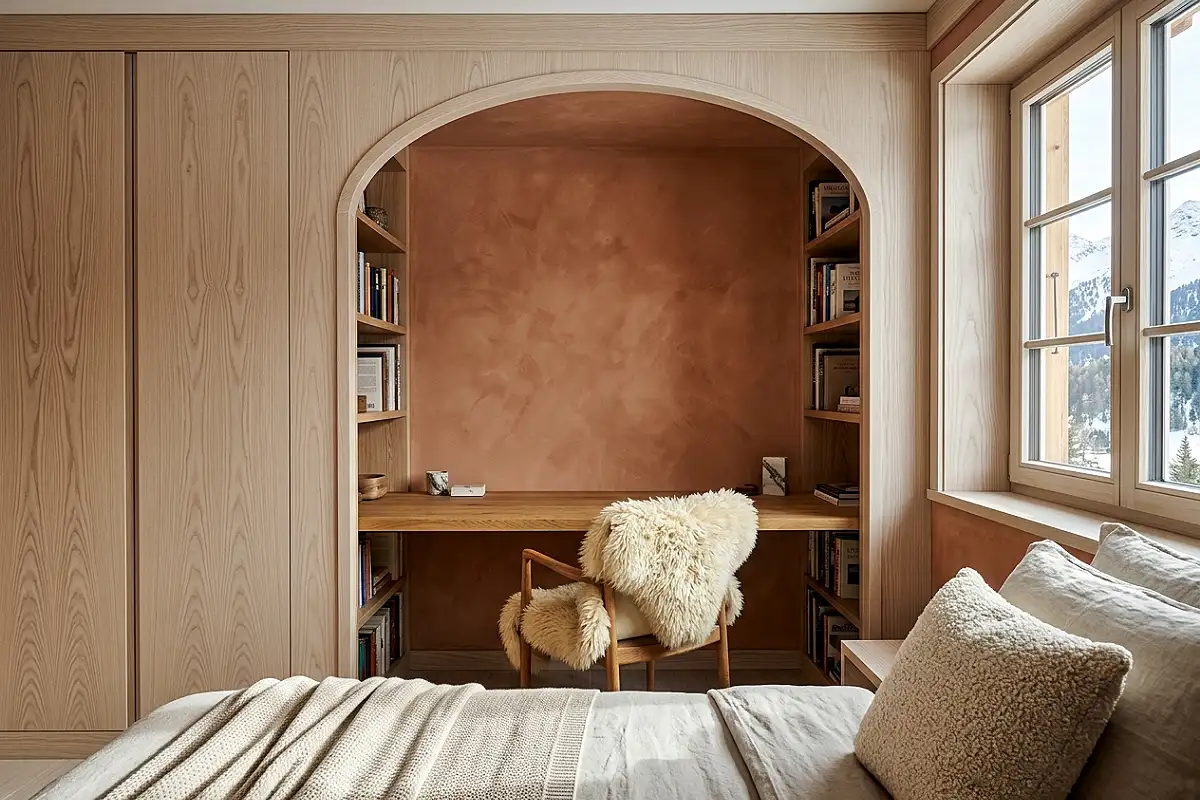
If your bedroom has a recessed alcove — whether original architecture or created with a simple half-wall partition — adding a graceful arched opening transforms it into the most coveted feature in the room. Fill the recess with a built-in or slab-topped desk that runs wall to wall, sitting just below the arch’s keystone so the curve frames you at seated eye level. Render the inside walls of the nook in a warm limewash finish: burnt sienna, aged terracotta, or deep clay are all stunning against natural linen drapes or a rattan pendant overhead. The arch itself creates a psychological boundary that makes working here feel focused and immersive — like stepping into a dedicated studio even though you’re still technically in your bedroom. Add a single slender built-in shelf on each side of the desk, floor to ceiling, for books and objects, and keep the chair uncomplicated: a simple wooden chair with a sheepskin thrown over it reads as intentionally artisan rather than office-supply-adjacent.
Pro Tip
Painting only the interior of the alcove in your accent color — while leaving the surrounding bedroom walls neutral — creates a compelling focal point and makes the workspace feel like it has its own identity without committing the whole room to a bold palette.
Lofted Bed with Desk Below
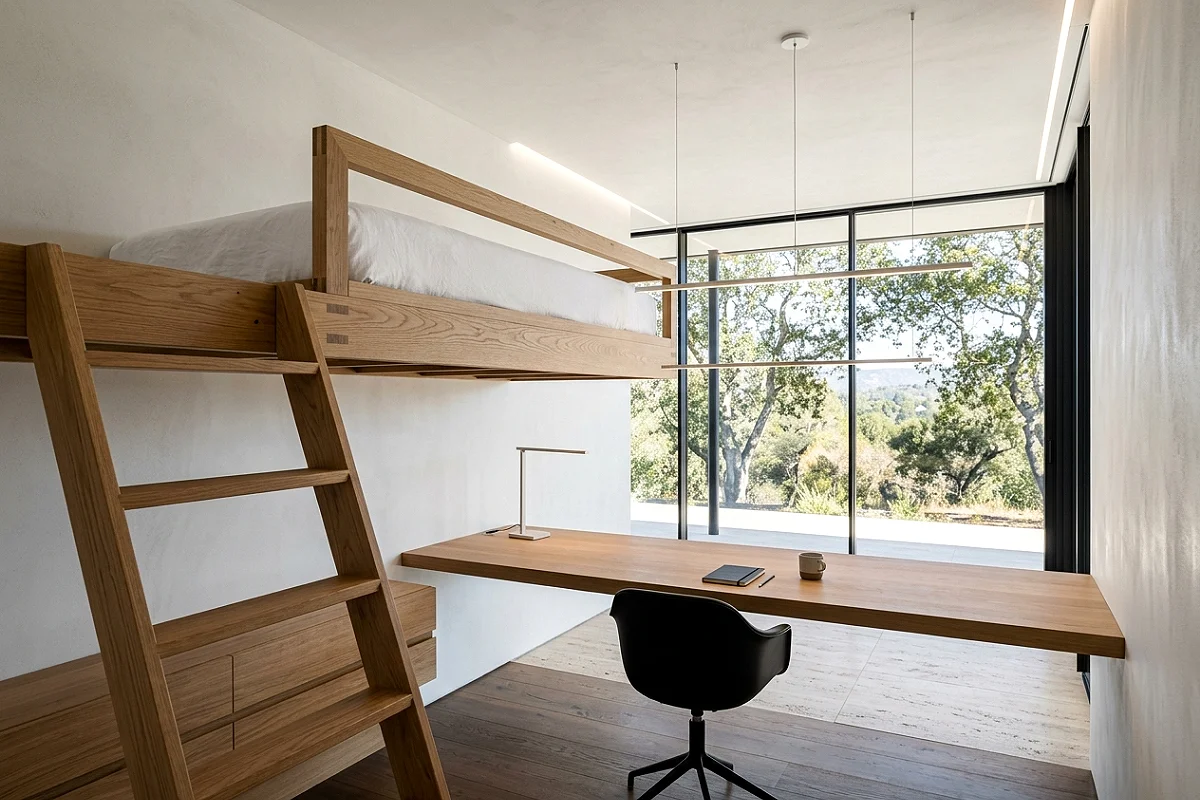
This one earns its place far outside the college-dorm association it tends to carry, because when done with the right materials, a lofted sleeping platform with a dedicated workspace below it is genuinely sophisticated. The secret is to build or source a loft frame in solid wood — white oak, blackened steel, or natural pine — and let the desk below take up the full footprint rather than cramming in a tiny table. A deep, continuous desk surface running the full width of the bed above feels more like a bespoke studio setup than a bunk. Hang a slim pendant from the underside of the loft frame for focused task light, and keep the vertical wall behind the desk relatively bare — a single large moodboard or pegboard in natural cork gives you a functional art piece. This configuration is especially clever in rooms with ceilings above 9 feet, where the loft can sit high enough that the workspace below doesn’t feel cave-like. Choose a low-profile task chair so the visual weight stays grounded.
Pro Tip
Install a fabric curtain track along the front edge of the loft frame so you can draw a panel across the desk opening when you want the room to feel like a pure bedroom. Heavy linen or velvet makes this feel luxurious rather than makeshift.
Mirrored Vanity Desk Hybrid
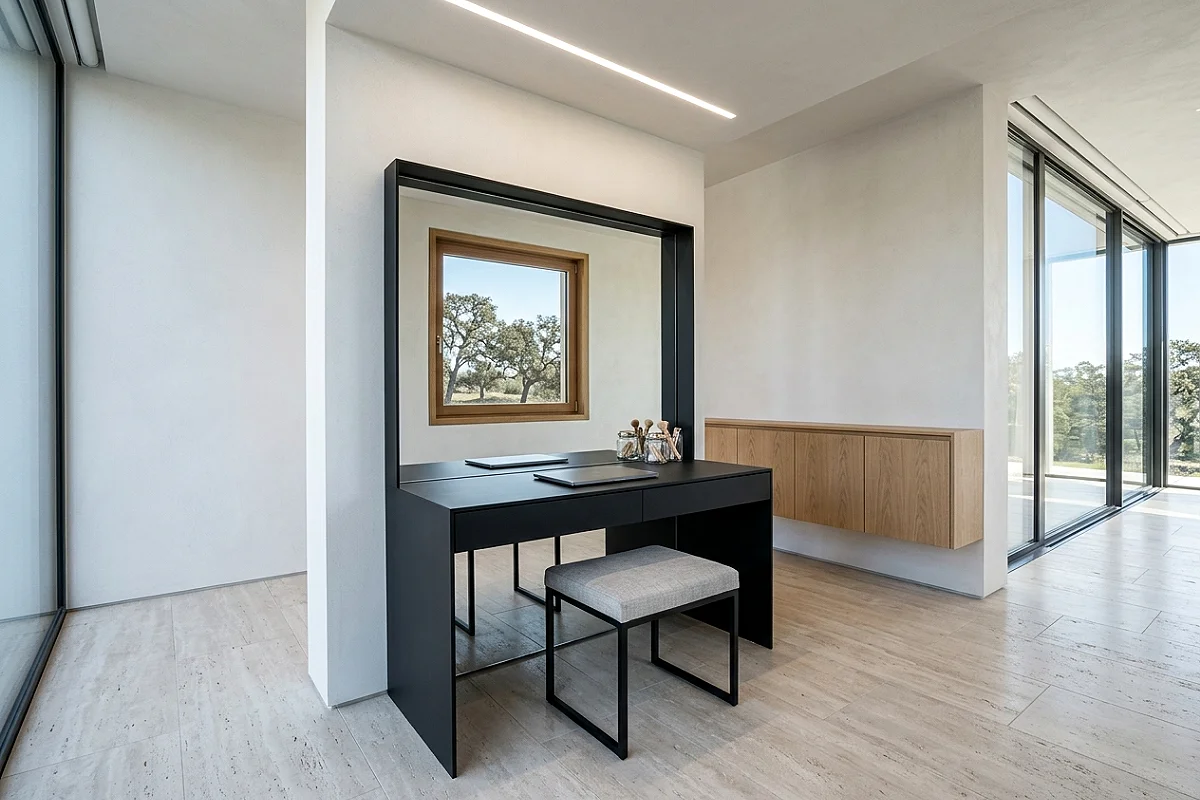
One of the most genuinely brilliant double-duty pieces you can invest in is a vanity desk that functions equally well as a work surface. The large mirror backing reflects light and makes the space feel twice its size — an especially valuable trick in a smaller bedroom. Choose a piece with a clean, straight-lined frame rather than an ornate Hollywood style: think brushed brass or matte black metal with a substantial rectangular mirror and a tabletop deep enough (at least 20 inches) to fit a laptop beside a small makeup or skincare tray. The West Elm Terrace Vanity strikes this balance at a mid-range price point; for a more investment-worthy piece, the Gubi Vanity Mirror Desk is quietly stunning in any light. Style the surface with cohesive vessels — a ceramic catch-all for pens, a glass jar for brushes — so the two functions blend rather than compete. A linen-upholstered stool that tucks fully beneath keeps the floor clear and the silhouette sleek.
Pro Tip
Position the vanity desk so the mirror reflects the window rather than the room’s clutter. Natural daylight bouncing back off the glass elevates both your complexion and your mood during video calls.
Bookcase Room Divider Workspace
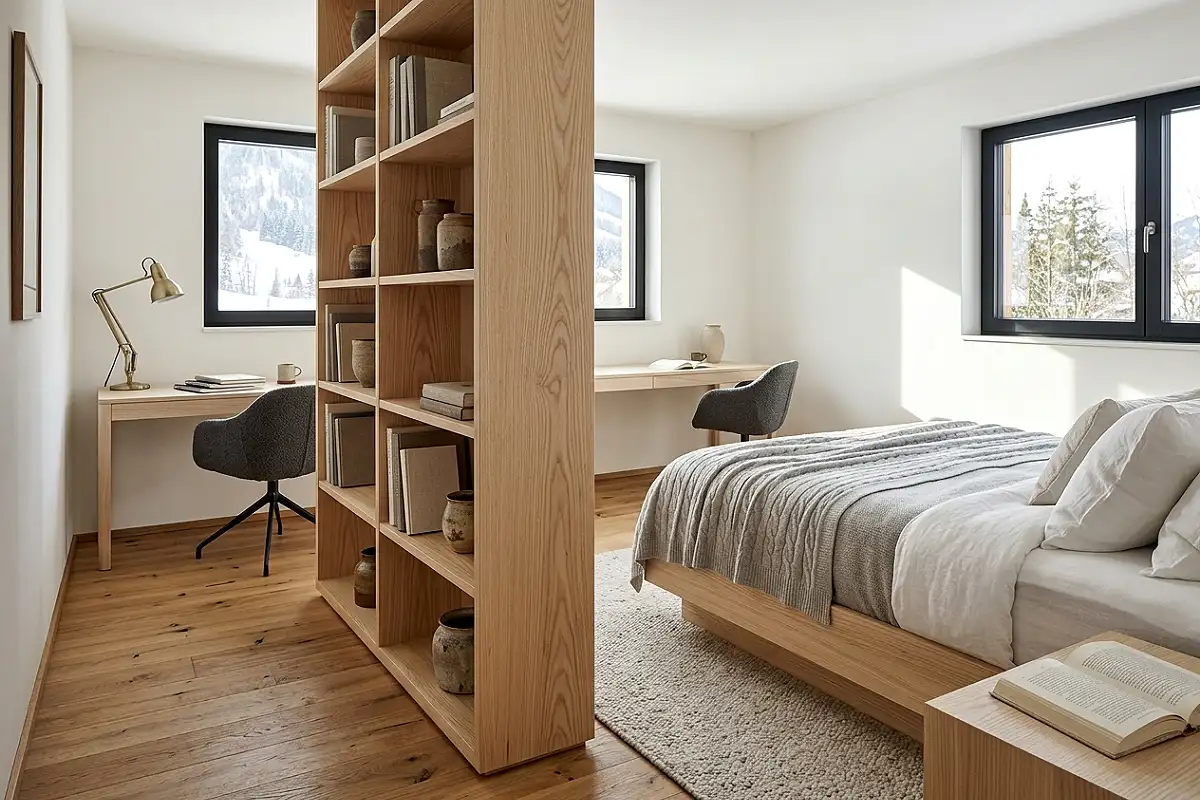
Rather than placing a desk in the corner and hoping for the best, use a full-height open bookcase as a room divider to carve out a genuine office zone within the bedroom. Position the shelving unit perpendicular to one wall, deep enough from the bed that you can pull a chair up to a desk placed just inside the newly formed “room.” The bookcase does double duty: it serves as a sculptural storage wall and creates enough visual separation that you genuinely feel like you’ve left the sleeping space behind when you sit down to work. Fill the shelves with a curated mix of books, ceramics, trailing plants, and baskets for loose items — the styling is visible from both sides, so make it count. The desk on the office side can be as simple as a solid wood plank mounted on two filing cabinet bases, which gives you both surface area and drawer storage in one clean, efficient footprint.
Pro Tip
Choose a bookcase with a back panel in a contrasting color or material — rattan, fluted glass, or painted plywood — so objects displayed on the shelf appear set against an intentional backdrop rather than the wall behind it.
Window Seat with Pull-Out Desk
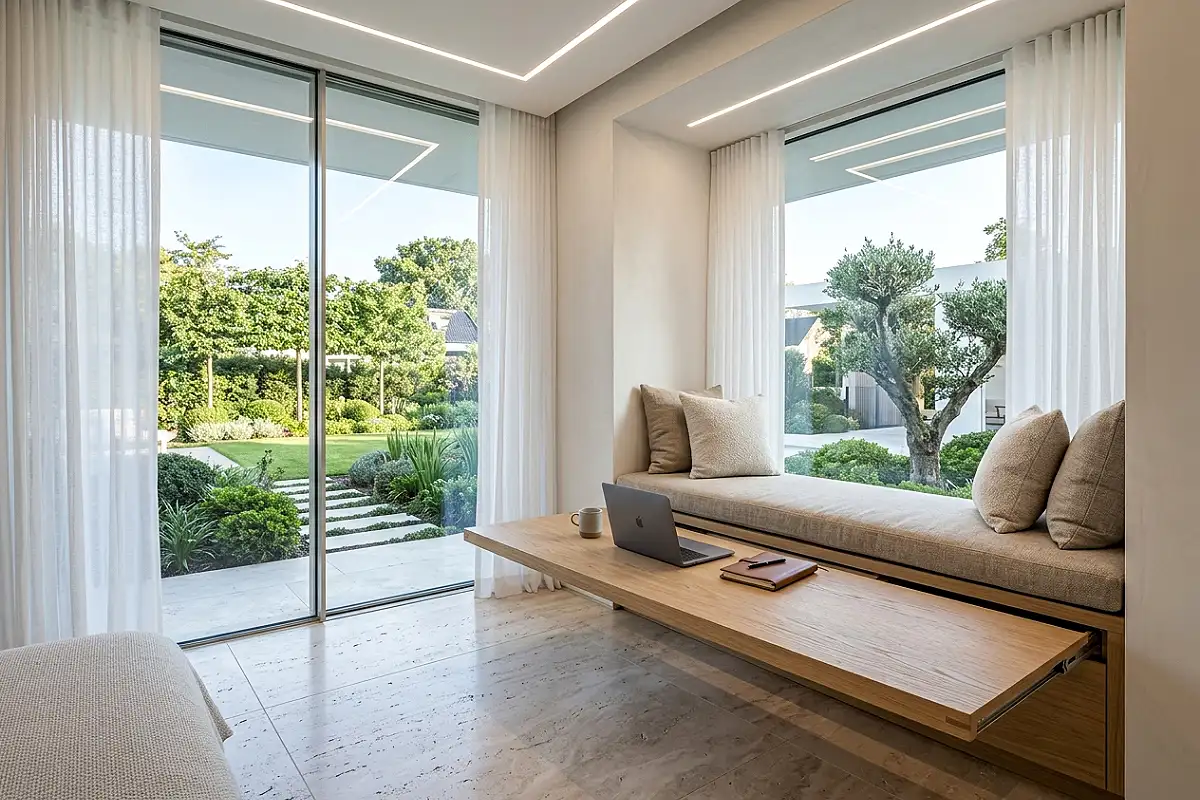
A built-in window seat already does the charming, architectural heavy lifting — but tuck a pull-out desk into the base cabinet below it and suddenly you have one of the most naturally lit, genuinely pleasant places to work in any home. The desk surface slides out horizontally from the base, sitting at table height once extended, and slides cleanly back in when you want the window seat returned to its lounge-and-read purpose. Upholster the cushion in a durable, washable fabric — performance linen in a warm stone or deep teal holds its shape beautifully and wipes clean. Line the window above with sheer panels that filter rather than block natural light; you want soft, diffuse daylight on the desk surface, not glare. The built-in cabinetry on either side of the seat can house deep drawers for files, stationery, and a router, keeping all the utilitarian elements invisible from the rest of the room. This setup works especially well in bay windows or wide sill recesses.
Pro Tip
If you work on video calls from this spot, position your monitor or laptop so your face is lit by the window rather than silhouetted against it — light should fall on your face, not behind you.
Minimalist Floating Plank Desk
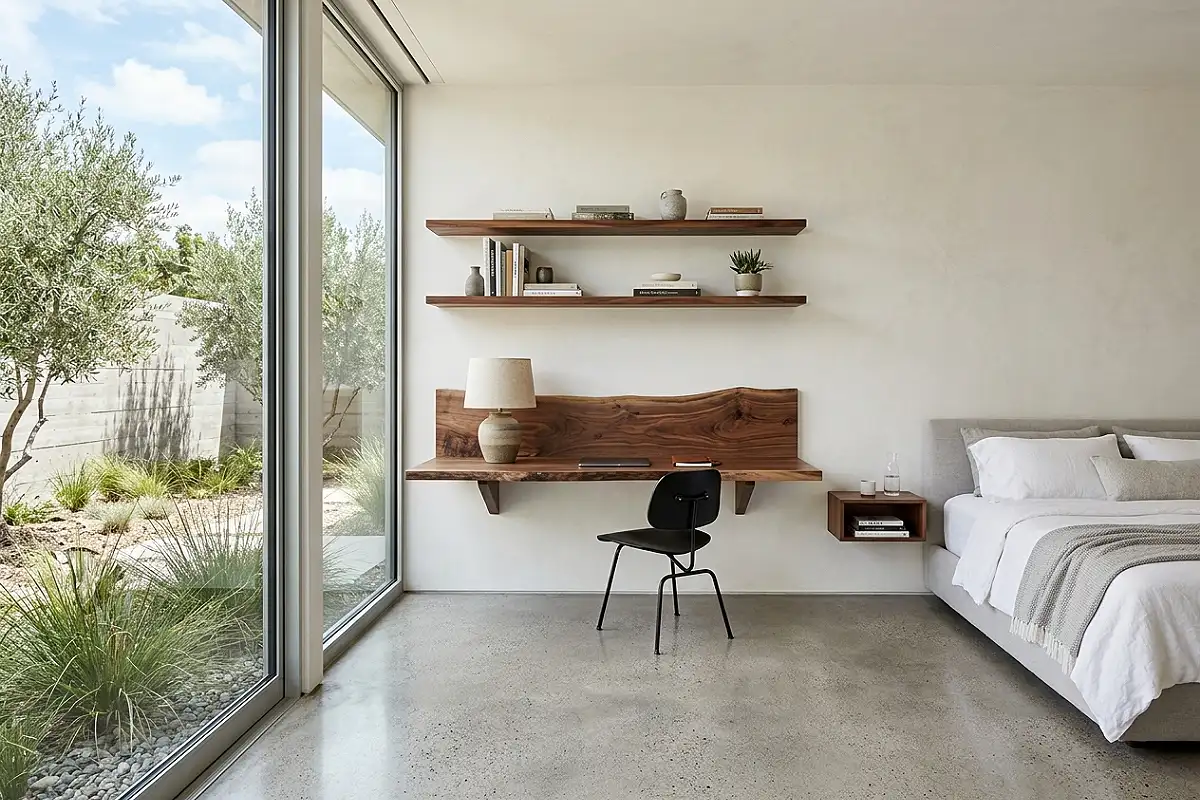
Sometimes the most sophisticated solution is also the simplest: a single thick plank of wood, wall-mounted on two sturdy brackets, at the perfect desk height. No legs, no pedestals, no bulk below — just a clean, floating surface that disappears against the wall when the chair is pushed in. Choose a plank in live-edge walnut or butcher-block maple for warmth, or go lacquered in matte white if the room is leaning Scandinavian. The material quality matters more here than anywhere else, because this piece is barely there — so what’s visible needs to be beautiful. Under the plank, mount two or three small floating shelves in the same material for a printer, books, or a Bluetooth speaker. A slim cable management tray screwed to the underside of the plank keeps cords invisible from the front. This approach works remarkably well in rooms with a strongly architectural aesthetic — exposed brick, plaster walls, concrete ceilings — where a traditional desk would fight the room’s rawness.
Pro Tip
Mount the plank at 28–29 inches from the floor rather than the standard 30 inches — it drops the monitor to a slightly more ergonomic angle and prevents neck strain on long working days.
Antique Armoire Office
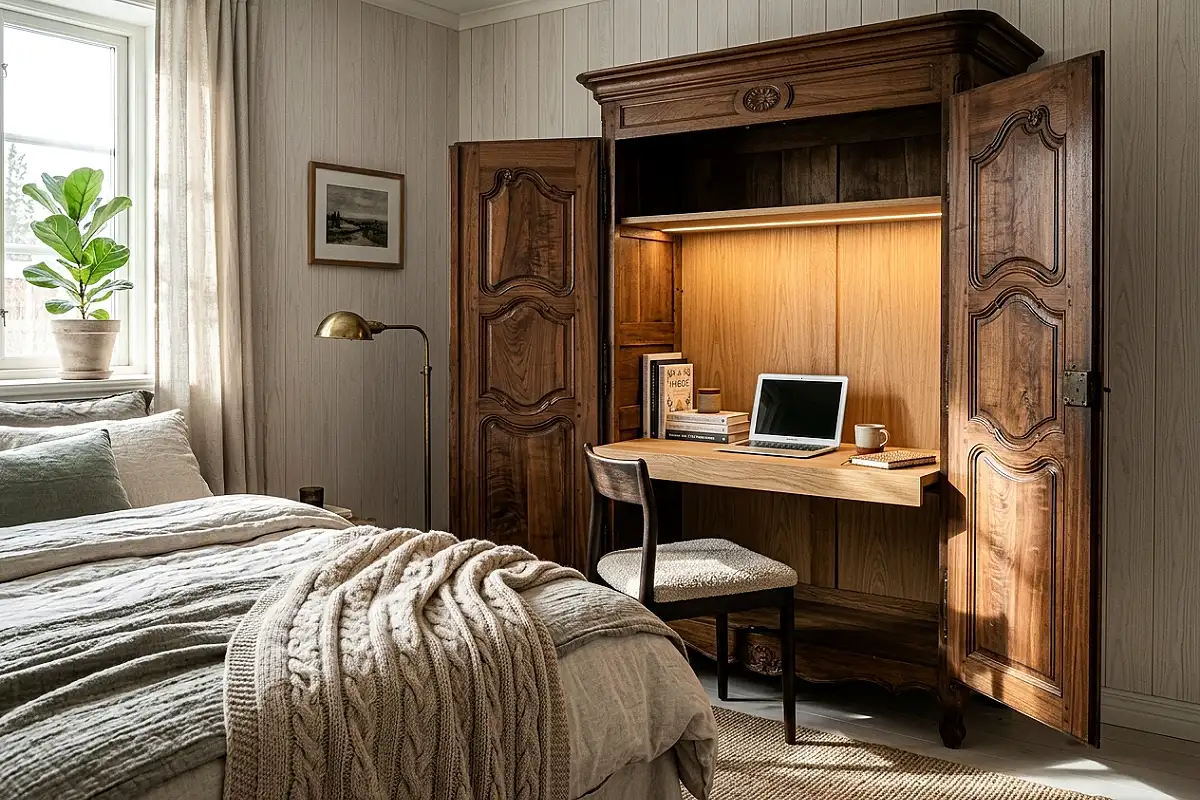
An antique armoire — the kind with tall double doors, a deep interior, and those satisfying old-fashioned hinges — is one of the best pieces of vintage furniture you can repurpose as a bedroom office. Strip out the original interior fittings, add a custom-cut desktop at the right working height, and run two or three narrow shelves above it for books and storage. The exterior of the armoire remains entirely in keeping with its original character: a carved walnut piece from a French auction, a painted Gustavian cabinet in faded grey, or a lacquered chinoiserie piece all work beautifully, depending on your room’s existing aesthetic. Close the doors at the end of the workday and every trace of the office disappears. The key is to choose a piece with enough interior depth — at least 20 inches — to fit a laptop and a small monitor without feeling like you’re working in a cupboard. Add a small USB-C power strip mounted to the side wall inside for cable management.
Pro Tip
Install a slim, battery-operated LED bar light inside the top of the armoire, triggered by a magnetic door sensor — it comes on automatically when the doors open and switches off when you close up for the night. Brilliant, no wiring required.
Japandi Tatami Platform Office
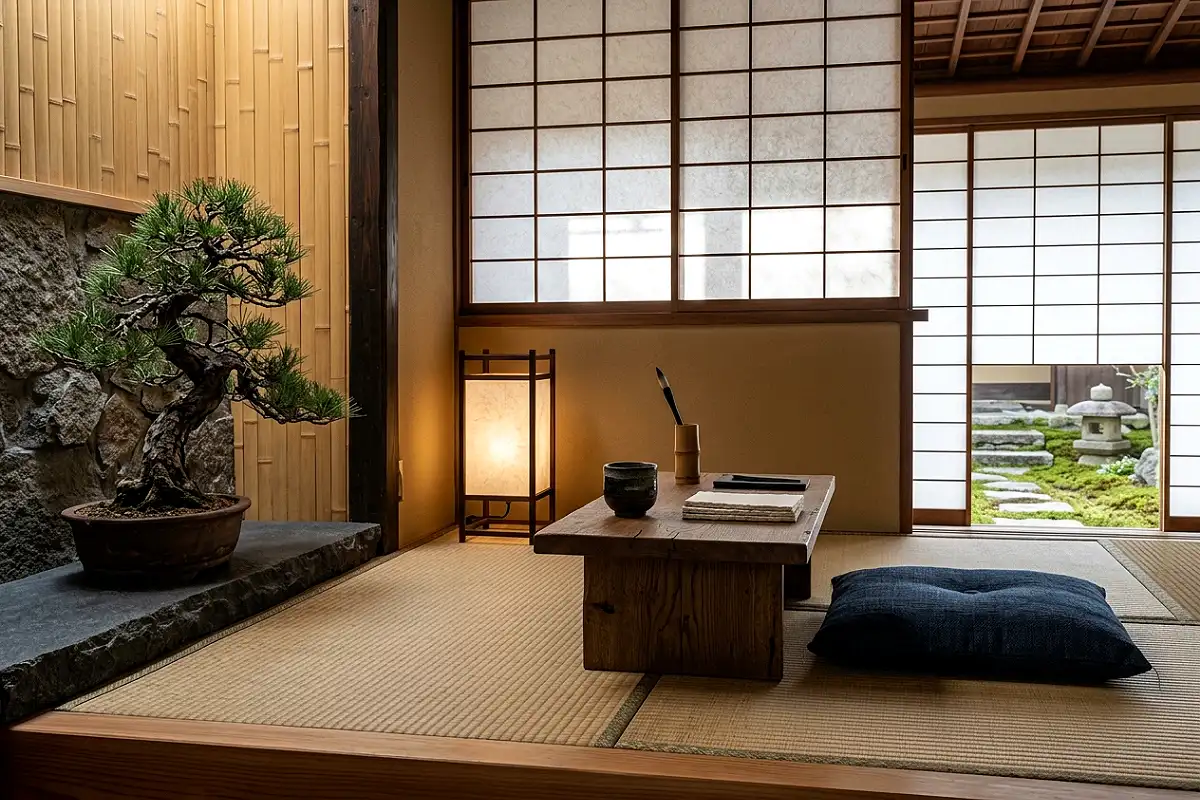
A floor-level workspace inspired by Japanese interior principles creates a meditative, completely distinct visual register from anything else in this list. Build or purchase a low tatami-style platform — roughly 6–8 inches off the ground — covered in woven rush or natural jute matting, and place a low table (around 14–16 inches high) at its center as your desk. You work seated on a zabuton meditation cushion in natural cotton or linen, knees folded or legs stretched beneath the table. The platform itself defines the workspace as a deliberate zone; step up onto it to work, step down to return to the rest of the room. Keep the desk surface entirely clear except for a laptop, a single ceramic cup for tea, and perhaps a small bud vase. The room around it should be spare: natural linen drapes, a shoji-influenced rice paper floor lamp nearby, raw plaster walls or a white linen wallcovering. This is the most architecturally committed option on this list, and the most serene.
Pro Tip
A floor-level desk requires strong core support for extended working sessions. Invest in a proper zazen cushion — firmer and higher than a decorative throw pillow — and take short movement breaks every 45 minutes. The posture benefits are real when done correctly.
Gallery Wall Workspace
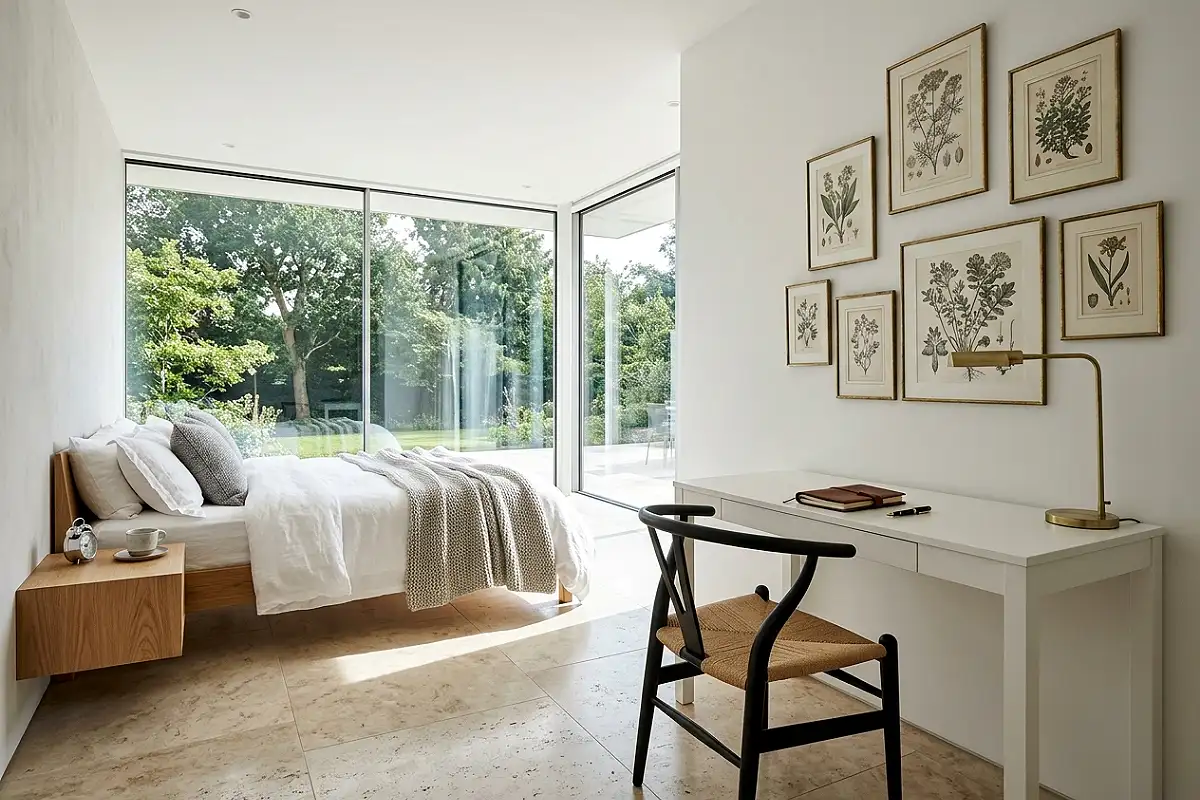
This idea is less about the desk and more about the wall behind it — because an elevated, curated gallery wall transforms a basic desk into a workspace that feels like a creative studio. Choose a simple desk in a neutral finish: matte white, raw oak, or pale concrete-look laminate. Then treat the wall above it as a genuine art installation: mix framed prints of varying sizes with small objects (a shelf bracket holding a single ceramic, a dried botanical specimen under glass, a small mirror), all arranged in a cohesive, asymmetric composition that extends at least 12 inches beyond the desk’s width on either side. The color story of the gallery should tie directly to the bedroom’s palette so the workspace doesn’t feel bolted on. Use gallery-wall ledges rather than individual picture hooks — they allow you to rearrange without new nail holes, which is invaluable as your tastes evolve. A thin-armed desk lamp in aged brass grounds the composition and adds the warm glow this setup calls for.
Pro Tip
Keep all frames within one or two finishes — all brass, all black, or all raw wood — even when the art inside varies widely. Consistent frame finishes are what make a gallery wall look styled rather than collected over time without a plan.
Behind-the-Headboard Desk Setup
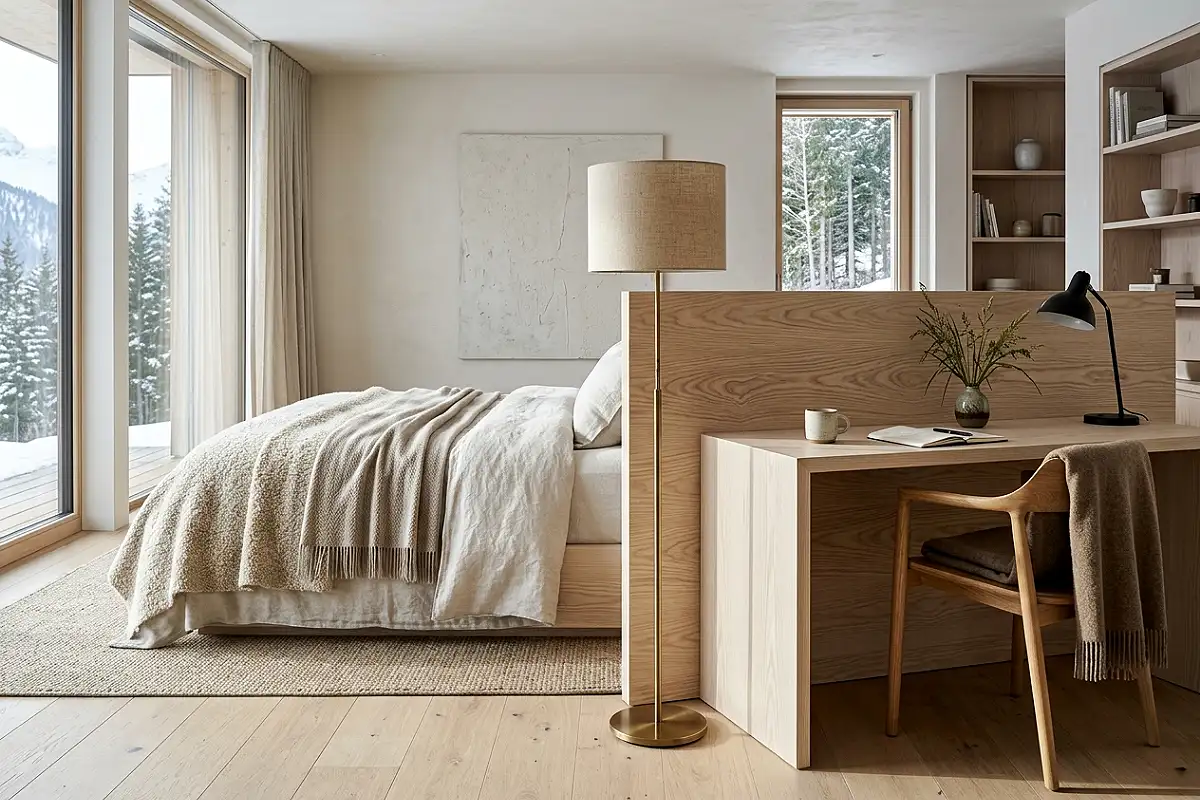
In a larger bedroom, floating the bed away from the wall creates an unexpected opportunity: a desk that sits flush against the back of the headboard, essentially hidden from anyone lying in bed but fully visible and functional from the room’s entry point. This configuration is particularly clever in open-plan bedrooms or loft apartments where sightlines from the main living space carry through. Choose a desk with a back panel or modest hutch that matches the headboard’s height — it presents as a cohesive double-sided unit rather than two separate pieces. In a room decorated in dark, moody tones (deep inky blue, forest green, charcoal), this setup has a particularly cinematic quality — the desk glows with task lighting while the bed retreats into shadow behind it. Keep both surfaces organized and intentional, since they’re viewed as a unit from afar. A floor lamp placed between the headboard and desk helps bridge the two zones visually.
Pro Tip
Ensure at least 24 inches of clearance between the back of the headboard and the front of the desk chair to move comfortably. Less than that and the setup becomes impractical for daily use.
Industrial Pipe Shelf Desk
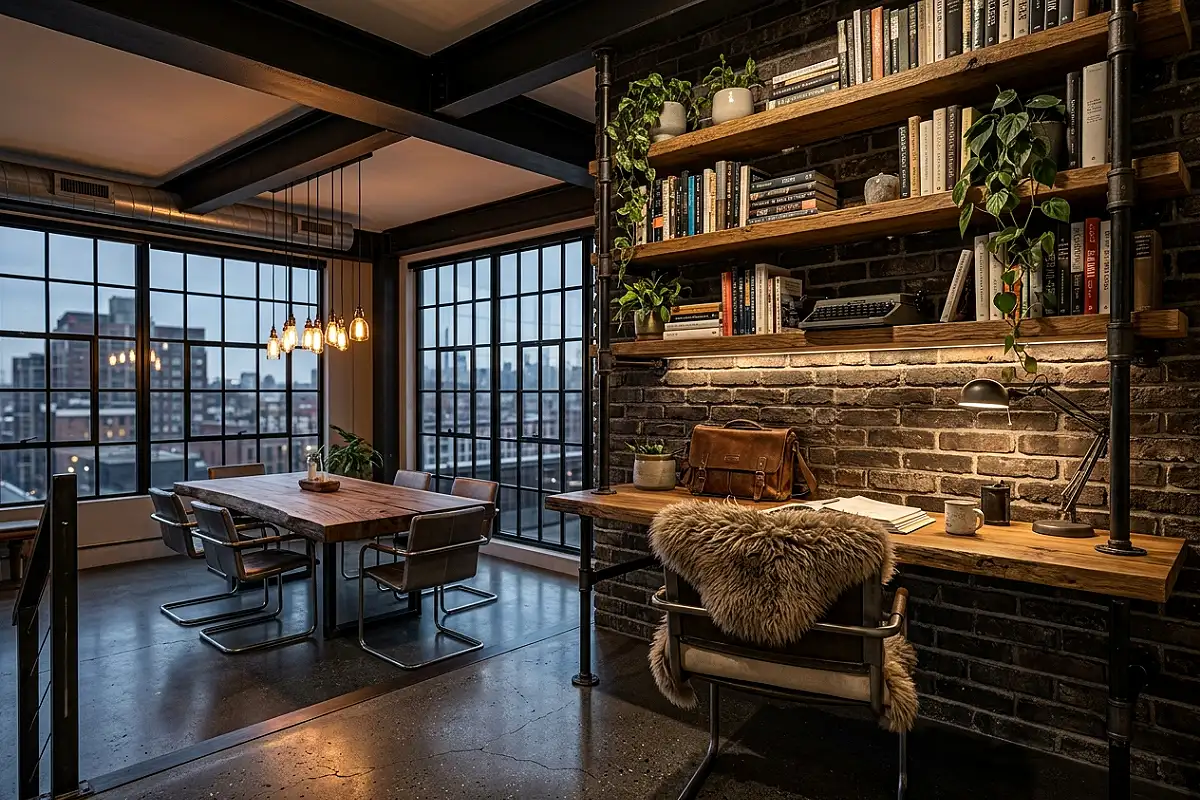
Raw black iron pipe combined with reclaimed wood or oiled pine creates a desk system with real structural character — the kind that looks like it was designed by someone who spent time in both a factory and a design studio. Mount horizontal pipe rails to the wall at desk height, then lay a thick slab of reclaimed oak, pine, or black-stained plywood across them to form the working surface. Add vertical pipe risers above the desk at irregular heights, each capped with a horizontal pipe arm holding another shelf for books, plants, or a vintage desk lamp. The hardware is visible and becomes the design: each flange, elbow joint, and coupling is a graphic element. This works particularly well in rooms with exposed brick, concrete, or rough-plaster walls — industrial materials demand honest partners. Soften the overall effect with a sheepskin chair, a woven basket under the desk, and a few trailing plants. The contrast between organic softness and structural raw metal is what elevates this from functional to genuinely styled.
Pro Tip
Seal reclaimed wood desk surfaces with a matte hardwax oil rather than a glossy polyurethane — it protects the grain while keeping the texture visible and tactile, which is the whole point of using raw, characterful wood in the first place.
Curtain-Divided Study Corner
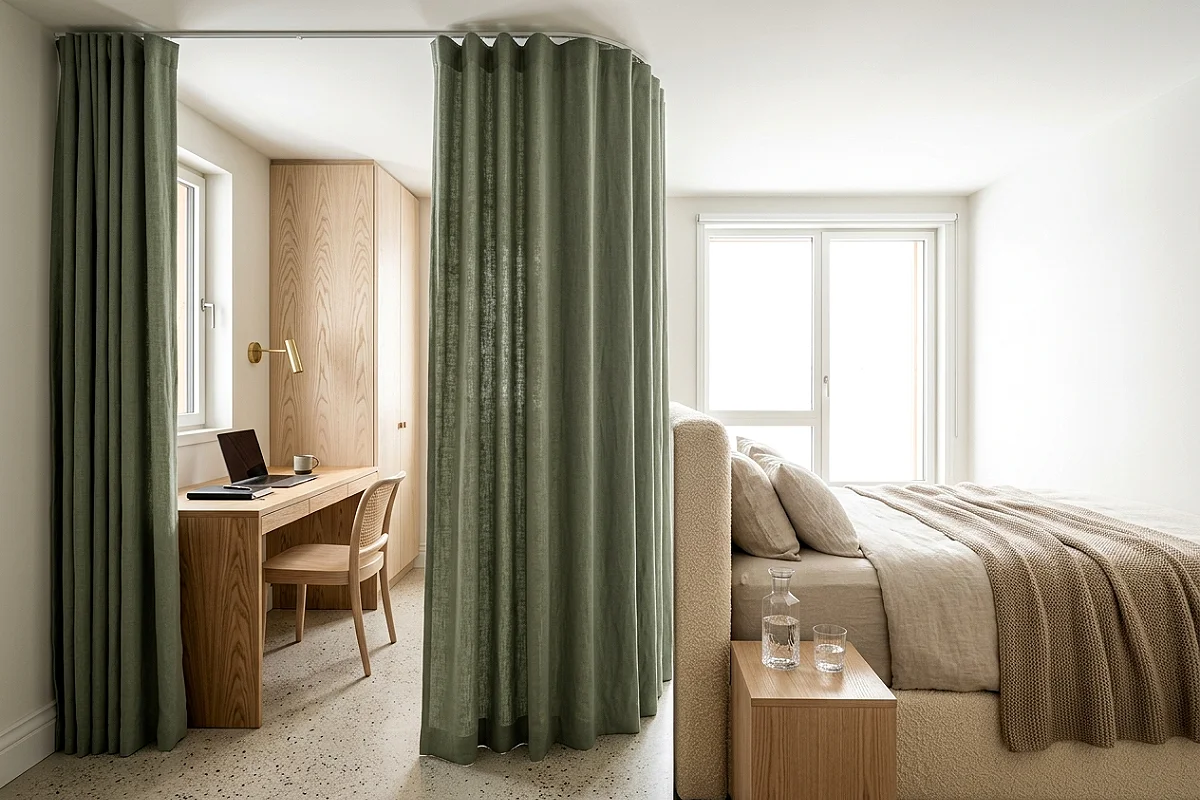
If your bedroom has a usable corner but no natural architectural feature to separate the workspace from the sleeping area, a ceiling-mounted curtain track is one of the most budget-conscious and visually effective solutions available. Mount a curved curtain track from the ceiling so that it arcs out from one wall and back to another, carving off a generous corner behind it. Inside, place your desk, shelving, and task lighting — the full office setup, uncompromised. Draw the curtain when you want to work, and open it when the bedroom should reclaim its full visual footprint. The curtain fabric is where the design lives: a floor-to-ceiling panel in heavyweight linen, block-printed cotton, or velvet transforms what could feel like a room divider into a deliberate design moment. Choose a color that’s already present in the bedroom’s palette — a muted terracotta that echoes the rug, or a deep sage that nods to the throw pillows — so the curtain looks chosen rather than added as an afterthought.
Pro Tip
Use a curved ceiling track rather than a straight rail — the gentle arc of fabric feels architectural and intentional, whereas a straight track reads more like a hospital room partition. The curve is everything.
Tonal Monochrome Work Zone
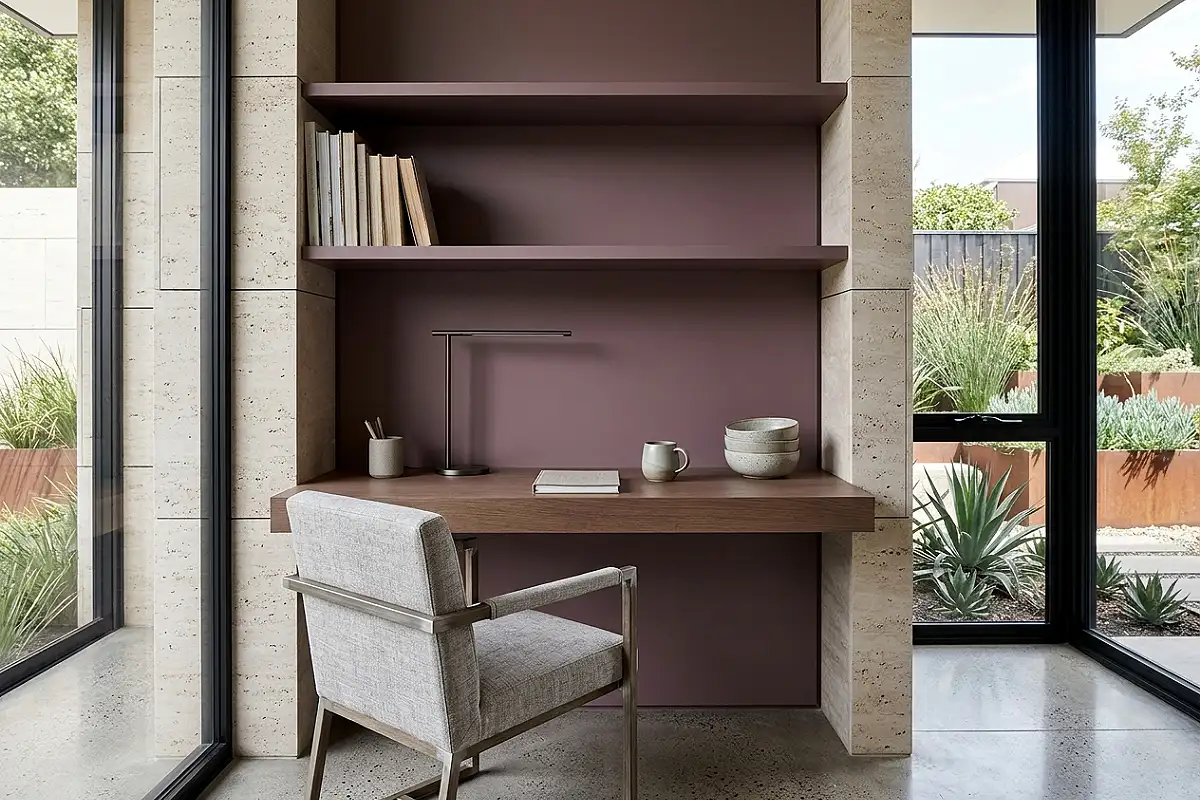
A monochrome workspace doesn’t mean boring — it means everything within the desk area stays within one color family, creating a zone so visually cohesive it functions as its own self-contained room within the bedroom. Choose a palette anchor: dusty mauve, warm putty, sage green, or smoked charcoal. Then apply that tone consistently across every element within the desk zone — the wall color behind the desk, the desk itself, the shelving, the chair upholstery, even the small accessories on the surface. Vary texture aggressively to maintain visual interest: a matte plaster wall, a linen-covered chair, a ceramic desk lamp, a woven leather blotter. The rest of the bedroom can stay in a completely different but complementary tone. The effect is that the desk zone appears as a considered, curated backdrop — almost like a design still-life — that happens to be fully functional. This approach photographs exceptionally well, which matters if you’re building a workspace you’d actually enjoy spending time in.
Pro Tip
Go two or three shades darker on the wall behind the desk than on the rest of the room walls. That contrast depth creates a shadow box effect that frames you on video calls and makes the whole workspace feel more intentional and architectural.
Bedside Nightstand Command Desk
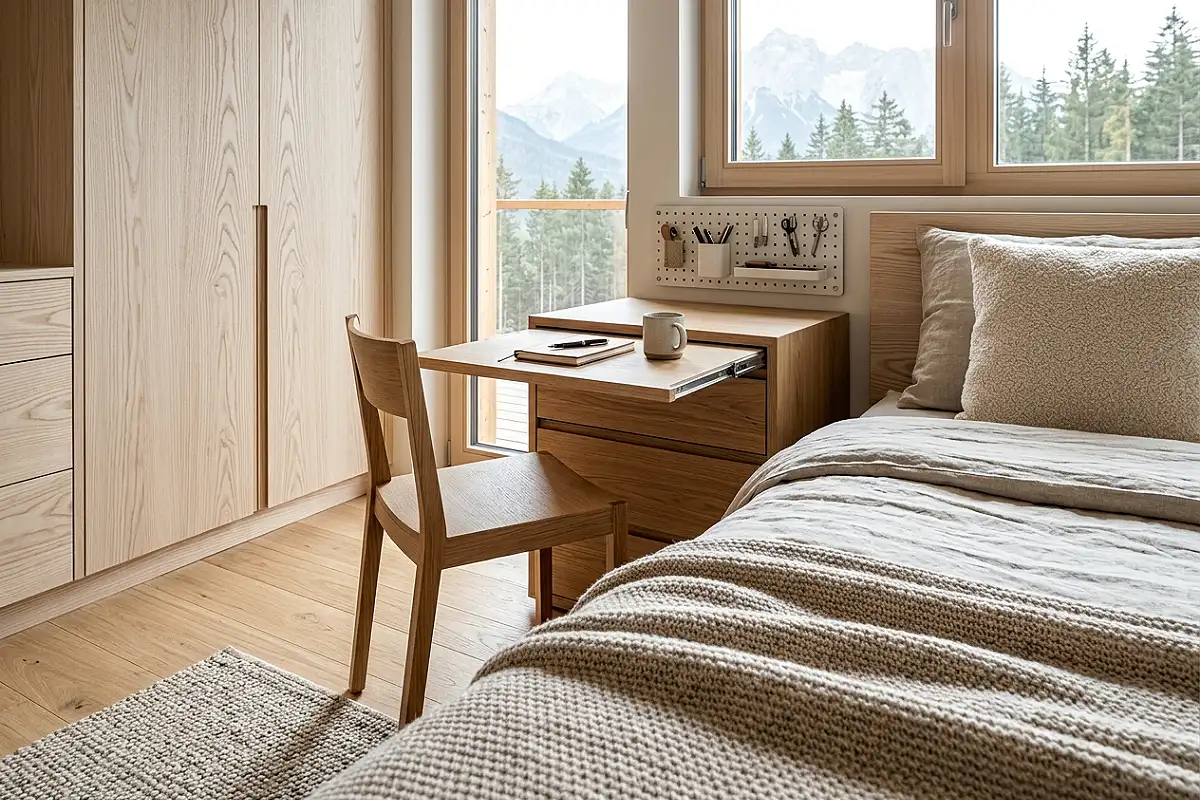
For the truly compact bedroom — a studio, a box room, a ship’s cabin of a space — a nightstand that converts into a small desk may be the most practical idea on this entire list. Look for a bedside cabinet with a pull-out surface at desk height, or repurpose an adjustable-height side table that can shift from nightstand height (26–28 inches) to seated desk height (28–30 inches) with a simple mechanism. Pair it with a space-saving task chair on casters that rolls away entirely when not in use, or a folding stool that hangs on a hook behind the bedroom door. The nightstand desk works best when it’s the room’s single piece of furniture assigned to both functions: keep the surface rigorously clear at night (lamp, book, glass of water only) and equally focused during the day (laptop, notebook, coffee). A small pegboard mounted on the wall directly beside the nightstand gives you a vertical surface for notes, cables, and tools without expanding the desk’s footprint at all.
Pro Tip
The biggest risk with a nightstand desk is losing the psychological boundary between sleep and work. Create a simple ritual: when the workday ends, place a decorative object — a candle, a stone, a small book — on the desk surface to signal it’s no longer a workspace. Small rituals matter more than you’d think.
Frequently Asked Questions
Can I really have an office in my bedroom without it affecting my sleep?Yes, with the right setup. The key is creating a clear psychological boundary between work and rest. Designs that allow the desk to be hidden, curtained off, or visually separated from the bed — like the Murphy desk, armoire office, or curtain-divided corner — are the most effective for preserving the bedroom’s restful quality. If hiding it completely isn’t possible, maintaining strict “desk-off” rituals at day’s end helps considerably.
What is the smallest space I need for a bedroom office?A functional workspace can fit into as little as 24 × 48 inches of floor space. Floating wall desks, pull-out surfaces from existing furniture, and nightstand desk conversions are all designed for exactly these constraints. Vertical thinking — using wall height for shelving instead of floor area — is the most important mindset shift for truly compact rooms.
What desk style works best in a small bedroom?Wall-mounted floating desks and fold-down Murphy desks consistently perform best in small bedrooms because they free up floor space entirely when not in use. L-shaped corner configurations are excellent for maximizing a corner without taking up additional room footprint. The single most important rule: avoid desks with bulky bases or thick legs, which make the room feel heavier and smaller than it is.
How do I prevent my bedroom office from looking cluttered?The single most effective strategy is enclosed storage: drawers, cabinets, baskets, and boxes that hide paper, cables, and office supplies from view. Beyond storage, cable management is essential — a single visible bundle of cords can undermine an otherwise beautifully styled desk. Limiting the desk surface to only items in active use (not a holding zone for everything) is the habit that makes the biggest difference long-term.
What lighting should I use for a bedroom office?Layered lighting works best. A directional task lamp on the desk (look for adjustable arm styles in brass or matte black that double as decor) handles focused work light. Ambient overhead or floor lighting keeps the rest of the room from going too dark around you, which causes eye strain. Avoid cool-white bulbs in a bedroom; warm white at 2700K maintains the room’s relaxed atmosphere and is far gentler on your eyes during evening work sessions.
Is it worth investing in a proper desk chair for a bedroom office?Absolutely, especially if you work there for more than two hours a day. A proper ergonomic chair doesn’t need to look clinical — many brands now offer chairs in upholstered fabric, bouclé, or leather that read as lounge furniture. The HAG Tion and Branch Ergonomic Chair are two options that offer solid lumbar support without the aggressive office-supply-store aesthetic. A dining chair with good height and a lumbar cushion is the budget-friendly alternative that works better than most people expect.