
21 Black Bedroom Ideas with Luxury Decor Inspiration
Black in a bedroom is one of the most misunderstood design decisions you can make — and one of the most rewarding when it’s done with confidence. The hesitation is understandable: black feels permanent, dramatic, a little unforgiving. But the bedrooms that lean into it fully — all four walls, or one commanding accent wall, or an entirely ebonized furniture palette against white — consistently produce some of the most visually arresting, most deeply comfortable sleeping environments possible. Black absorbs light in the best way. It makes a room feel finished in the way that lighter colors rarely quite manage. It turns a bedroom into a place with genuine atmosphere.
These 21 ideas move across every register of the black bedroom — from the near-black of a charcoal cave to the graphic drama of black-and-white contrast, from a single matte black headboard against ivory walls to a fully wrapped cocoon where ceiling and floor and furniture disappear into each other. Each concept is built around a specific material palette, a distinct emotional quality, and the luxury decor accents that make the darkness feel chosen rather than heavy.
All-Black Velvet Cocoon
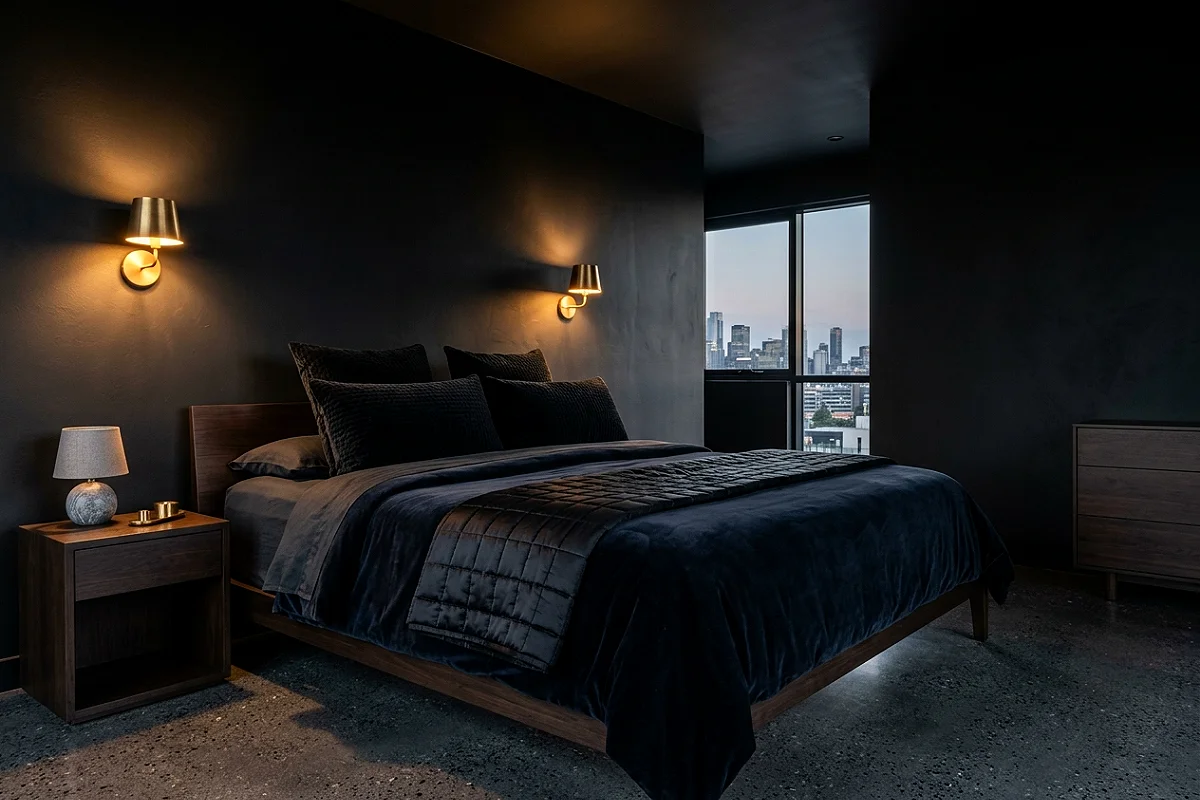
The most committed version of the black bedroom is the one that makes no concessions whatsoever: walls, ceiling, bedding, and curtains all in the same deep, lightless black, differentiated only by texture. This is the room that looks like somewhere between a five-star suite and the inside of a very expensive jewelry box. The walls should be in a flat, chalky black — Farrow & Ball’s Pitch Black or Off-Black in dead flat finish — so they absorb light completely rather than reflecting it. Against those walls, the textiles do all the work of making the room feel luxurious rather than austere: a velvet duvet cover in near-black navy or the deepest charcoal, a quilted satin throw in true black, cushions in varying black fabrics — a silk, a matte jersey, an embossed velvet, a chunky knit. The visual interest comes entirely from the interplay of these finishes catching the light differently. A pair of brushed gold or unlacquered brass wall sconces on either side of the bed are the only genuine light sources needed — their warm amber glow against the matte black walls is the single most beautiful lighting effect a bedroom can produce. Keep the floor in a very dark stained oak or a large-format charcoal stone tile so the room stays tonally consistent underfoot as well.
Pro Tip
In an all-black room, the paint finish is everything. Use dead flat or matte on walls and ceiling — never eggshell or satin — so that every surface absorbs light uniformly. Any sheen on a black wall reveals every brush stroke, roller texture, and imperfection; flat finish makes all four walls read as a single seamless envelope.
Black and Gold Art Deco Bedroom

The Art Deco period understood the black bedroom better than any other design movement in history: it saw the combination of black lacquer, gilded metal, and rich jewel-tone accents not as darkness but as glamour at its most architectural. A bedroom built on Art Deco principles starts with black — lacquered black walls or a deep, near-black charcoal — and introduces gold as the light source, present in every metallic surface. Choose a bed frame with a graphic, geometric headboard in ebonized wood with brass inlay detailing, or an upholstered headboard in black velvet with a gilded trim frame. Nightstands in black lacquer with gold hardware on every drawer face. A large sunburst or starburst mirror in aged gold above the bed or on the opposite wall. The bedding should be in cream or the palest champagne silk or satin — the contrast between the ivory textile and the black velvet headboard is quintessentially Deco in its graphic precision. Add one or two pieces of colored glass — an amber bedside lamp base, a deep green glass vase — to introduce the jewel-tone accent that separates true Art Deco from its many imitators. The Jonathan Adler Claridge Collection executes this aesthetic with particular confidence at a luxury price point.
Pro Tip
Art Deco gold should be warm, slightly antiqued, and consistent in tone across all fixtures — avoid mixing bright chrome, rose gold, and warm gold in the same room. Choose one gold tone — either polished warm brass or aged unlacquered brass — and use it as the singular metallic throughout. Consistency in the metal finish is what gives this style its architectural discipline.
Charcoal Linen Minimalist Bedroom
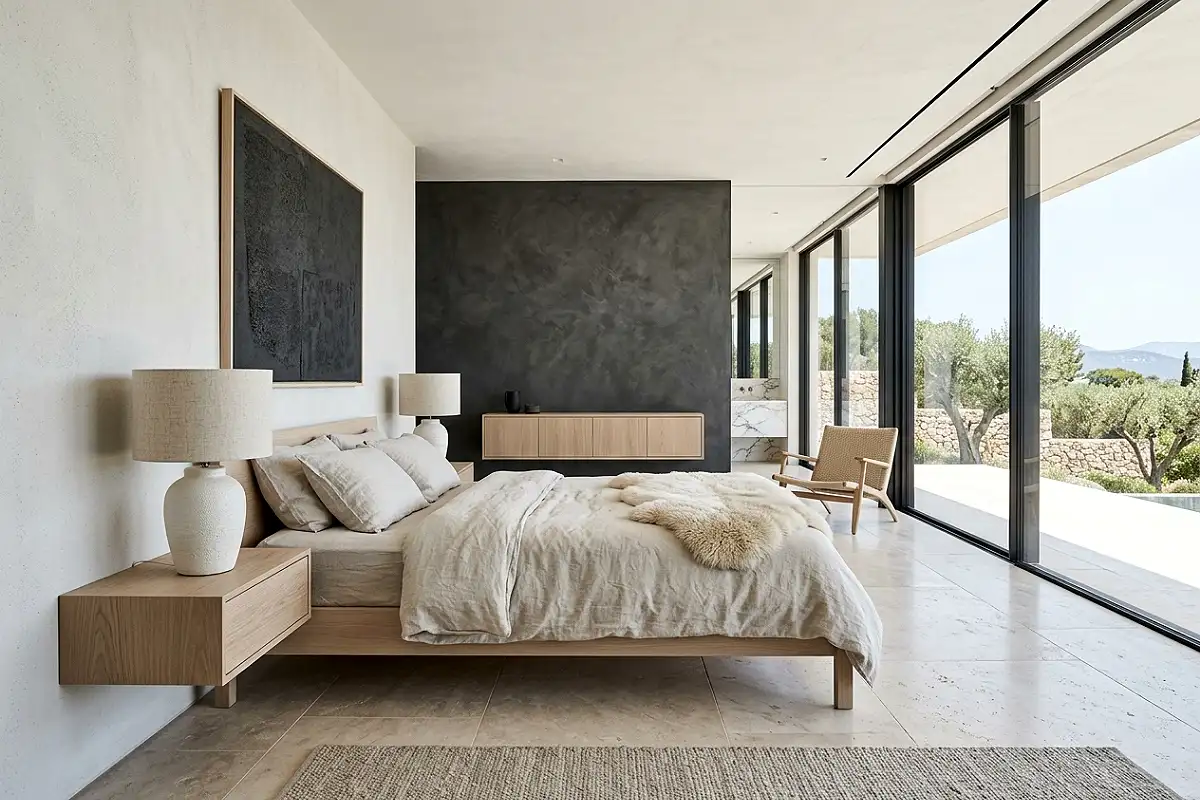
Charcoal occupies the most liveable territory between white and black — dark enough to have genuine presence and atmosphere, light enough to retain a sense of air and openness that pure black occasionally sacrifices. In an unwashed linen or washed cotton finish, charcoal walls have a warmth and texture that flat paint alone cannot replicate. Start with charcoal linen wallcovering or a textured paint technique that gives the wall a slight fabric-like quality — Portola Paints’ limewash in a deep grey or a Venetian plaster in charcoal both produce beautiful tactile surfaces. Against those walls, keep every textile in pale natural tones — undyed linen bedding, a raw cotton waffle throw, a sheepskin across the foot of the bed. The contrast between the dark, textural wall and the pale, honest textiles is the entire design: nothing else is needed. A bed frame in natural white oak or pale ash disappears against the pale bedding and creates a compositional balance with the dark walls. No overhead lighting — a pair of ceramic table lamps in warm white beside the bed, with linen drum shades, keep the light intimate and low. One large trailing plant in a pale concrete pot in the corner provides the only organic element.
Pro Tip
Charcoal walls require daylight to reveal their full warmth and complexity. Avoid heavy curtains that block morning light; instead use sheer linen panels that diffuse it. The interaction between natural light and charcoal walls shifts beautifully through the day — it’s one of this color’s greatest qualities, and blackout treatments eliminate it entirely.
Black Canopy Bed Drama
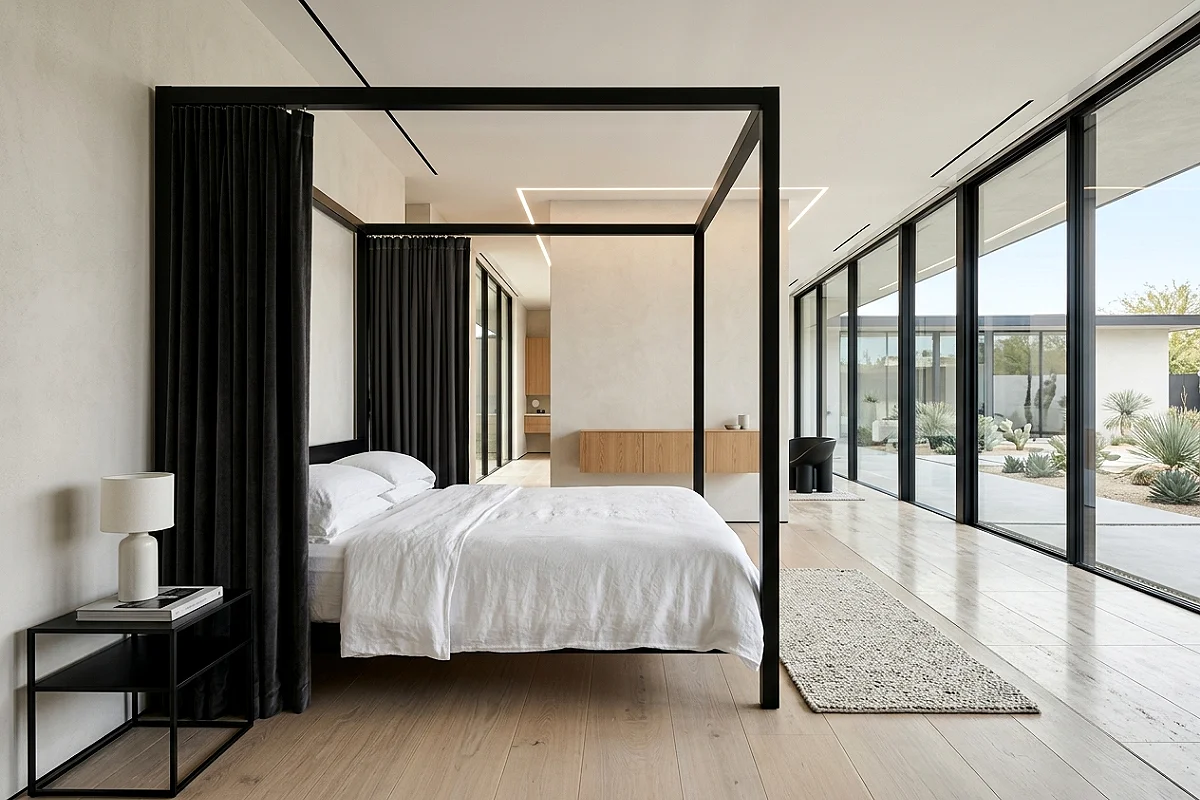
A four-poster canopy bed in black — whether lacquered wood, powder-coated steel, or wrought iron — is the single most structurally dramatic piece of furniture a bedroom can hold. It doesn’t need black walls to make its point; in a room of white or pale neutral walls, a black canopy bed becomes the room’s entire personality, a graphic architectural object that commands the space from floor to ceiling. Choose a canopy bed with clean, contemporary proportions — square-section posts in matte black steel, a simple rectangular frame overhead with no finials or ornamentation — and dress it with curtains in a heavy, floor-length fabric: a velvet in deep charcoal, a silk dupioni in blackened ivory, or a heavyweight linen in near-black navy. The contrast between the dark frame and the gathered fabric is where the drama lives. Keep the bedding in crisp white or ivory — the starkness of the contrast is the point. A large black-framed mirror on one wall echoes the bed frame’s graphic quality. The floor should be pale — white oak, bleached pine, or a light stone — so the bed’s dark silhouette reads clearly against it from every angle in the room.
Pro Tip
Hang canopy curtains from a ceiling-mounted track inside the top frame rather than from rings on the frame’s horizontal rail — the curtains hang with a cleaner, more architectural drape and can be drawn fully closed for a genuinely enclosed sleeping space, which transforms the experience of being in the bed entirely.
Black Bedroom with Warm Brass Accents

The combination of matte black and warm, unlacquered brass is one of the most reliably sophisticated material pairings in contemporary interior design — and in a bedroom, it creates a space that reads as both masculine and sensual, rigorous and warm. The black here should be the walls and the primary furniture: a matte black paint on all four walls, a black-upholstered bed frame in a slightly tufted or channel-quilted velvet, a black bedside table in lacquered MDF or powder-coated steel. Then introduce brass as the single accent metal across every fixture and fitting: a pair of wall-mounted brass reading lamps with adjustable arms beside the bed, brass drawer pulls on a black dresser, a brass-framed oversized mirror, a brass pendant light overhead with a smoked glass or opaque dome shade that throws light downward rather than out. The bedding should be in warm ivory or caramel — a silk-cotton blend in champagne or a linen in the palest honey — so the bed itself provides warmth against the dark walls and furniture. A single large artwork in warm tones — an abstract in terracotta and gold, or a landscape in amber and ochre — grounds the warmth of the brass and keeps the room from reading as purely monochromatic.
Pro Tip
Unlacquered brass will develop a natural patina over time — darkening and deepening in areas of touch, brightening on exposed faces. Embrace this rather than polishing it away; a year-old unlacquered brass fixture in a black room has a richness that new bright brass simply cannot replicate. It is the material equivalent of fine leather aging well.
Graphic Black and White Contrast Bedroom
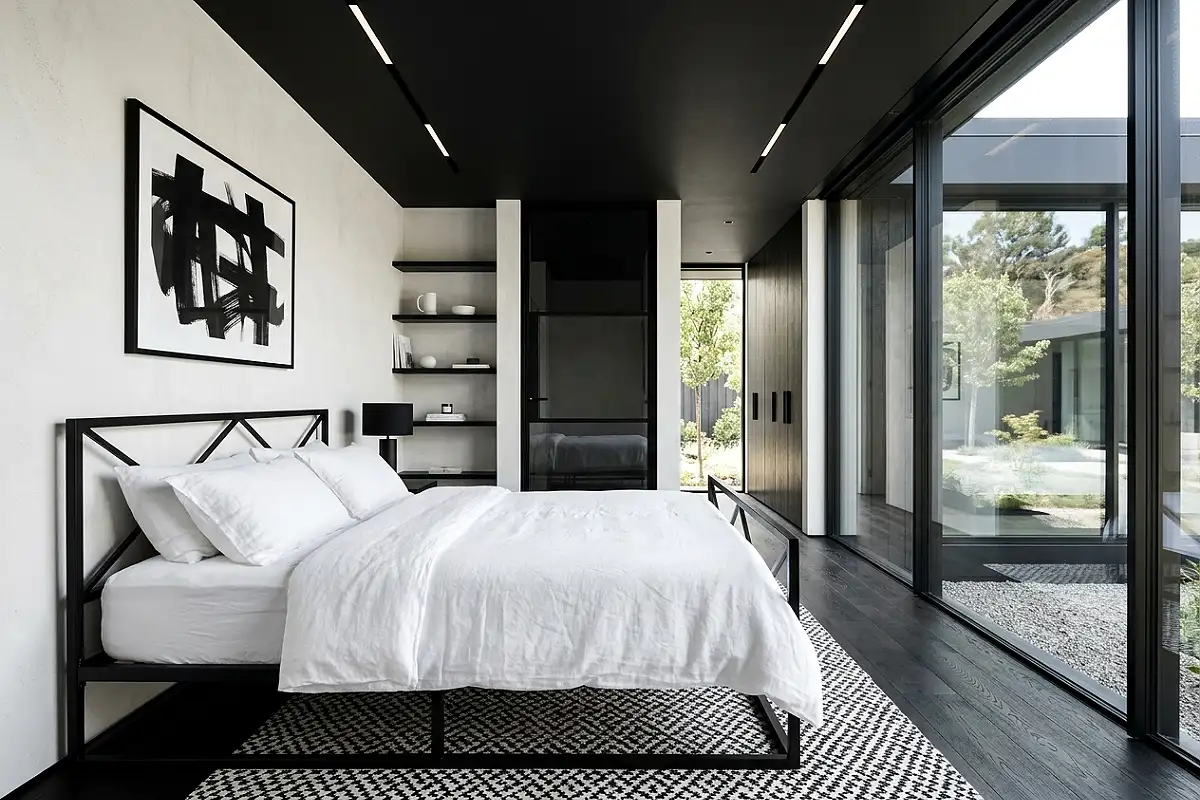
Pure black and pure white in a bedroom, used at equal visual weight, creates the most graphic, most architecturally bold interior a room can hold — the visual language of a film noir still, a Japanese ink painting, or a Mondrian composition scaled to inhabit. The key decision is which surface gets black and which gets white. The most resolved approach: white walls, black ceiling, black bed frame, white bedding. The dark ceiling lowers visually and creates a sense of intimate enclosure overhead; the white walls keep the room light and expansive at eye level; the dark bed frame is a graphic anchor; the white bedding glows against it. Alternatively: one black wall, three white walls, a black-and-white graphic rug, and a bed frame in black iron with white linen. Either way, pattern enters only through geometry — black-and-white stripes on a cushion, a houndstooth throw, a graphic mosaic tile in an adjacent bathroom glimpsed through an open door. No color anywhere — not a green plant, not a brown wooden nightstand. The discipline is the design. If this feels extreme, introduce one material in dark walnut or warm brass as the only point of relief.
Pro Tip
In a strict black-and-white room, the white you choose matters as much as the black. A warm white (with cream or yellow undertones) softens the contrast and makes the room feel more approachable; a cool blue-white (with no warmth) sharpens the graphic tension. Decide which emotional quality you want and choose your white accordingly — they are not interchangeable.
Matte Black Japandi Bedroom
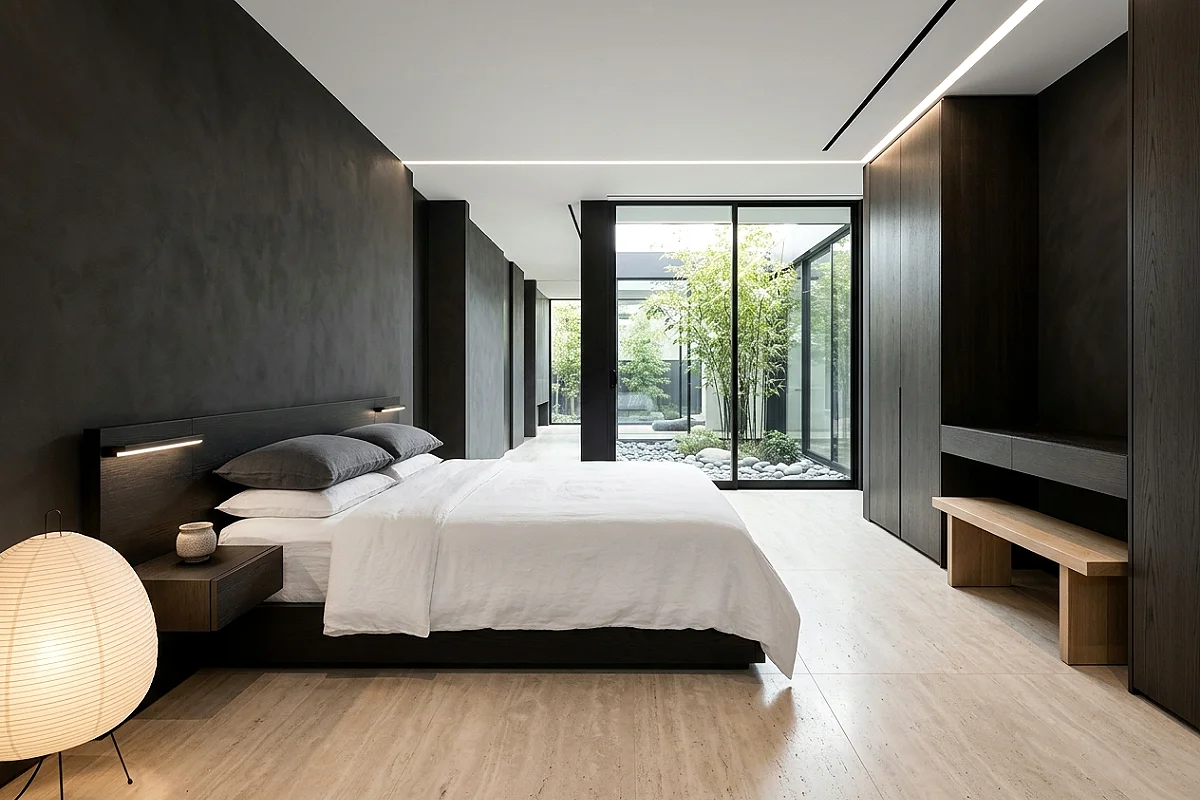
The Japandi aesthetic — which approaches every design decision with a kind of quiet, philosophical deliberateness — handles black with particular grace. In a Japandi bedroom, black is not dramatic; it is simply honest. It is the color of an ink stone, a cast iron kettle, the glazed interior of a tea bowl. Paint the walls in a deep, warm charcoal — close to black but with enough brown to feel organic rather than synthetic. Choose a platform bed in blackened or ebonized oak: low, wide, and absolutely without ornamentation. The headboard is a slab of the same dark timber, or simply the wall itself. Bedding in white or undyed linen, folded with precision — flat sheet tucked tight, pillows in matching linen covers stacked without excess. A single ceramic vase on the nightstand in matte black or iron-oxide glaze holding one bare branch or one stem. A flat-weave rug in natural undyed wool on the floor. No overhead light — a paper or washi floor lamp in one corner, its warm diffuse glow the only light source after dark. The black in this room is not about luxury in the conventional sense; it is about the luxury of absolute quiet. Nothing is unnecessary. Nothing apologizes for being there.
Pro Tip
In a Japandi black bedroom, even the black should feel warm rather than cold. Mix a small quantity of raw umber or brown oxide into your black paint before applying — most paint brands can do this as a custom tint. The resulting tone has a depth and warmth that straight black paint rarely achieves, and it responds far more beautifully to natural light.
Black Bedroom with Jewel Tone Accents
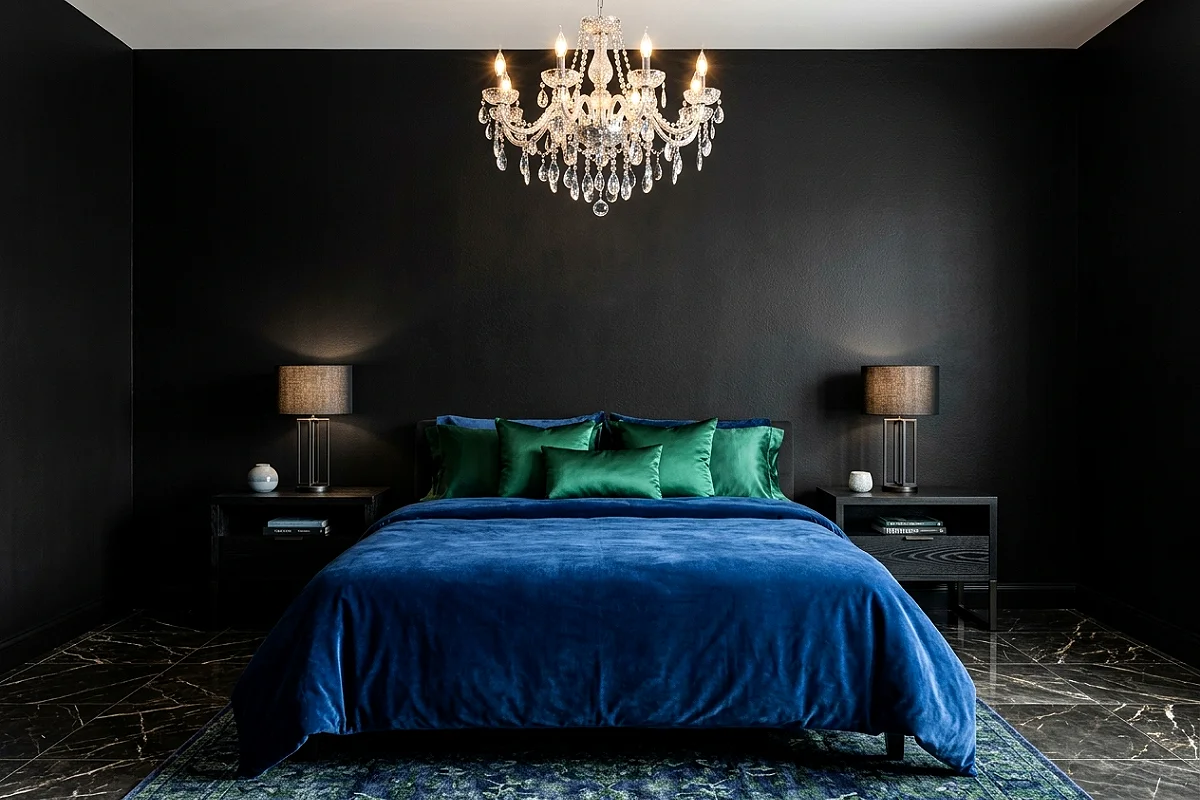
Black walls in a bedroom create the most perfect backdrop for jewel-toned textiles and accents — because the depth of the dark ground makes every saturated color appear to glow from within, the way gemstones look more brilliant in a dark velvet case than under a white spotlight. Start with walls in a strong, consistent black — Farrow & Ball’s Pitch Black or Little Greene’s Obsidian — and then introduce jewel tones with genuine commitment. A sapphire blue velvet duvet. Emerald green silk cushions. An amethyst throw in silk chiffon or woven wool. A ruby red upholstered bench at the foot of the bed. Each piece should be in a single, pure jewel tone — not muddied or muted, but genuinely saturated. The black walls act as a deep shadow that makes each color more itself. The furniture can be black lacquer or dark ebonized wood throughout so that the jewel tones read as the sole color story. Choose two or three tones from the jewel spectrum rather than all of them — sapphire and emerald, or ruby and amethyst — and repeat each one across different objects and textiles to create visual rhythm rather than chaos. A large antique chandelier in crystal or amber glass overhead catches the lamplight and throws tiny prisms across the dark walls.
Pro Tip
In a jewel-tone-on-black bedroom, the textiles should be in genuinely luxurious materials — silk, velvet, and cashmere rather than polyester or acrylic blends. Under lamplight on dark walls, the sheen difference between real silk and synthetic silk is unmistakable, and the distinction matters more here than in any other room type.
Ebonized Wood Bedroom Suite
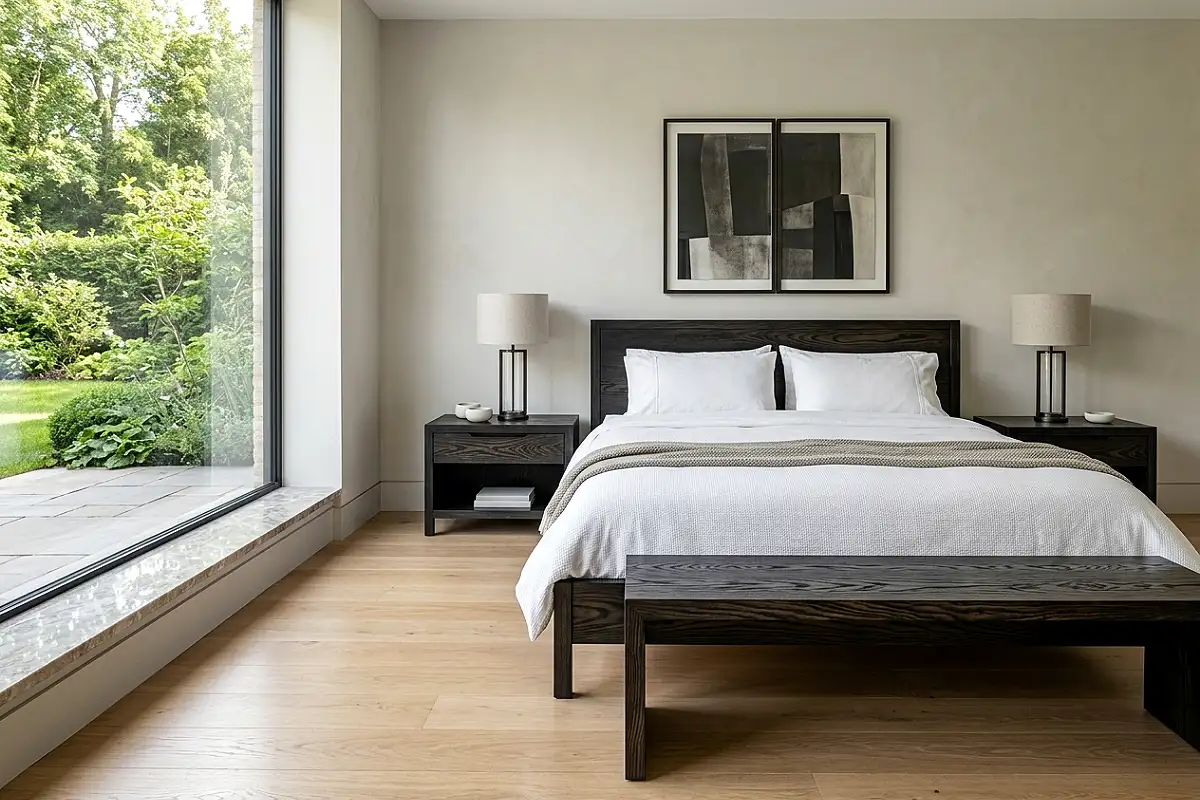
An ebonized wood bedroom — where every piece of furniture has been stained or treated to a deep, near-black finish while retaining the visible grain structure of the underlying timber — creates a room of extraordinary material richness. The black here is not paint; it is wood transformed, and the grain still shows through: oak becomes a shadowy chessboard of dark and slightly less dark, walnut becomes so deep it barely distinguishes itself from black ink, ash develops a particular silvered blackness that is unlike any other species. Choose a bedroom suite in ebonized timber — bed frame, nightstands, dresser, and a low storage bench at the foot — all in the same species and finish so the suite reads as a composed whole. The walls should be in a warm, contrasting neutral: a pale warm white, a soft greige, or the palest stone — something that lets the dark furniture read clearly and with genuine visual weight. Bedding in crisp white or the lightest ivory cotton creates the sharpest possible contrast against the dark frame. A large gilded or silver-leaf framed mirror on one wall reflects the room and introduces a metallic element that responds to the sheen in the ebonized timber. This is a bedroom with the gravitas of a well-designed museum gallery — everything considered, nothing incidental.
Pro Tip
True ebonizing is done with an iron acetate solution — steel wool dissolved in white vinegar — applied to raw wood. It reacts chemically with the wood’s tannins to produce a deep black that penetrates the grain rather than sitting on the surface like paint or stain. The result has a depth and authenticity that no commercial black wood stain fully replicates.
Black Bedroom with Marble and White

Pairing matte black walls with genuine white marble — on nightstand surfaces, as a fireplace surround, as a bathroom countertop glimpsed through an open door — creates the specific aesthetic of a high-end boutique hotel: dark, enveloping walls beside luminous white stone with its grey and gold veining catching the light. The marble is the luxury signal in this room; everything else exists to support it. Choose wall-mounted nightstands with a marble top in Carrara, Calacatta, or White Onyx so the stone floats at bed level, visible and prominent against the dark walls. A marble-topped dresser in ebonized wood or black lacquer continues the material story. Overhead, a pendant in smoked glass or blackened brass with a visible filament bulb provides warm, directional light that falls onto the marble surfaces below and reveals their veining. Bedding in white or the palest warm linen. Black linen curtains falling floor to ceiling. A single large abstract artwork above the bed in black, white, and the specific grey of the marble’s veining — so the art feels sourced from the room’s own material palette rather than imported from elsewhere. This combination of black and white marble is one of the very few bedroom palettes that genuinely communicates luxury without anything else needing to be said.
Pro Tip
If genuine marble is beyond budget, a high-quality porcelain slab in a white Calacatta pattern is visually indistinguishable at room distance and far more practical for nightstand surfaces — it requires no sealing, is impervious to water rings and perfume spills, and maintains its appearance indefinitely with minimal care.
Dark Romantic Maximalist Bedroom
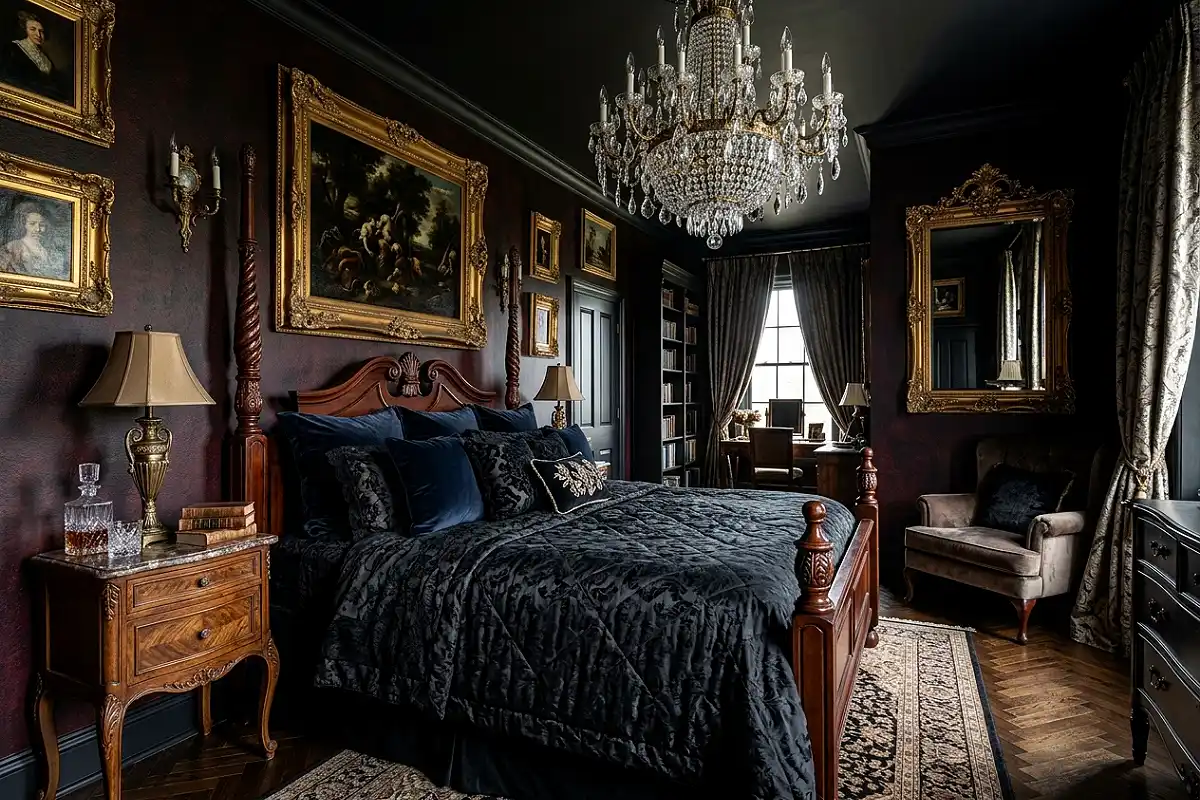
A dark romantic bedroom takes the maximalist instinct — more pattern, more texture, more layering — and applies it entirely within a black and deep-toned palette, creating a room of extraordinary visual density that somehow never tips into chaos. The walls are in a deep, warm black — one with brown or red in its base tone: Farrow & Ball’s Brinjal pressed to its darkest, or their Mahogany darkened further still, or a custom mixture of black with a touch of deep crimson. Against those walls, layer textiles of every description within the same dark register: a quilted duvet in black damask, cushions in midnight navy velvet, a throw in deep burgundy cashmere, lace pillow covers in ivory over deep charcoal, a beaded or embroidered coverlet draped across the foot. Mix patterns freely but keep the tones within the same deep family: a paisley in black and gold, a floral in midnight blue and burgundy, a geometric in charcoal and cream. Hanging above the headboard: an elaborate gilt frame holding an antique oil painting or a richly colored botanical print. A crystal chandelier overhead. Every surface has an object: a collection of perfume bottles on the dresser, stacked velvet-bound books on the nightstand, a pair of black taper candles in silver holders. This is a room that takes unapologetic pleasure in its own beauty.
Pro Tip
Dark romantic maximalism needs strong, layered light to prevent it from reading as simply gloomy. Combine a chandelier overhead, bedside table lamps with dark or colored glass bases, at least two candle sources, and a dimmer on every circuit. The ability to modulate light levels throughout the evening is essential — this room should feel different at 7pm than it does at midnight.
Black Bedroom with Natural Wood and Linen
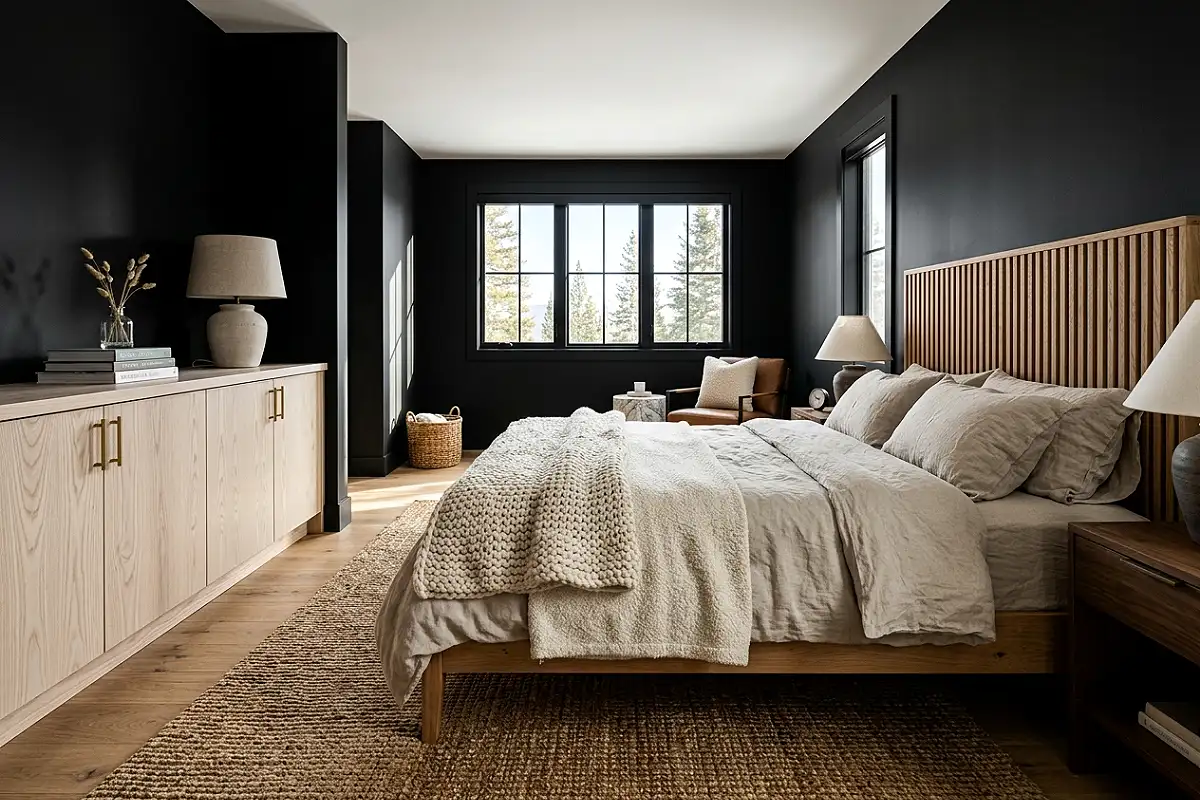
The counterintuitive pairing of black walls with warm, unfinished natural materials — raw oak, pale pine, undyed linen, jute, terracotta — creates a bedroom that manages to feel simultaneously dramatic and deeply grounded. The black recedes and the natural materials come forward, appearing warmer and more alive against the dark backdrop than they ever would against white. Paint the walls in a deep matte black — all four walls — and then furnish entirely in natural, organic materials. A bed frame in raw, unfinished white oak with a simple slatted headboard. Nightstands in bleached pine with turned legs. A large woven jute rug on the floor. Bedding in undyed linen or washed cotton in natural oat, with a hand-knit throw in cream chunky wool. A terracotta floor lamp base with a linen drum shade. One large fig tree or olive plant in the corner in a raw clay pot. The black walls make the terracotta of the pot, the cream of the knit, and the honey of the oak all appear more saturated and intentional than they would against white — the dark ground is acting as a shadow that makes every natural tone glow. This is a bedroom that manages to feel both bold and effortlessly relaxed.
Pro Tip
In a black-and-natural room, avoid any wood with a glossy or orange-toned finish — it will read as cheap against the sophistication of the dark walls. Choose only raw, oiled, or matte-sealed timber in cool or neutral tones. The wood should look like it grew somewhere, not like it was manufactured.
Black Wallpaper Feature Wall Bedroom
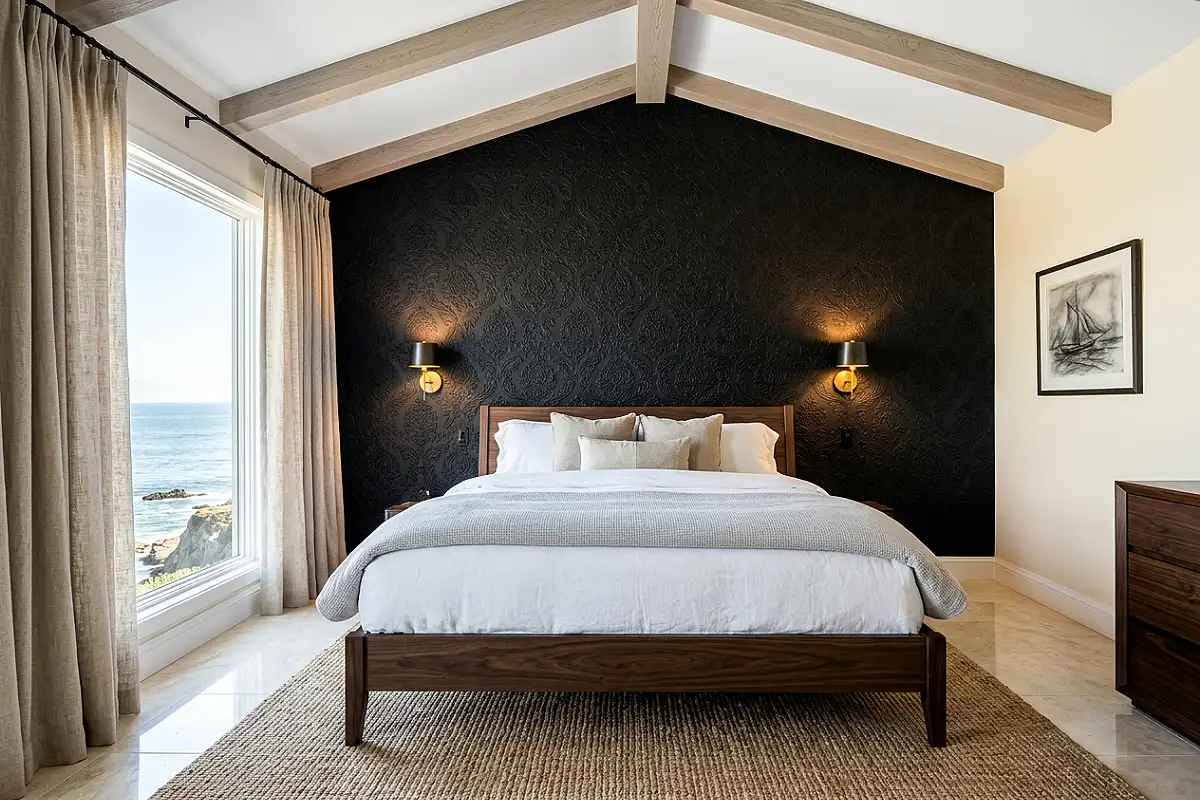
A black wallpaper — particularly one with a tonal pattern that reveals itself only in certain lights — creates a feature wall of far greater depth and complexity than black paint alone can achieve. The pattern might be a damask in black on black, where the repeat is only visible as a slight sheen difference between the pattern and the ground; a large-scale floral in charcoal and dark grey on a near-black background; a geometric tile-effect paper with a subtle metallic thread running through the repeat; or a rich, heavily embossed Victorian-style pattern that reads as pure texture until the light catches it at an angle. Paper the wall the bed sits against only, and paint the remaining three walls in the darkest possible warm white — a white with so much warmth it reads as cream in lamplight, preventing the contrast from becoming harsh. Choose a wallpaper with a vertical repeat so the pattern pulls the eye upward and makes the ceiling feel higher. Bedroom furniture in a warm dark walnut or a pale, bleached ash — either works, depending on whether you want the furniture to merge with the dark wall or contrast with it. Cole & Son’s Fornasetti range and Phillip Jeffries’ grasscloth in dark natural tones are two very different but equally beautiful options for this approach.
Pro Tip
A tonal black-on-black wallpaper needs raking light to reveal its pattern — light that comes from the side, at a low angle, rather than directly in front. Position a pair of wall sconces on the same wall at either side of the bed so the light washes across the wallpaper surface and reveals its embossed or printed depth throughout the evening.
Black and Blush Feminine Luxury Bedroom
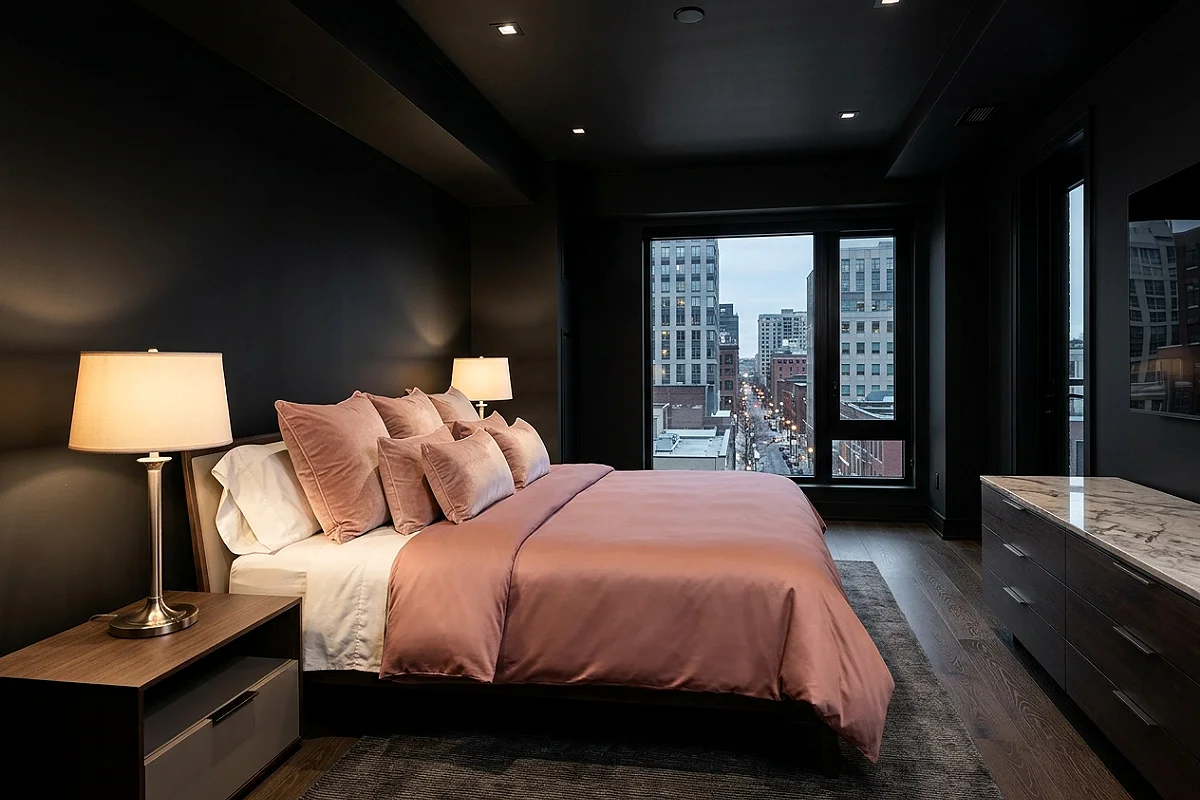
Black paired with the right shade of blush creates a bedroom that has the particular quality of a high-fashion editorial: deeply glamorous, visually assured, and unexpectedly tender at the same time. The black provides the structure and the authority; the blush provides the softness and the warmth. Choose a deep matte black for the walls — all four, including the ceiling in this version — and introduce blush across every textile surface: a silk or silk-blend duvet cover in the palest dusty rose, cushions in blush velvet of varying depths from petal pink to dusty mauve, a cashmere throw in warm sand that sits between the black and the pink as a tonal bridge. The furniture should be in polished nickel or chrome — not the warm brass of other black bedroom treatments — because the cooler metal responds to the blush in a more feminine, contemporary way. A large oval mirror in a polished nickel frame above the dresser. A fluted glass vase holding white or pale pink peonies on the nightstand. Curtains in a heavy blush velvet, floor to ceiling, that pool slightly at the base — the surplus fabric is not a mistake, it’s the point. The Aerin Lauder for Visual Comfort lighting collection produces bedside lamps that are made for exactly this palette.
Pro Tip
Blush reads very differently in different light temperatures. Under warm incandescent bulbs, blush leans peachy and golden; under cooler LED light, it reads more pink and clear. For a black-and-blush bedroom, choose bulbs at 2700–3000K — the warmth deepens the blush into a more complex, dusty rose that works far better with the black than a cool-toned pink would.
Moody Black Bedroom with Antique Mirrors
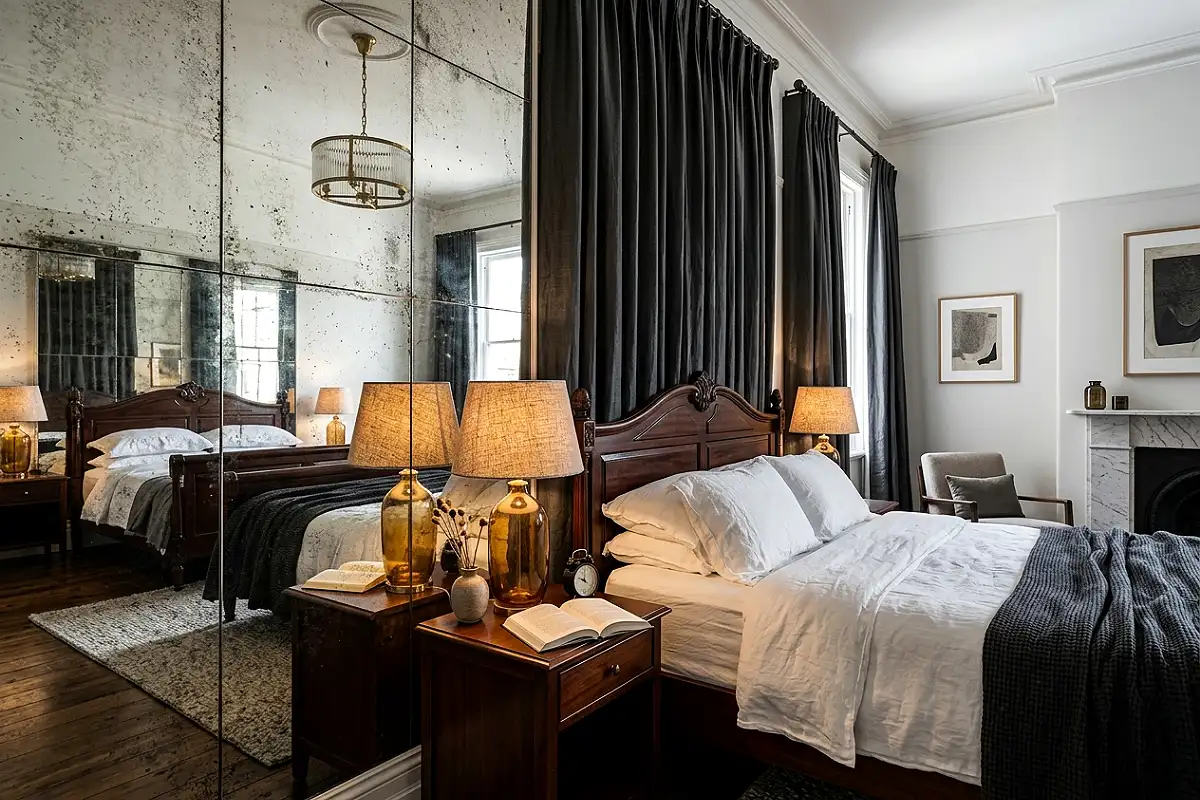
Few surfaces transform a dark bedroom more dramatically than antique mirror — that softly foxed, slightly hazed glass that reflects without the sharpness of modern mirror, creating reflections that look like watercolor approximations of the room rather than exact copies. In a black bedroom, antique mirror becomes a source of light itself: it catches and redistributes every candle flame, every lamp glow, every reflection without the harsh clarity that full-length modern mirrors can introduce in a dark space. Panel an entire wall in antique mirror glass — sourced from a salvage specialist or replicated with artificially aged mirror panels available from specialist glass suppliers — and position it directly opposite the windows so it collects daylight and distributes it gently around the dark room throughout the day. A bed frame in dark mahogany or ebonized oak. Heavy silk curtains in deep charcoal or near-black burgundy. A large Venetian glass chandelier overhead, its many facets multiplied endlessly in the antique mirror wall. Bedside table lamps in hand-blown amber glass. The room becomes a series of layered, softly imperfect reflections — never quite showing you the room directly, always offering the most flattering, most mysterious version of it instead.
Pro Tip
True antique mirrors are expensive and fragile — but commercially produced “foxed mirror” panels, available from specialist glass suppliers, replicate the look convincingly at a fraction of the cost. Specify irregular foxing density across the panels so they don’t all look identical, which is the detail that distinguishes a genuinely aged wall from a manufactured effect.
Black and Terracotta Earthy Bedroom

Black walls paired with terracotta, rust, and burnt clay tones create a bedroom with the particular warmth of a Moroccan riad or an Andalusian farmhouse at nightfall — earthy, intimate, and deeply human in its color story. The contrast between the cool depth of black and the warm red-brown of terracotta is one of the most instinctively satisfying combinations in any interior: they exist beside each other in the natural world — night sky above sun-baked clay earth — and they translate with equal success into a bedroom. Paint the walls in a deep, slightly warm matte black and introduce terracotta through every textile and accessory layer: a terracotta linen duvet cover, burnt rust velvet cushions, a woven kilim rug in rust and cream and ochre on the floor. The furniture should be in natural rattan, raw clay finish, or dark hammered iron to keep the materials feeling organic and honest. A cluster of terracotta pots — varying sizes, some glazed and some raw — holding trailing plants or dried botanicals. Hand-thrown ceramic table lamps in terracotta glaze with natural linen shades. A Moroccan-style pendant lantern in blackened iron overhead, throwing geometric shadow patterns across the dark walls after dark. This room is warm in every sense of the word.
Pro Tip
Choose a black for this room that has a very slight warm or brown undertone — avoid cool blue-blacks entirely. A warm black beside terracotta creates harmony; a cool black beside terracotta creates a jarring contrast that reads as accidental rather than designed. Benjamin Moore’s Black Panther or Sherwin-Williams’ Caviar are both warm-undertoned blacks that work beautifully with earth tones.
Monochrome Black Bedroom with Texture Play
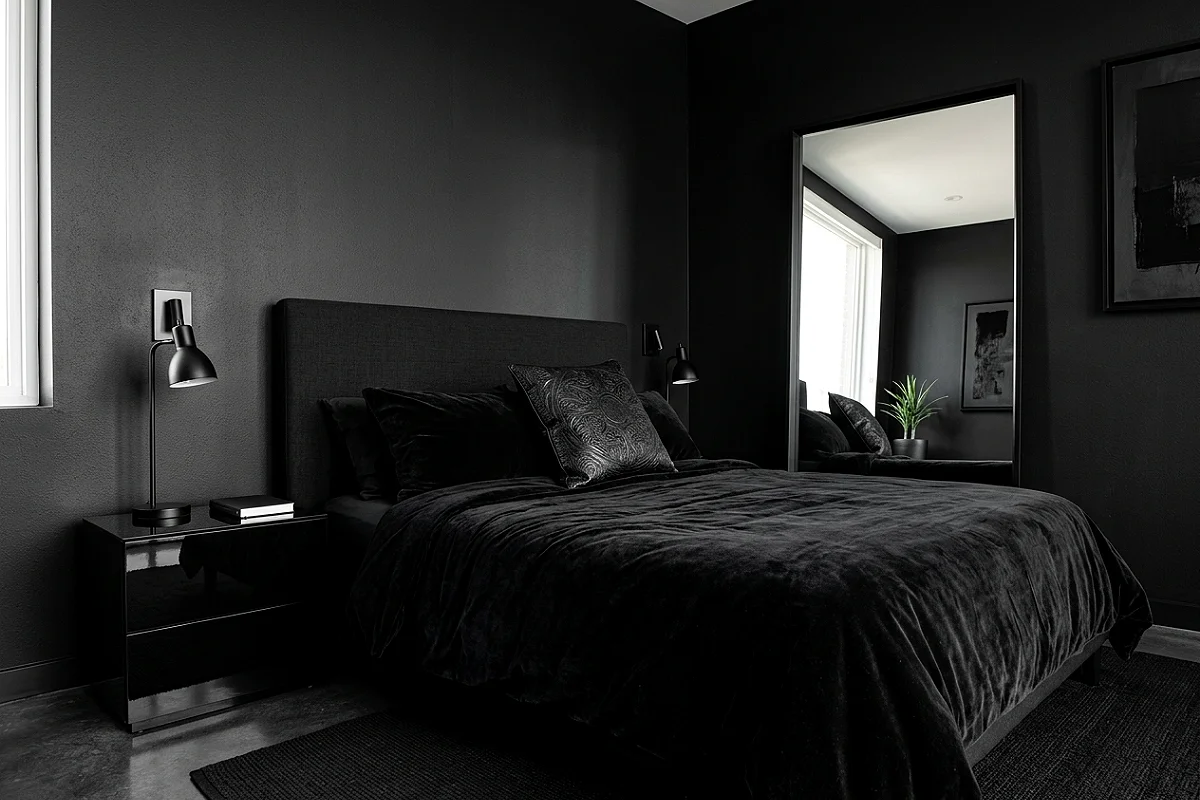
A monochrome black bedroom — where every surface, every textile, and every object exists in black, near-black, or the dark charcoal range — is one of the most technically demanding and most visually rewarding bedroom concepts to execute well. The challenge is preventing the room from feeling flat or oppressive; the solution is aggressive variation of texture, so that every surface catches light differently and the eye moves continuously around the room finding new depth and interest. Matte black walls beside a glossy black lacquered nightstand. A black velvet duvet beside a matte black cotton flat sheet. A chunky black bouclé throw beside an embossed black leather cushion. A black silk lampshade that glows from within beside a matte ceramic lamp base that absorbs all light. A black rattan pendant overhead beside a smoked glass table lamp. The floor in a black stained timber with visible matte grain. Every surface participates, and every surface has its own finish. The room should feel like looking into deep water: the more you look, the more you see. One concession to light is permitted and recommended — a large, plain mirror in a black frame, which brings reflected daylight into the room without introducing any other color.
Pro Tip
In a monochrome black room, the hierarchy of finishes matters as much as their variety. As a rule: matte on the largest surfaces (walls, ceiling, floor), mid-sheen on medium surfaces (furniture), and high gloss or reflective on the smallest (hardware, lamp bases, decorative objects). This creates a visual layering from background to foreground that gives the room its sense of depth.
Black Bedroom with a White Plaster Ceiling
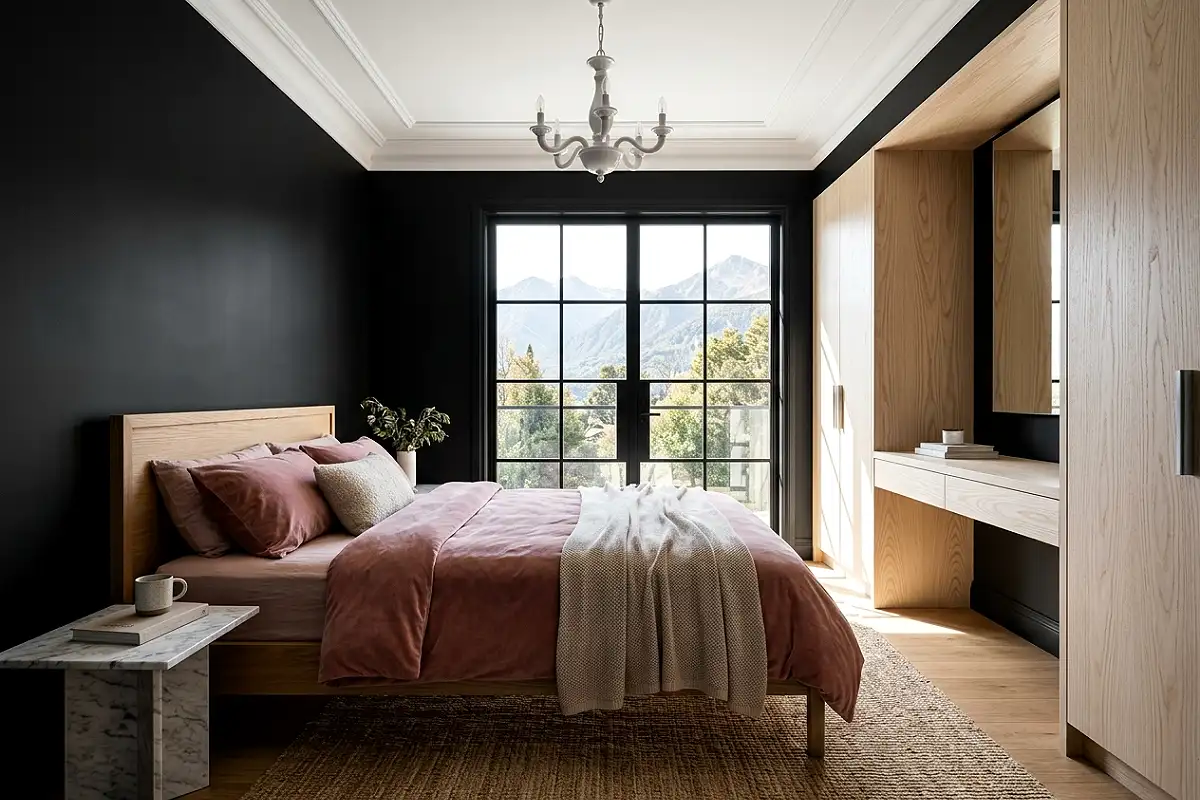
One of the most elegant and surprisingly lightening approaches to the black bedroom is painting the walls and all furniture in deep matte black while leaving the ceiling in a brilliant, ornate white plaster — or simply in the lightest possible warm white. This configuration inverts the standard expectation of a dark room: the ceiling becomes a sky, a source of light and openness above a cocooning dark interior. In a period room with ornamental plasterwork — a central rose, a coved cornice, a run of egg-and-dart moulding — the white plaster details become dramatically visible against the dark walls below, like an architectural drawing brought to life. A crystal or white porcelain chandelier suspended from the white ceiling appears to float above the dark interior. The bed should be in a warm, mid-tone material — a natural oak frame, a caramel leather headboard, or a dusty rose velvet — that acts as the transitional element between the dark walls and the pale ceiling. This is a bedroom that manages to feel genuinely tall, open, and light while simultaneously dark, intimate, and enveloping — a balance very few design approaches achieve as naturally.
Pro Tip
Stop the black paint precisely at the top of the cornice or ceiling moulding line — never take it onto the ceiling itself, even by a fraction. A crisp, clean transition between the dark wall and the white ceiling is what makes this look intentional and architecturally confident; any bleeding of the dark tone onto the ceiling destroys the effect entirely.
Black Bedroom with a Statement Art Collection
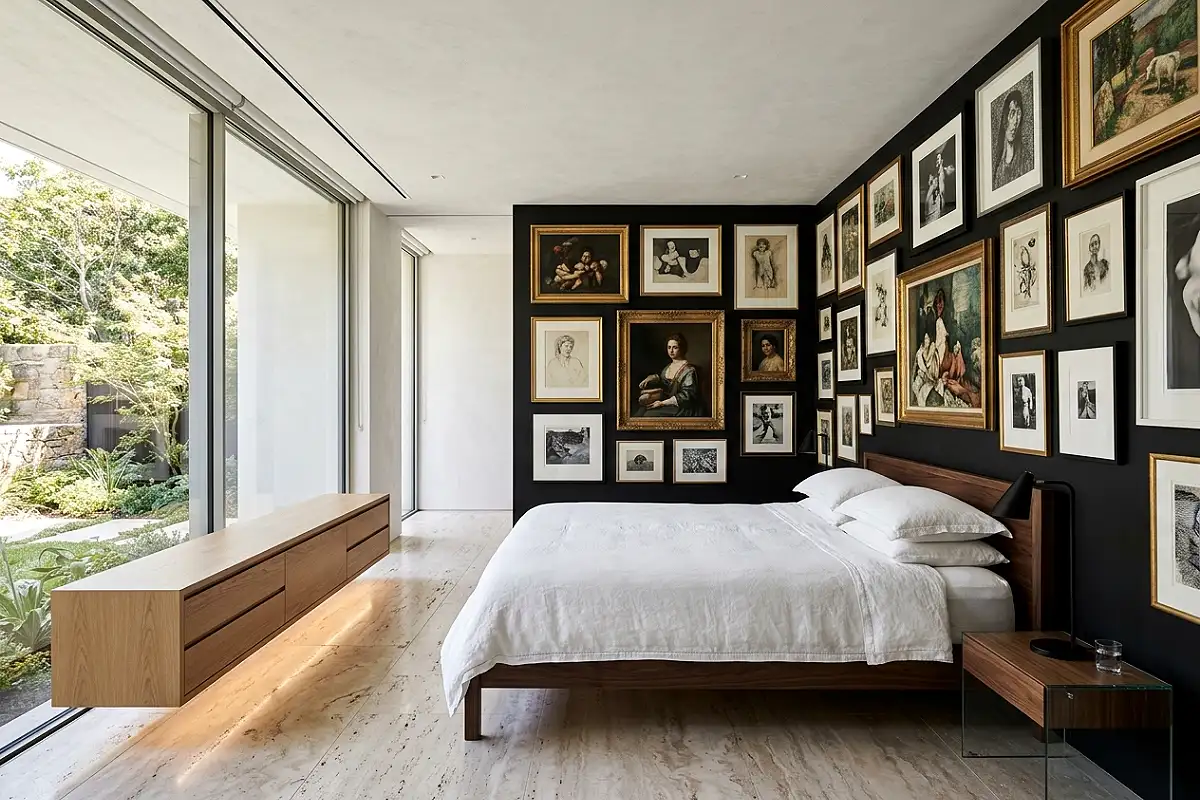
A curated art collection hung on black walls creates a gallery-like quality in a bedroom that no other wall color replicates — because black walls provide the same neutral, receding backdrop that gallery curators have used for centuries to make art appear more luminous and more present. The walls are not the design; the walls are the frame. Choose art with genuine intention: a mix of scales, mediums, and frames, but unified by a clear aesthetic sensibility — all figurative, or all abstract, or all botanical, or all photographic. Frame choices matter enormously: gilded frames for old masters or botanical studies, thin black frames for photography or graphic prints, raw gallery-wrapped canvas for abstracts that need no frame at all. Hang the collection across the entire wall the bed faces — floor to ceiling if possible, extending past the bed’s width in both directions — so it creates an immersive backdrop rather than a discrete arrangement. Keep everything else in the room minimal and dark so that the art is unmistakably the subject: a simple dark bed frame, white bedding, no decorative clutter on nightstands. The bedroom becomes a private gallery that happens to have a bed in it — a deeply personal and consistently impressive result.
Pro Tip
Use picture rail hooks rather than individual wall fixings for a gallery wall in a dark bedroom — they allow you to reposition and add to the collection without new nail holes in the dark paint, which are nearly impossible to touch up invisibly. Picture rails also allow artwork to hang at varying heights with a single horizontal anchor point, giving the arrangement a more fluid, salon-style quality.
Midnight Blue Bedroom with Black Accents
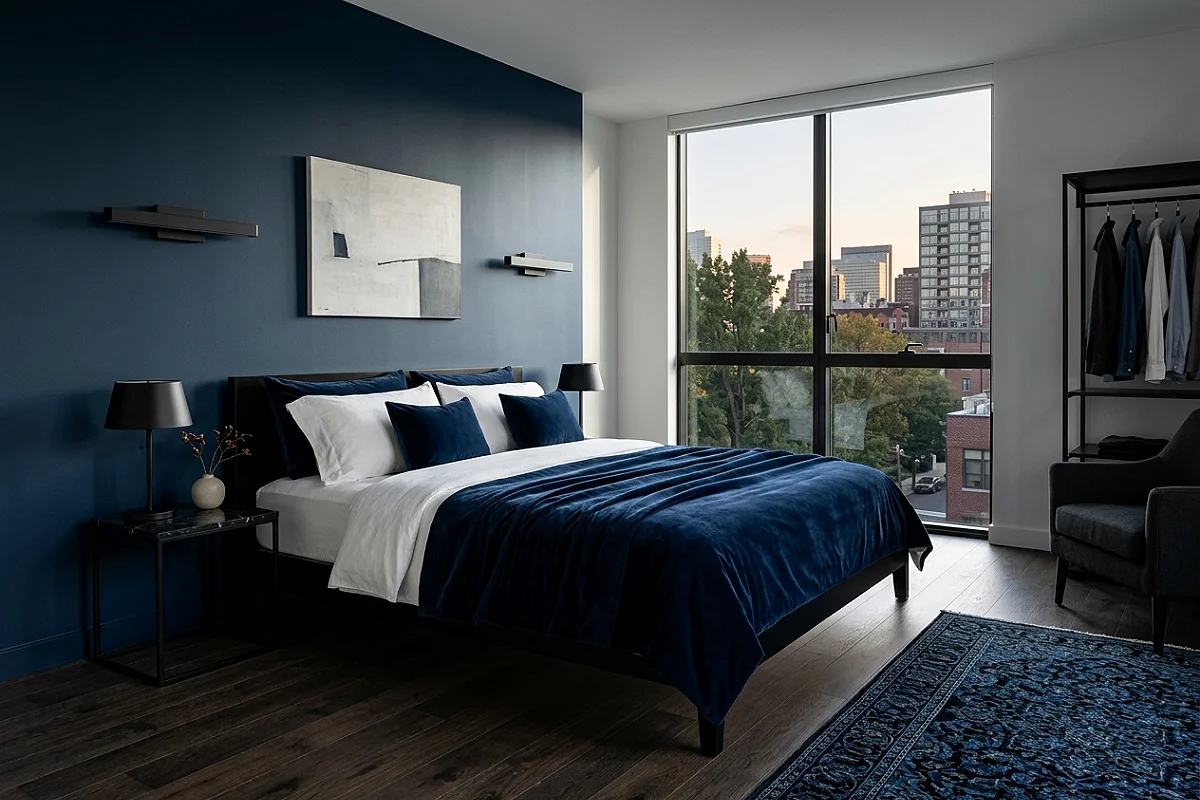
Midnight blue — so dark it reads as black in all but the brightest light — deserves a place in the black bedroom canon as the most romantic and most atmospheric of the near-blacks. It carries all the depth and drama of true black while retaining a color quality that gives the room a slightly more jewel-like, less absolute quality. Paint the walls in a deeply saturated midnight blue — Farrow & Ball’s Hague Blue, Little Greene’s Celestial Blue, or Benjamin Moore’s Gentleman’s Gray pushed to its darkest reading. Then introduce true black accents throughout as the grounding element: a black lacquered bed frame, matte black wall sconces, black linen curtains that fall from ceiling to floor, a black-framed mirror. The bedding should be in the crisopest possible white — a white that reads as light itself against the dark walls — with a single navy or midnight velvet throw draped across the foot as the tonal bridge between the walls and the bed. The combination of midnight blue and black creates a room with genuinely different visual quality from either color alone — darker and more absolute than blue, warmer and more complex than black — and in the right room, under the right lighting, it is one of the most beautiful interiors imaginable.
Pro Tip
Midnight blue walls with black accents require very warm light — bulbs no cooler than 2700K throughout. Cooler light pushes midnight blue toward a flat, cold navy and loses the depth and warmth that makes this color combination so compelling. Warm bulbs push it toward the deep inky end of the spectrum where the blue and black qualities are both present simultaneously.
Black Bedroom with Cream and Cashmere Luxury
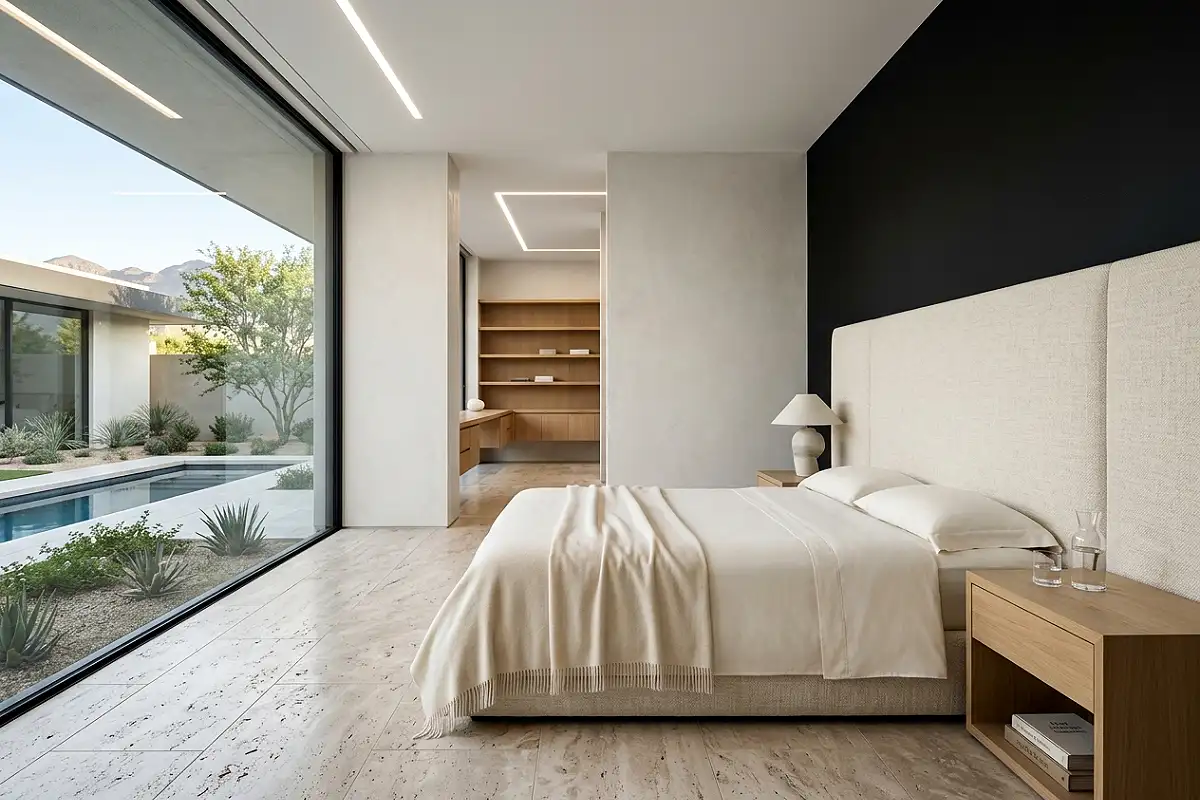
The simplest, most reliably elegant formulation of the black bedroom is also the most timeless: black walls against the palest possible cream textiles, with cashmere, silk, and the finest natural materials used at every point of contact. This room asks nothing elaborate of you — no pattern, no color, no art collection or jewel tones. It requires only quality: the quality of the matte black paint on the walls, the quality of the cream cashmere throw at the foot of the bed, the quality of the 400-thread-count ivory cotton sheets, the quality of the natural oak or the unlacquered brass. The bed should be an overscaled upholstered headboard in cream or the palest warm linen — tall enough to nearly reach the ceiling, making the bed appear impossibly generous and hotel-like against the dark walls. The duvet is in the finest white cotton; the throw is a double-faced cashmere in oatmeal cream. The nightstands in natural oak, each holding only a single lamp and a single book. The lamps are in cream linen shades with a brass or oak base. No clutter anywhere. The room communicates luxury entirely through material quality and restraint — the two things that money can buy and that no amount of styling can substitute for. This is the black bedroom at its most refined.
Pro Tip
In a black-and-cream bedroom, the cream must stay consistent in tone across every textile — all warm cream, no pure whites mixed in, no cool greige. Even a small tonal variation between the pillowcases and the duvet cover will read as a mistake against the black walls, which act as a neutral backdrop that makes every textile color relationship visible and explicit.
Frequently Asked Questions
Will a black bedroom feel too dark and oppressive?
Only if the lighting isn’t considered. A black bedroom with layered warm lighting — bedside lamps, wall sconces, and at least one floor or table lamp at low level — feels enveloping and intimate rather than oppressive. The rooms that feel gloomy in dark colors are those relying on a single overhead light source, which flattens the space and removes all the depth that dark walls create under multiple warm light points. Mirrors also help considerably: a large mirror or antique mirror panel redistributes available light and prevents any corner from feeling truly dark.
What colors pair best with black in a bedroom?
Black is genuinely one of the most versatile backdrop colors available in a bedroom because it makes every other color appear more saturated and luminous. Its most successful pairings, in roughly ascending order of drama: cream and ivory for timeless elegance; warm brass and gold for glamour; natural wood and linen for organic warmth; blush and dusty rose for romantic softness; jewel tones — emerald, sapphire, ruby — for maximalist luxury; terracotta and rust for earthy warmth; and white in pure contrast for graphic boldness. The only colors that genuinely struggle beside black are cool pastels and bright primaries, which can appear washed out or discordant against a dark ground.
What is the best black paint color for a bedroom?
The answer depends on the undertone you want. For a warm black — one that reads as almost brown in natural light — Farrow & Ball’s Off-Black or Benjamin Moore’s Black Panther are excellent. For a true, neutral black with no strong undertone, Farrow & Ball’s Pitch Black or Sherwin-Williams’ Caviar are reliable choices. For a black with a very slight green undertone that makes it feel more organic, Little Greene’s Obsidian or Farrow & Ball’s Studio Green pushed dark. Always test in your specific room — black paint shifts dramatically between morning and evening light, and between north and south-facing rooms.
Is a black bedroom a good idea for a small room?
Counterintuitively, yes — with some important caveats. Small rooms in dark colors don’t read as smaller; they read as more intimate. The walls recede rather than pressing inward, creating a sense of depth that can actually make a small room feel more spacious in the way that looking into a dark forest feels more expansive than looking at a white wall. The essential requirements for a black small bedroom are good mirror placement (to multiply available light), warm layered lighting (to prevent any corner from going truly dark), and pale bedding and ceiling (to provide visual relief and reflected light from above).
How do I add luxury to a black bedroom without spending a lot?
The highest-impact, lowest-cost upgrade in a black bedroom is paint quality — spending more on a better flat black paint with genuine depth rather than a cheap flat black makes an immediately visible difference. After that: replace standard bulbs throughout with warm, high-CRI bulbs at 2700K, which transform the way dark walls look under artificial light. Invest in one genuinely good textile — a cashmere throw, a quality linen duvet cover — and let everything else be simple. A single large mirror in a quality frame gives the room twice the apparent depth. And declutter rigorously: a black bedroom with too many objects reads as chaotic; with very few, beautifully chosen objects, it reads as curated and expensive.
Should I paint the ceiling black in a black bedroom?
It depends entirely on the effect you want. A black ceiling in a black-walled bedroom creates the most immersive, cocoon-like experience — the room loses its corners and becomes an envelope of darkness that many people find deeply restorative for sleep. A white or pale ceiling above black walls gives the room a sense of height and openness that keeps the darkness from feeling overwhelming and is generally the more liveable long-term choice. A third option — painting the ceiling the same black as the walls but using a slight sheen (eggshell rather than matte) — creates a subtle distinction that implies the ceiling without the visual heaviness of a fully wrapped dark room.