
18 Dark Moody Bedroom Ideas with Luxe Decor Finds
A dark bedroom is not a gloomy bedroom—and that distinction makes all the difference. Done well, moody interiors feel warm, intimate, luxurious, and incredibly restful. Deep walls create a cocooning atmosphere, while layered lighting adds warmth and rich materials like velvet, aged leather, natural wood, brass, and stone bring beautiful depth in low light.
The dark bedroom ideas below focus on atmosphere, texture, and thoughtful design rather than color alone. Whether you’re ready for dramatic dark walls or simply want to introduce the mood through bedding, lighting, and decor, these ideas offer stylish ways to create a bedroom that feels sophisticated, inviting, and truly personal.
Midnight Velvet Bed and Tonal Walls
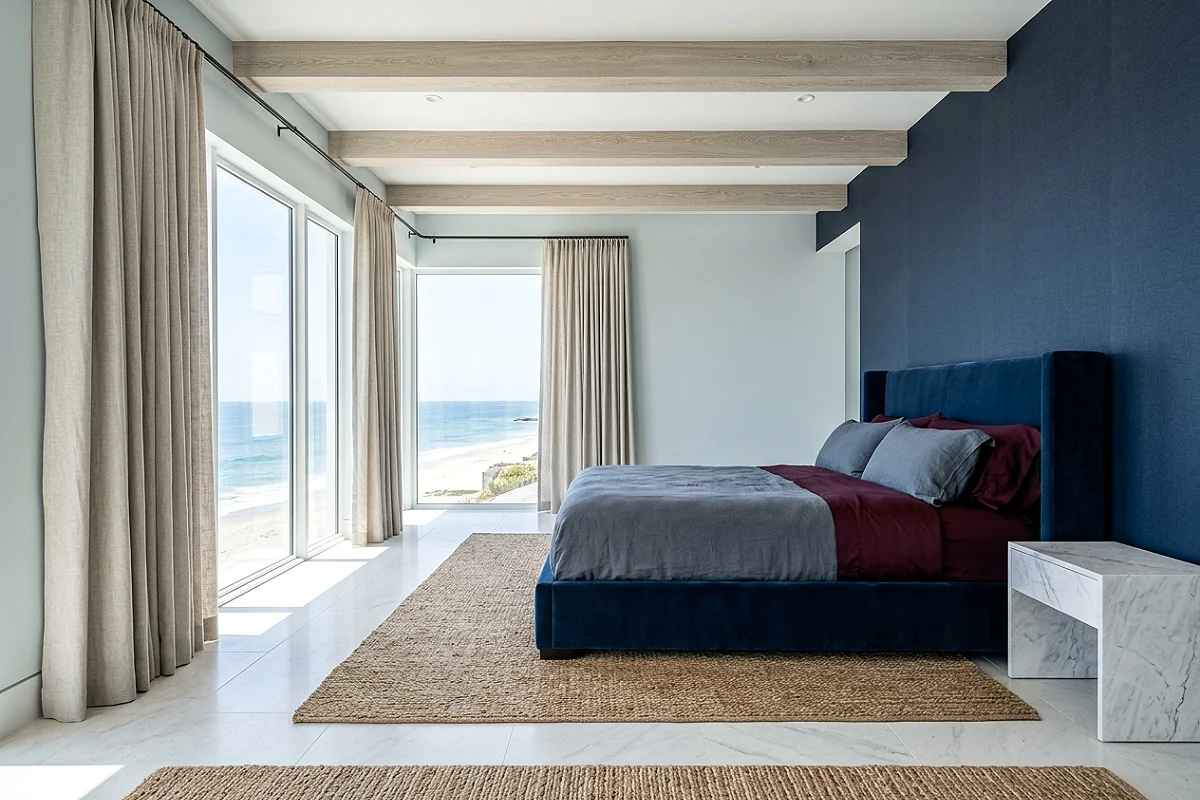
The single most impactful move in a dark bedroom is matching the depth of your upholstered bed to the depth of your walls. A deep navy or ink-black velvet bed frame against a wall painted in a near-matching hue — Benjamin Moore’s Hale Navy or Farrow & Ball’s Railings — creates a seamless, immersive envelope that makes the room feel as vast as it does intimate. Velvet catches light differently at every angle, so the bed never disappears into the wall; instead it reads as a rich, dimensional surface. Layer bedding in silver-grey, smoke, and deep burgundy to let the tonal composition breathe without breaking it.
Pro Tip
Paint your ceiling the same color as your walls — or one shade darker. It closes the room into a true cocoon. The first instinct is always to leave the ceiling white, but a dark ceiling is what separates a dramatically moody bedroom from a room that simply has dark walls.
Unlacquered Brass and Ebony Wood Nightstand Styling
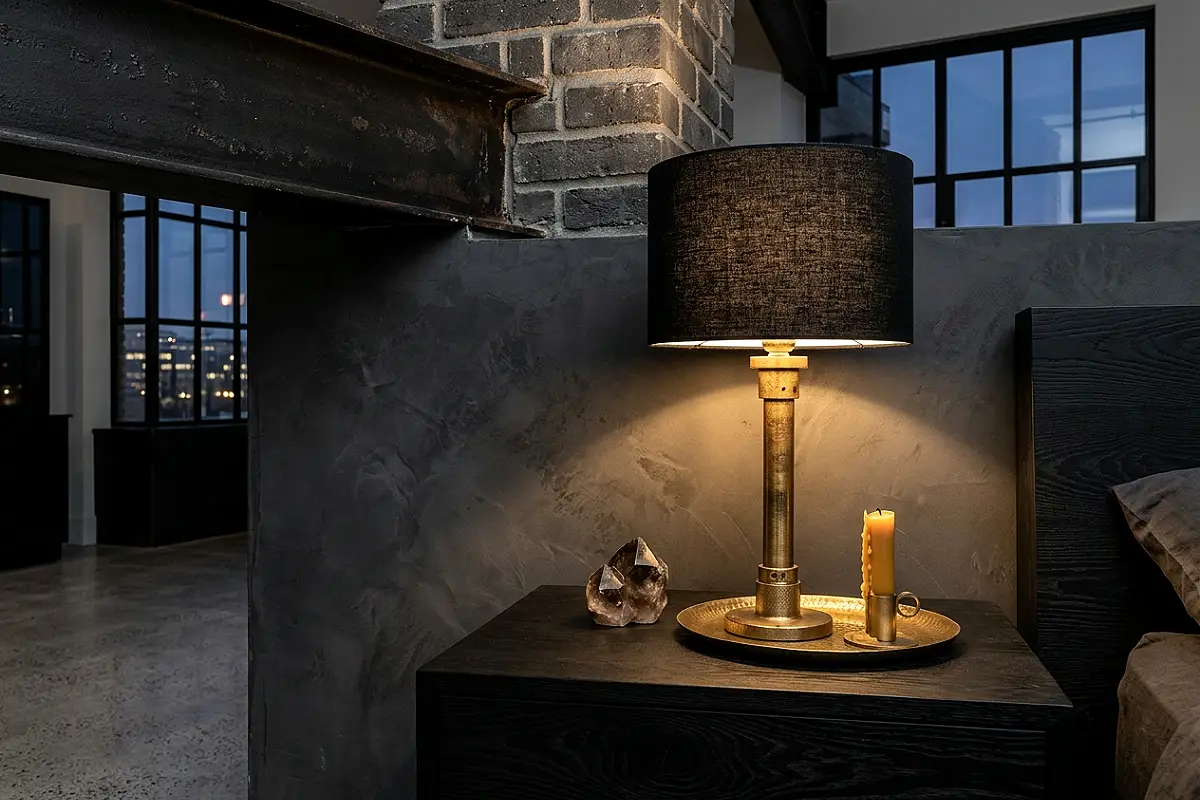
Against dark walls, unlacquered brass is transformative in a way that polished gold or chrome simply isn’t. The slightly tarnished, living-finish quality of unlacquered brass glows rather than glints, and that subtle warmth cuts through a dark room without jarring against it. Pair a dark-stained ebony or blackened oak nightstand with brass hardware, a brass-based table lamp with a dark linen shade, a small hammered brass tray holding a beeswax candle and one or two raw gemstones. The interplay between the warm metal and the dark wood is the kind of material tension that makes a room feel genuinely luxurious rather than just expensively furnished.
Pro Tip
Do not seal or lacquer your brass hardware and fixtures. The slow, uneven patina that develops over months is exactly what makes unlacquered brass look expensive and collected rather than bought off a shelf last Tuesday.
Floor-to-Ceiling Dark Bookshelf Wall
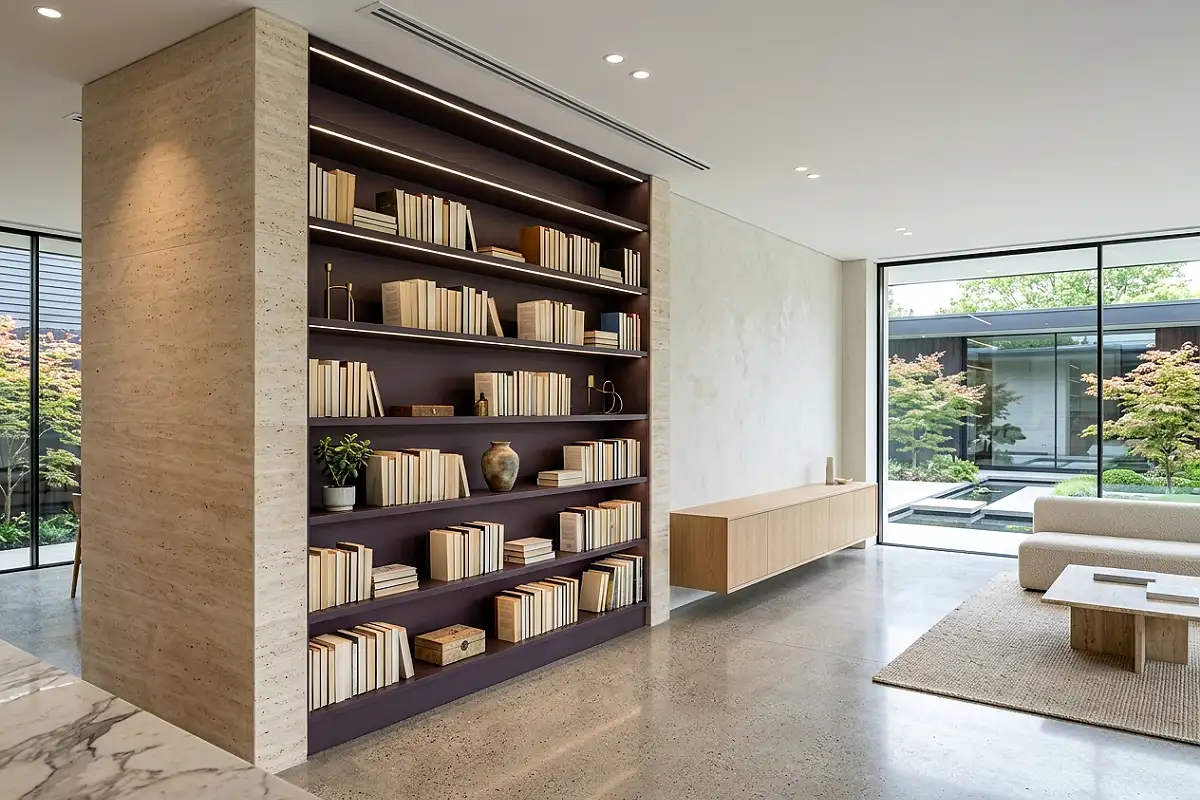
A full wall of deep, built-in or freestanding bookshelves painted the same color as the room — charcoal, forest green, dark plum — creates a library-grade depth that no art arrangement can match. The books themselves become the pattern and color, their spines ranging across cream, rust, navy, and gold against the dark backdrop. Style the shelves in loose vignettes: stacks of books interspersed with small sculptural objects, a globe, a brass clock, a small trailing plant spilling over a shelf edge. The overall effect is scholar-meets-sanctuary, intellectually rich and visually arresting in a way that is entirely unique to this treatment.
Pro Tip
Turn a third of your books spine-inward so the raw page edges face out. The creamy, textured page mass creates beautiful tonal contrast against the dark shelves and keeps the wall from feeling too chaotic when the collection is large.
Jewel-Toned Silk and Velvet Pillow Layering

In a dark bedroom, the bed is the one place where color should feel almost reckless. Layer throw pillows in deep emerald silk, garnet velvet, sapphire brocade, and antique gold jacquard — colors that would overwhelm a light room but ignite like gemstones against dark walls and deep bedding. The key is to keep the bedding itself restrained — a charcoal linen duvet, a matte black quilted coverlet, a plain dark fitted sheet — so the pillows read as an intentional jewel collection rather than a pattern collision. Two Euro shams, two standard shams, and two decorative front pillows in contrasting jewel tones is the formula that works every time.
Pro Tip
Shop vintage and estate sales for brocade and silk throw pillows. Older textiles in these materials have a depth of weave and color saturation that most contemporary production simply can’t replicate, and they’re often available at a fraction of what new velvet pillows cost at retail.
Sculptural Black Chandelier as Focal Point
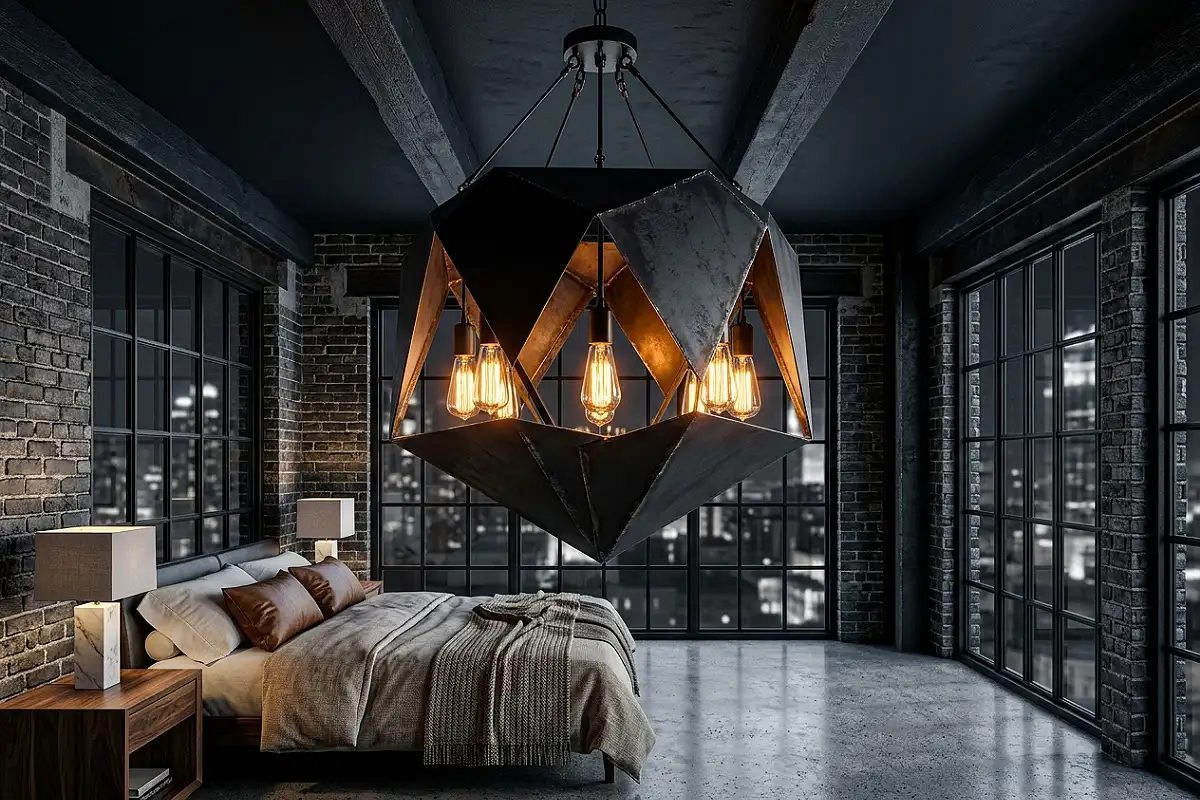
A dark bedroom demands a light fixture that earns its place as art. A matte black iron chandelier — particularly one with organic, forged, or geometric detailing — suspended above or near the bed transforms the entire vertical plane of the room. Look for designs with exposed bulb sockets in an Edison or globe format so the warm filament glow is part of the visual. The silhouette should be bold enough to read clearly against dark walls: open cage forms, starburst shapes, candelabra-style arms, or angular geometric frames all work well. Avoid anything that looks polished or delicate — the material language of a dark bedroom is raw, substantial, and deliberately imperfect.
Pro Tip
Always install a dimmer switch on a bedroom chandelier — not optional in a dark room. The difference between a chandelier at 100% and at 25% brightness is the difference between a room that feels lit and a room that feels alive.
Dark Forest Green Limewash Walls
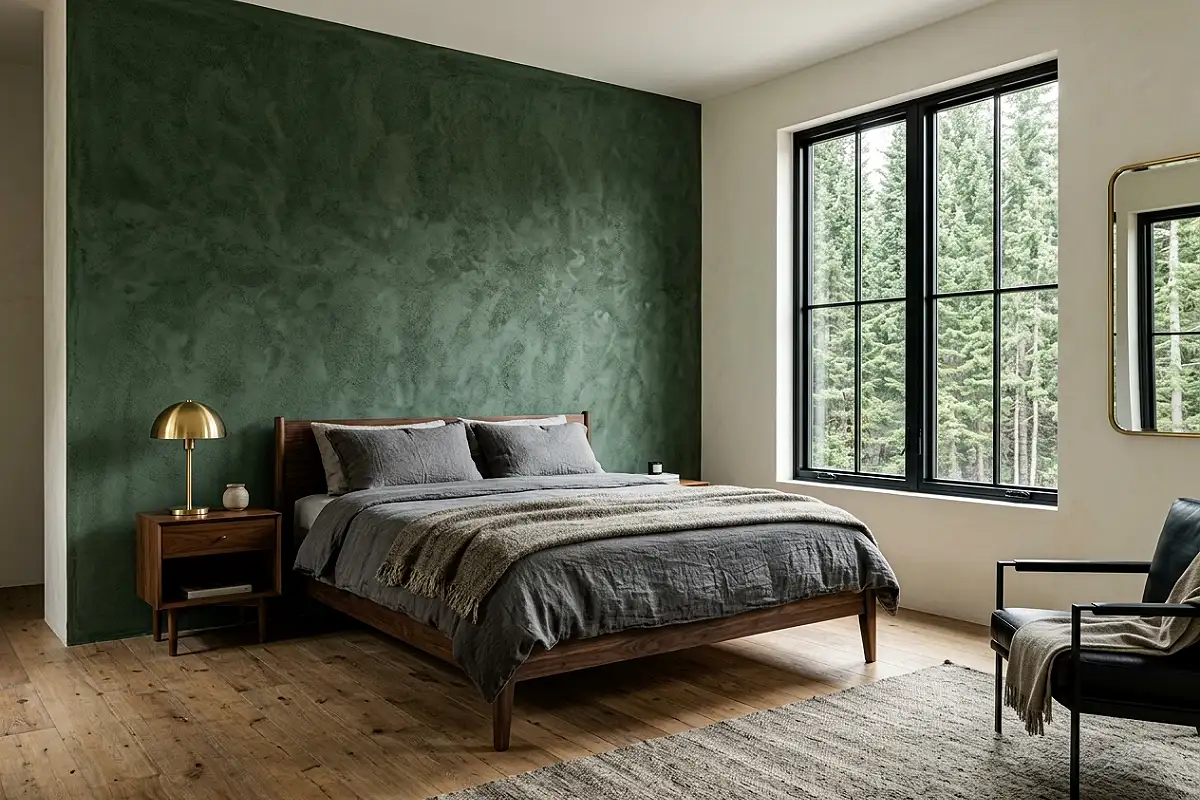
Standard paint is flat and uniform; limewash is layered, mottled, and alive. Applied to dark forest green, the limewash technique produces a wall surface that seems to shift tone as natural light moves across it throughout the day — lighter where the brush dried quickly, deeper where the wash pooled in slight texture variations. It reads simultaneously as aged plaster in a centuries-old European villa and as a deeply contemporary design choice. Portola Paints makes an excellent ready-to-apply limewash in multiple deep greens; Farrow & Ball’s Studio Shade Green and Calke Green in an authentic limewash base are more of an investment but produce an extraordinary result.
Pro Tip
Apply limewash in X-shaped strokes rather than horizontal or vertical passes. This creates the most naturalistic variation in coverage and avoids the subtle brush-stroke lines that can make limewash look more like a paint technique than an aged plaster surface.
Aged Leather Accent Chair in the Corner
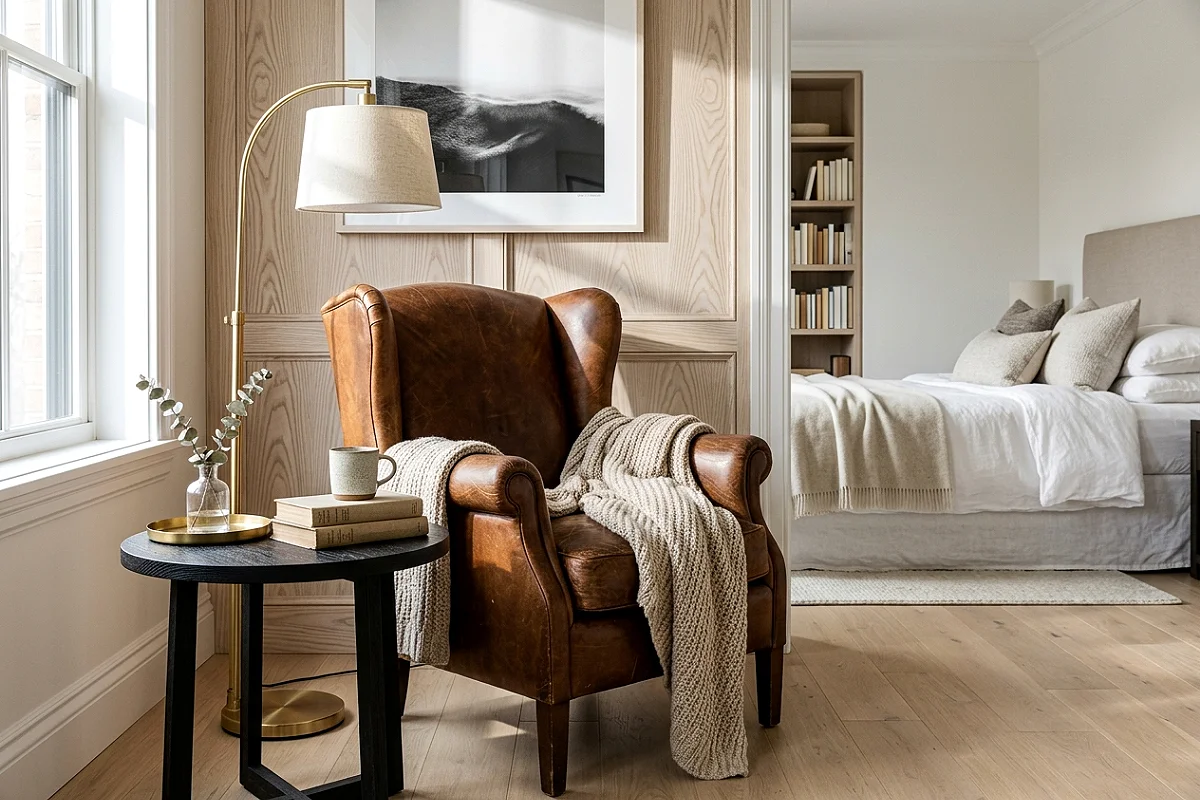
Every truly luxurious dark bedroom needs a sitting moment — one place that isn’t the bed where you can exist in the room with a book or a glass of wine without immediately committing to sleep. A vintage or high-quality aged leather club chair in cognac, tobacco brown, or dark oxblood, placed in a corner with a solid brass arc floor lamp curving overhead and a low side table beside it, accomplishes this with a quiet elegance that no other furniture category can match. The warm leather against dark walls creates a visual warmth that reads as both masculine and deeply inviting. A well-chosen floor lamp here — Rejuvenation’s Portland arc lamp is ideal — completes the vignette.
Pro Tip
Condition aged leather furniture twice a year with a natural beeswax leather conditioner. It deepens the color slightly, keeps the leather supple, and enhances the natural patina rather than masking it — especially important in a room where this chair is a focal point.
Moody Abstract Art Over the Bed
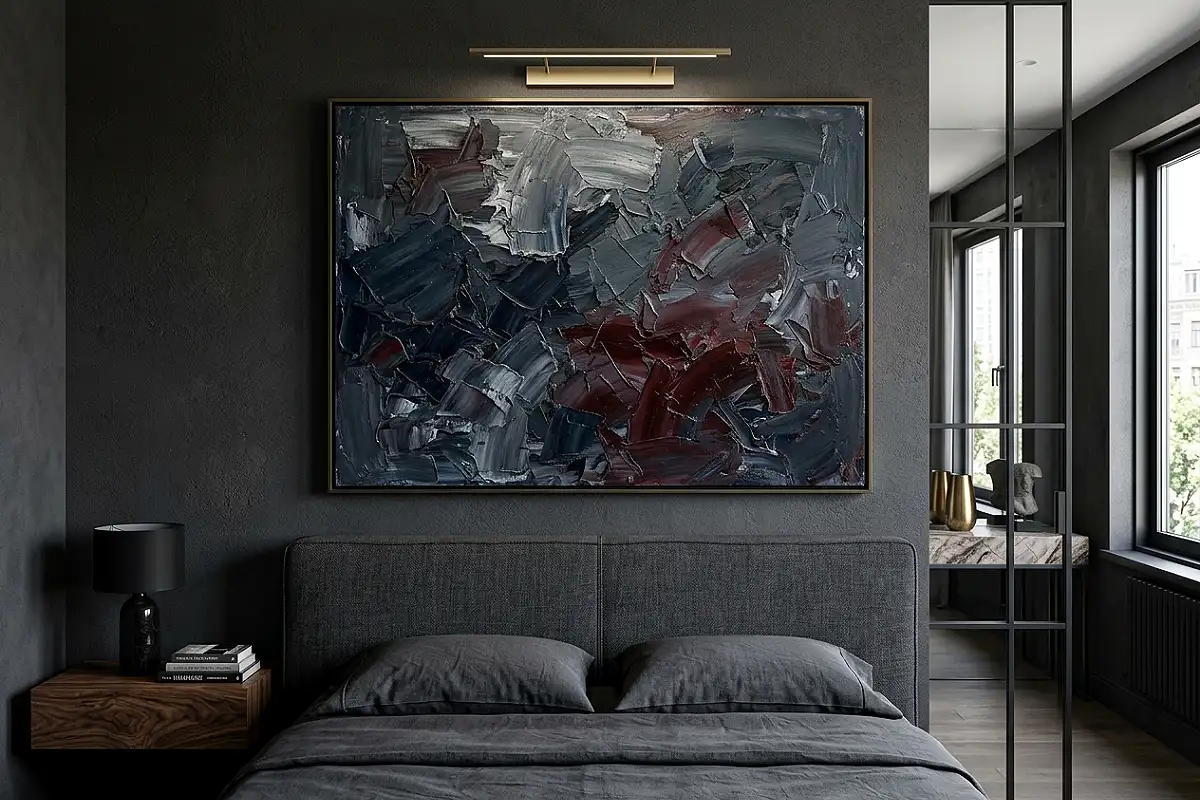
A large-format abstract painting or print in a dark bedroom should feel like a window into another atmospheric world, not a decorative afterthought. Look for works with heavy impasto texture, smoky blended backgrounds, or expressive mark-making in tones that echo the room — deep inky blues, storm grey, faded black, smoldering burgundy — with one unexpected element that pulls a highlight tone: a slash of aged gold, a bloom of dusty rose, a streak of raw sienna. The painting should be large enough to command the wall above the headboard — at minimum 40 inches wide for a queen, ideally wider. Original work on canvas from emerging artists carries a tactile quality that prints genuinely can’t replicate at this scale.
Pro Tip
Install a small picture light — a slim brass or matte black bar light mounted directly to the frame — above significant art in a dark bedroom. It creates a museum-quality focal point and keeps the painting from visually receding into the dark wall behind it.
Onyx and Marble Bathroom-Adjacent Vanity
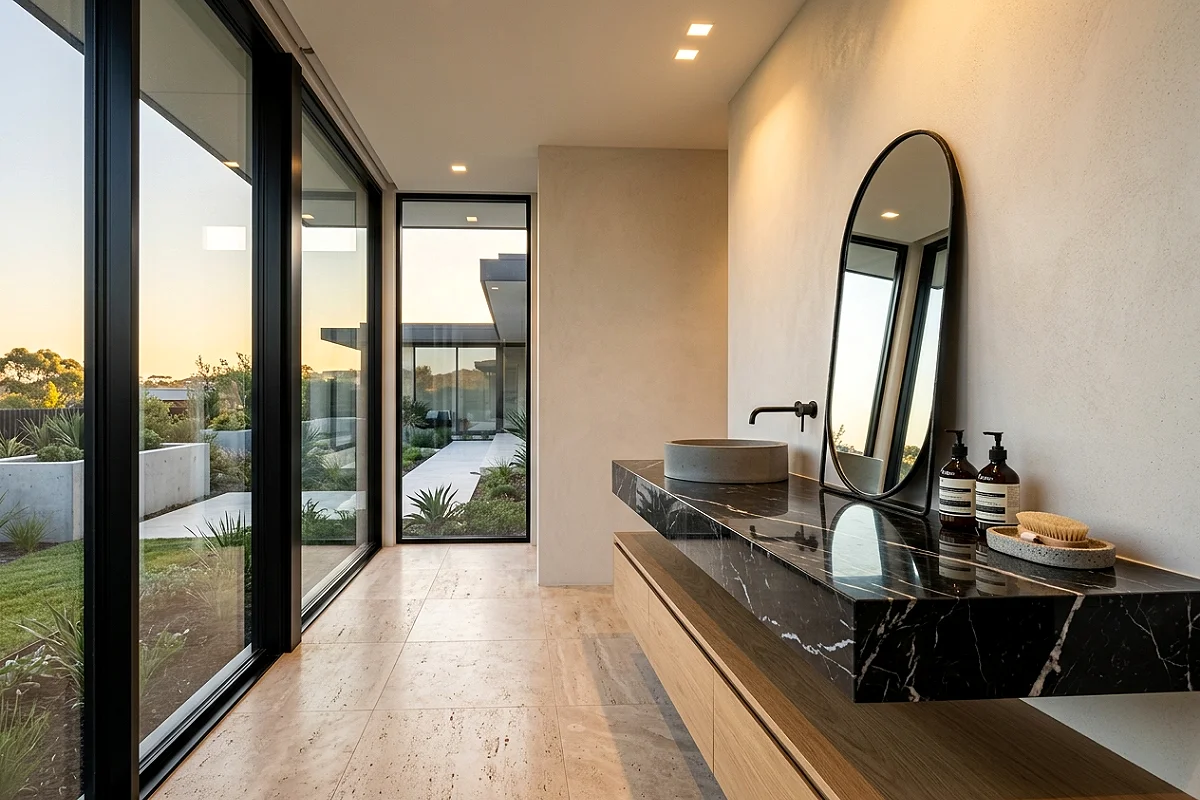
In a dark bedroom with an en suite or an open vanity area, bringing in natural stone surfaces elevates the entire space to a level that painted furniture simply can’t reach. A vanity or dresser topped with a slab of veined black marble, honed nero marquina, or dark green serpentine stone reads as genuinely architectural rather than decorative. Pair it with a leaning oval mirror in a forged iron or aged brass frame, a set of dark amber apothecary glass bottles for fragrance, and a small concrete or stone dish for jewelry. The stone surface connects the bedroom to the natural world in a way that’s particularly powerful in a room built around deep, earthy tones.
Pro Tip
Seal dark marble surfaces annually with a penetrating stone sealer — especially in a bedroom where perfume, oils, and cosmetics land on the surface. Unsealed dark marble stains quickly and the marks show far more dramatically against black and green stone than against white.
Smoked Glass and Dark Mirror Accents
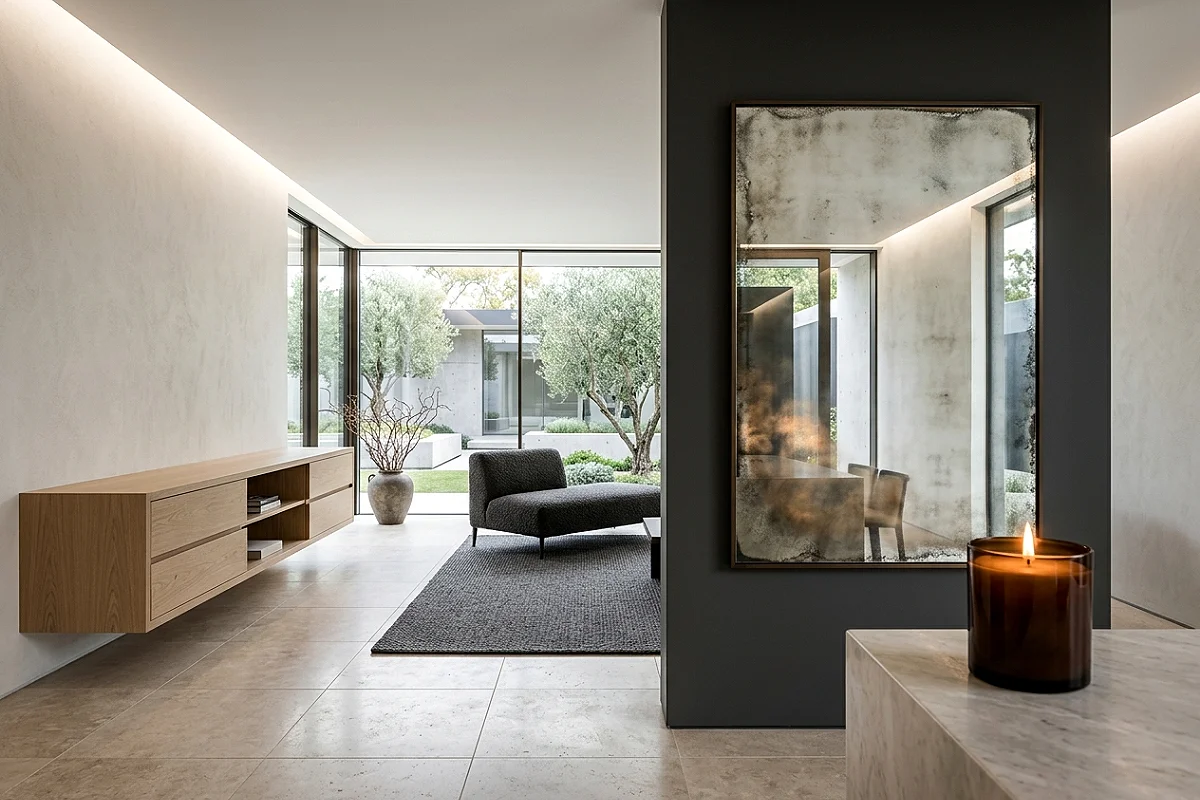
Standard mirrors brighten a room; smoked glass and antique mirror do something far more interesting in a dark space — they reflect light back at a muted, slightly amber-filtered depth that enhances the atmosphere rather than cutting through it. An antique mercury glass mirror above a dresser, a pair of smoked glass sconce shields on either side of the bed, or a floor-leaning antiqued mirror panel in the corner of the room all add a visual dimension that feels genuinely old-world. The slight cloudiness and bronze tinting of antique mirror glass is what sets this apart from any standard mirror — it looks found, not installed.
Pro Tip
To create an aged mirror effect on an inexpensive mirror, mix one part muriatic acid to ten parts water and lightly spray the back of the glass before applying mirror paint. The acid creates irregular clouded spots that replicate antique mercury glass convincingly. Always do this outdoors with gloves and eye protection.
Dramatic Dark Floral Wallpaper Feature Wall
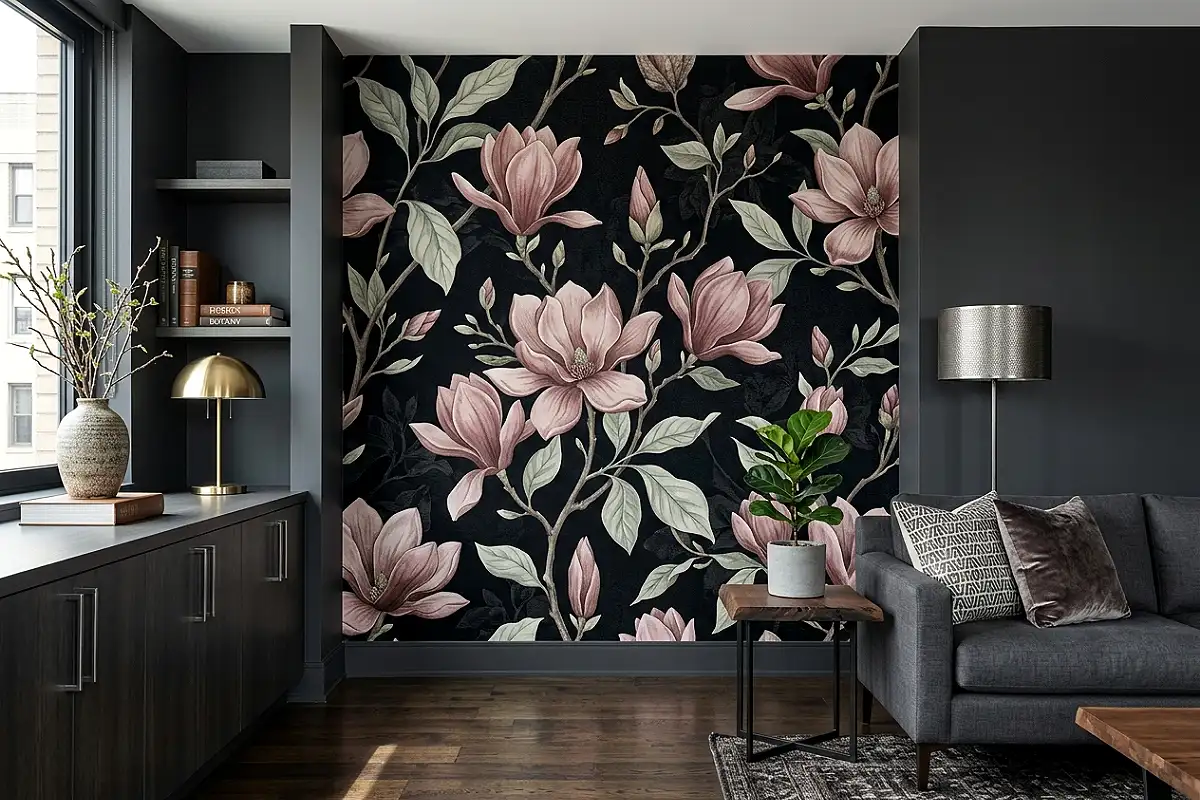
Floral wallpaper in a dark bedroom is one of the most striking pattern moves in interior design when it’s done correctly — meaning the ground color of the paper is as deep as the room itself, and the florals read as light emerging from darkness rather than pattern applied to a surface. Think large-scale midnight garden botanicals: peonies, magnolias, or tropical leaves rendered in silvery grey, dusty rose, sage, and cream against a near-black or deep charcoal ground. Cole & Son’s Botanical Stripe and Sanderson’s Bird of Paradise in their darker colorways are exceptional. Use it on the wall directly behind the bed and leave the other three walls in the coordinating deep solid paint.
Pro Tip
Match the solid paint on your remaining walls to the ground color of the wallpaper rather than to a color within the pattern. This creates the illusion that the wallpaper is an extension of the wall, not something applied to it — far more sophisticated than the two-tone look of matching paint to a motif color.
Layered Candlelight and Edison Bulb Ambiance
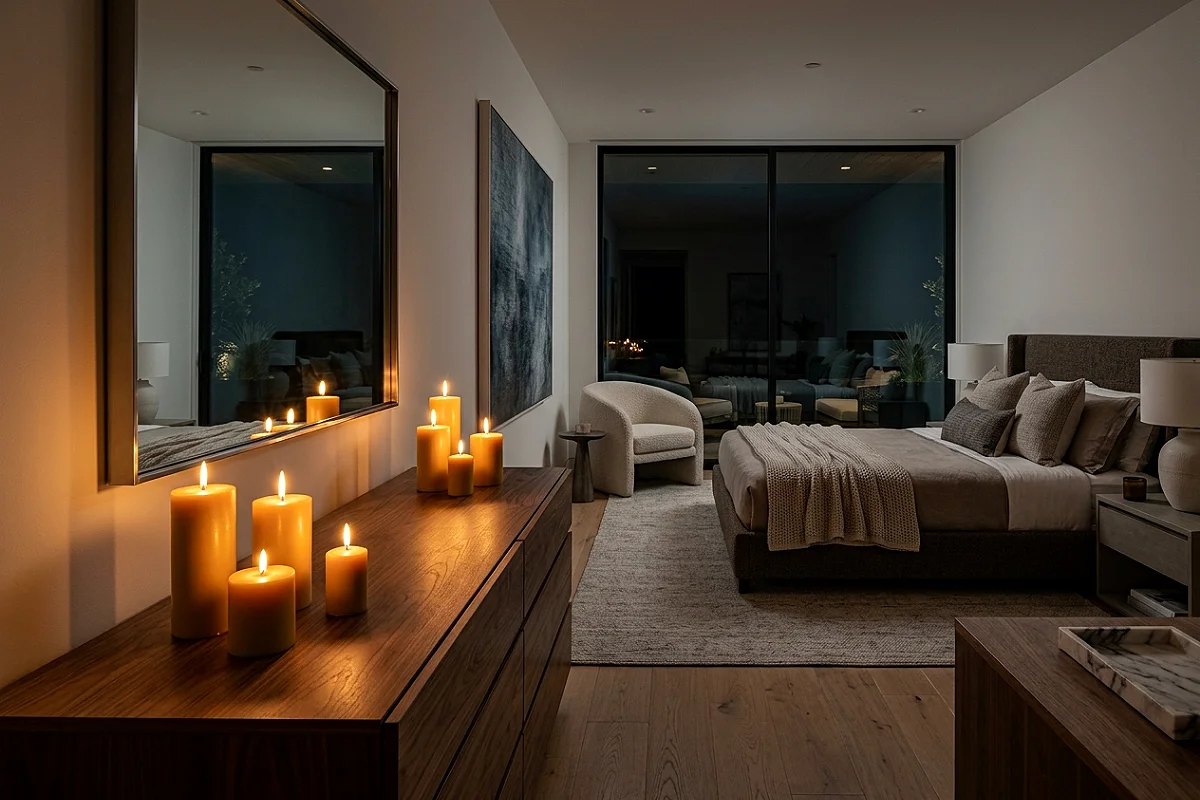
A dark bedroom lives or dies by its lighting plan, and the most important thing to understand is that ceiling fixtures should be entirely secondary to what’s happening at lower levels. Build a layered lighting system: a large cluster of pillar candles in varying heights on the dresser, plug-in brass sconces on either side of the bed fitted with amber-tinted Edison bulbs, a low table lamp with a charcoal linen shade in the reading corner, and a string of small warm globe lights tucked behind the headboard for a low, diffused backlight glow. Every light source should be warm-toned — 2200K to 2700K maximum — and every one should be dimmable.
Pro Tip
Replace every bulb in your bedroom with a 2200K warm amber option — Philips Hue’s Filament range or GE’s Vintage Edison series are excellent. The difference between a 2700K standard warm white and a 2200K amber is immediately apparent in a dark room, and it’s the single cheapest upgrade with the highest atmospheric return.
Dark Cashmere and Faux Fur Throw Layering

Texture in a dark bedroom does what pattern does in a light one — it creates the visual interest and tactile richness that keeps the room from feeling stark. A charcoal cashmere throw draped across the foot of the bed, a faux fur blanket in slate or storm grey folded over one side, and a knitted wool blanket in deep forest green layered below the duvet creates a bed that looks genuinely enveloping. The play of matte wool against the slight sheen of cashmere against the dense pile of faux fur reads as effortlessly luxurious in a way that no single blanket can achieve. For cashmere that holds up, Quince makes a beautiful 100% cashmere throw at a genuinely reasonable price point.
Pro Tip
Keep your throw textures within the same value range as your bedding — all deep, all muted — even when the materials vary. Mixing a pale cream faux fur with dark bedding reads as a contrast accent; mixing dark cashmere, dark fur, and dark wool reads as a cohesive, layered depth.
Woven Dark Jute and Wool Area Rug
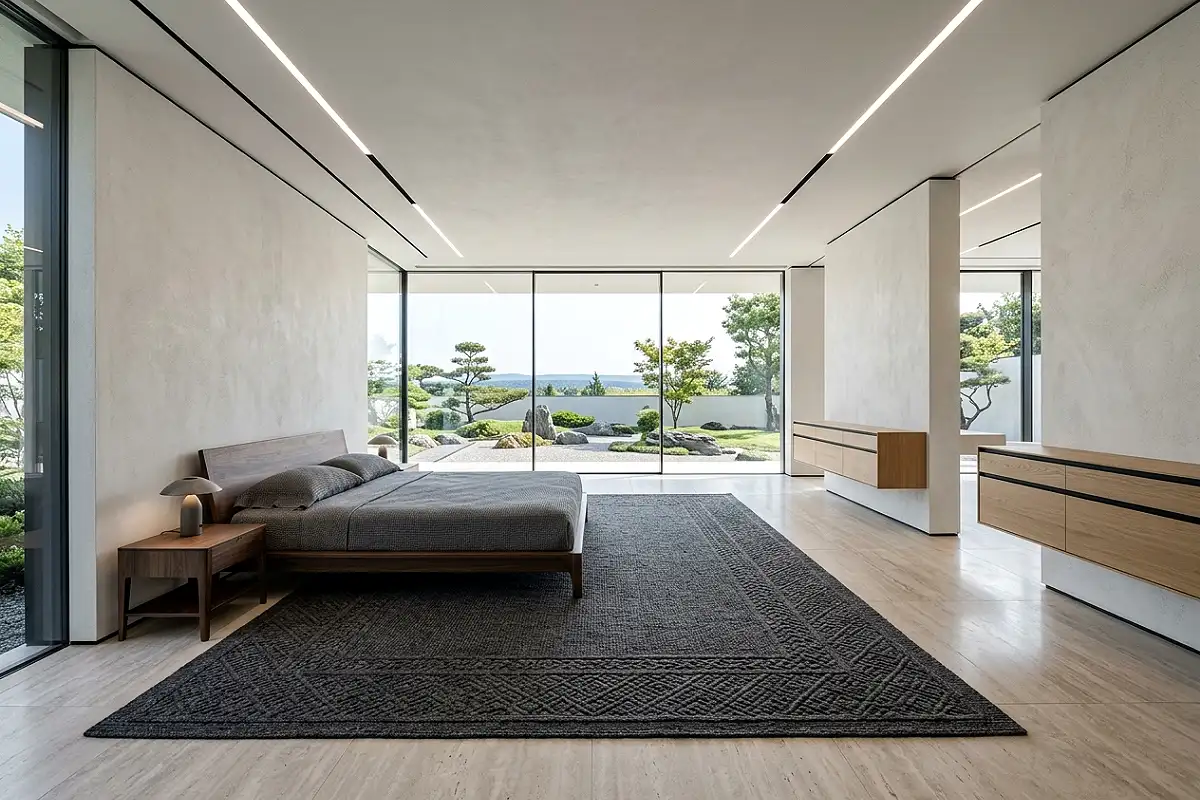
The floor in a dark bedroom is often an afterthought, but it’s one of the most important surfaces in the room. A large-format rug in a tight, tone-on-tone weave — dark charcoal wool with a subtle geometric pattern in a slightly lighter grey, or a deep indigo and black Turkish flat-weave — grounds the entire space and connects the walls to the furniture to the floor in a single unbroken dark palette. Avoid rugs that are significantly lighter than the walls; they create a sharp contrast that lifts the floor visually and breaks the immersive quality of the dark envelope. The rug should feel like it belongs to the room, not like a mat placed inside it.
Pro Tip
Size up one rug dimension from what you think you need. In a dark bedroom, a rug that extends 18 to 24 inches beyond each side of the bed reads as intentional and anchored; a rug that barely clears the bed frame reads as an afterthought regardless of its quality.
Blackout Silk Curtains Pooling to the Floor
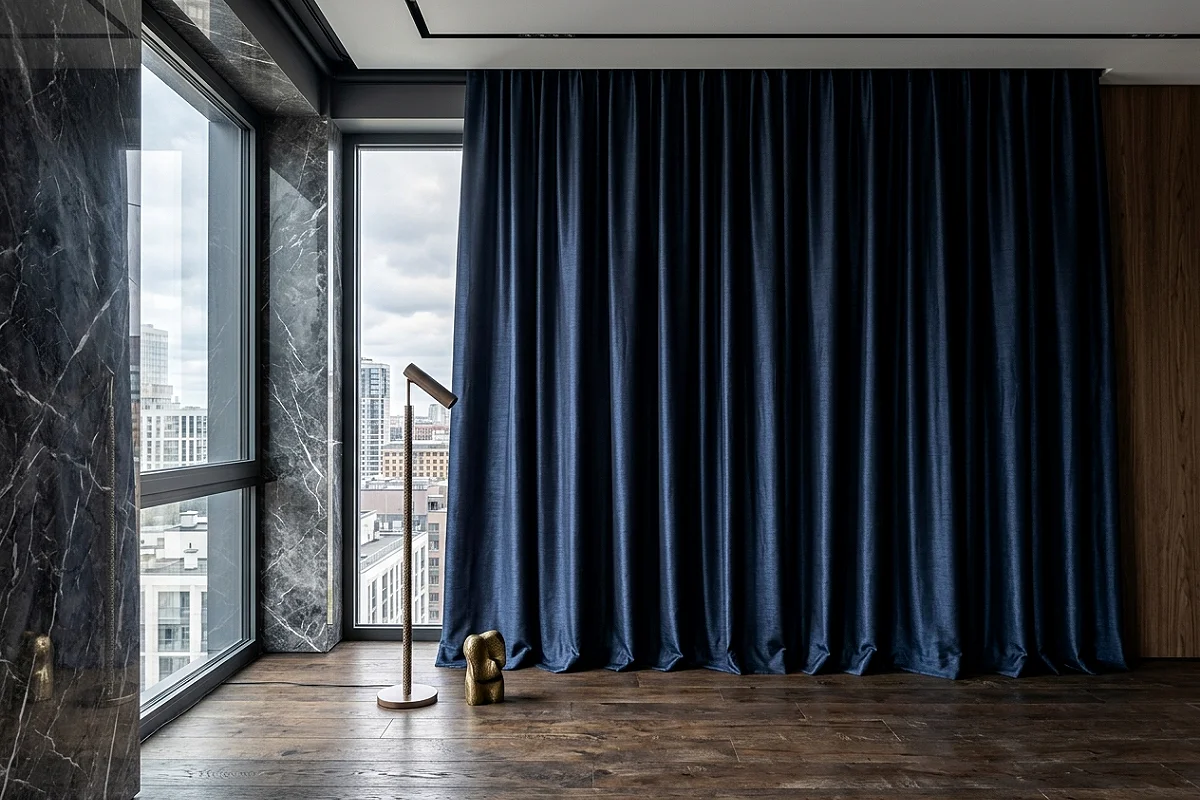
In a bedroom built for atmosphere, window treatments aren’t functional accessories — they’re architectural. Floor-to-ceiling blackout curtains in deep charcoal silk, midnight navy velvet, or matte black linen, hung from a ceiling-mounted rod and pooling 3 to 4 inches on the floor, transform windows from light sources into dramatic vertical design elements. Velvet blackout panels are particularly powerful because the pile absorbs light differently depending on how it catches the fold, creating a shifting, almost liquid quality in the fabric as it moves. They also provide exceptional sound dampening, which is an underrated benefit in an urban bedroom. RH’s Riviera Linen and H&M Home’s velvet panel range both offer excellent deep-tone options.
Pro Tip
Mount your curtain rod or ceiling track at least 4 inches wider than the window frame on each side. When the panels are open, they stack entirely off the glass, keeping the full window visible and preventing the room from feeling closed-in during the day even with heavy dark curtains.
Botanical Pressed Specimen Art in Black Frames
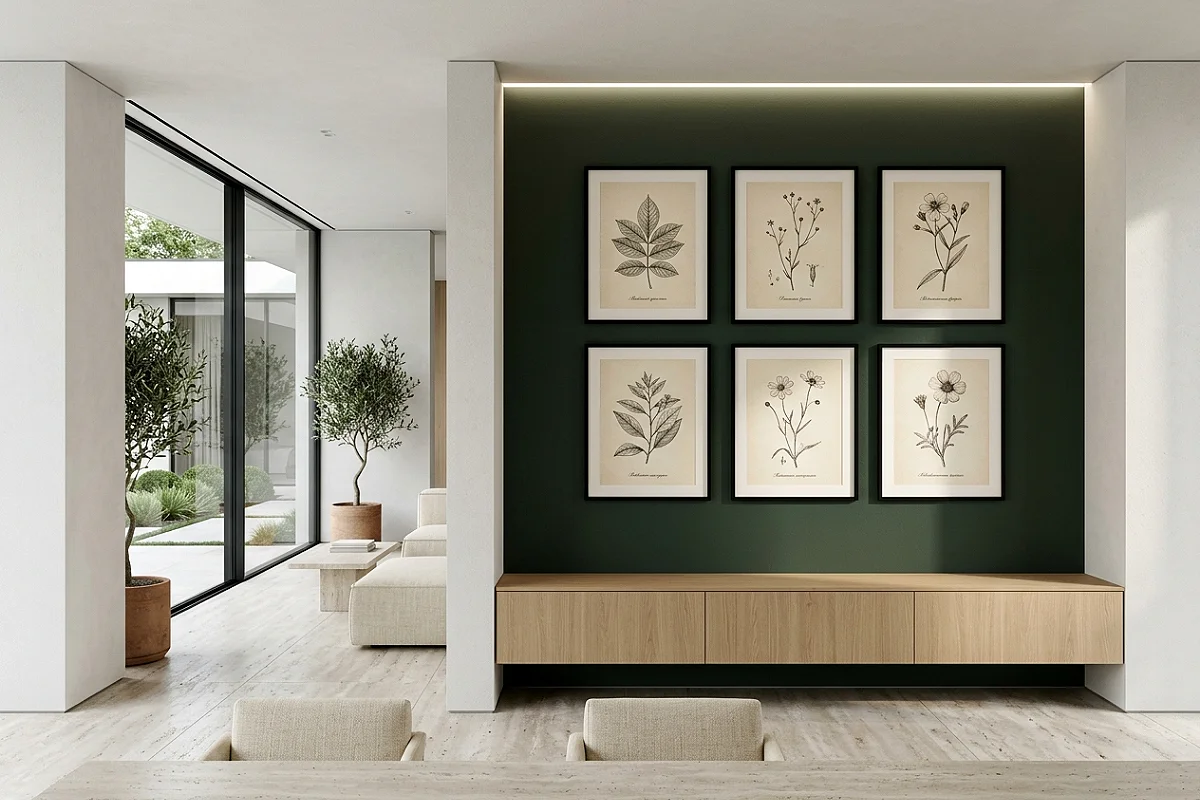
In a dark bedroom, art needs to do something specific with light and contrast. Large-format pressed botanical specimen prints — the scientific illustration style, rendered in cream and pale sage on a black or deep charcoal ground — create exactly the right tone. The cream outlines of the botanical drawings glow against a dark background in a way that feels both eerie and exquisitely beautiful, like a nature journal from a Victorian collector. Frame them in matte black or slim blackened brass frames and hang them in a tight grid arrangement with minimal spacing — two columns of three, or three columns of two — for maximum graphic impact. Public domain sources including the Smithsonian and Kew Gardens’ archives offer high-resolution downloads at no cost.
Pro Tip
Print botanical art on a warm cream or slightly yellow-tinted paper stock rather than bright white. The warmth of aged paper reads as authentic archival material and contrasts beautifully with a dark mat and frame — whereas brilliant white paper reads as a digital print regardless of the source artwork’s age.
Incense and Beeswax Sensory Ritual Corner
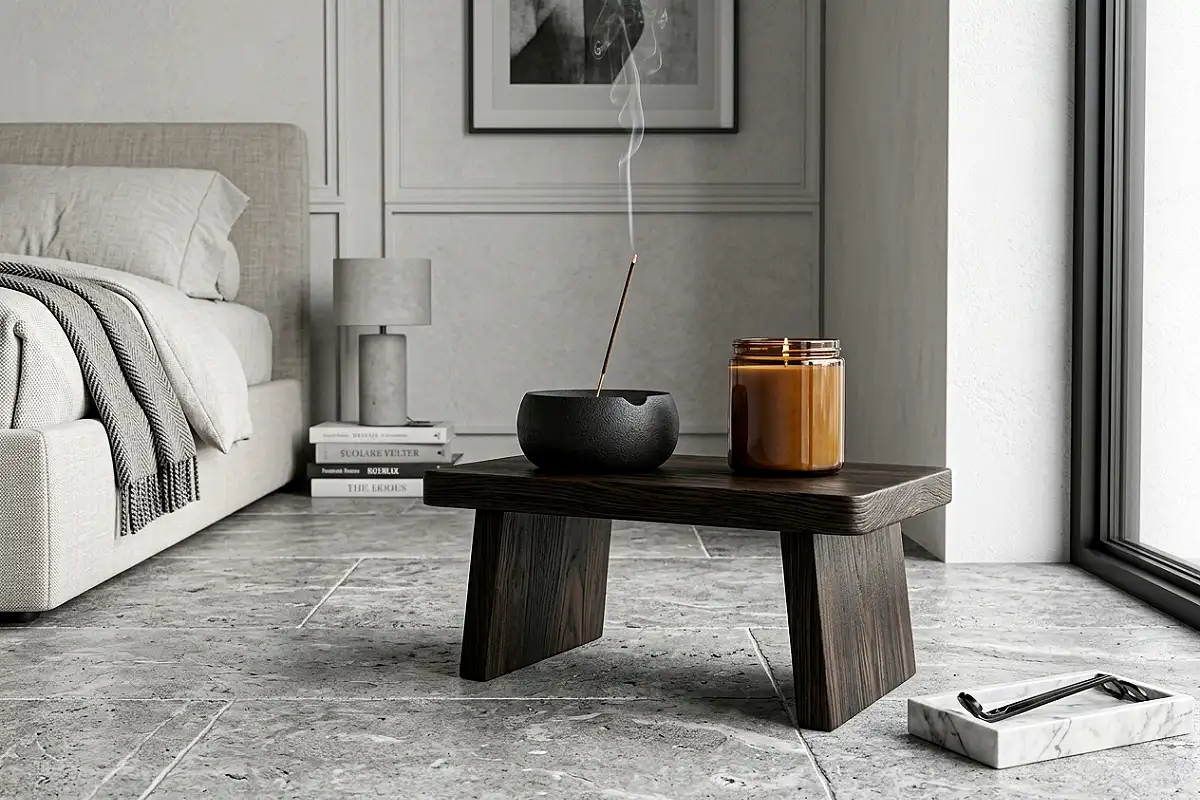
A dark bedroom designed for genuine rest and atmosphere deserves a dedicated sensory corner — a low, deliberately styled surface where scent and light ritual are the entire point. On a small ebony-stained side table or a low wooden stool, layer a matte black ceramic incense burner, a hand-dipped beeswax taper in a hammered brass holder, a small obsidian or volcanic stone dish holding loose incense or resin, and a dark amber glass candle in a heavyweight vessel. The dark materials absorb into the room’s palette while the candlelight and incense smoke create a living, flickering, aromatic atmosphere that no interior accessory can substitute for. Diptyque’s Baies or Byredo’s Bibliothèque in a large format candle are room-defining choices.
Pro Tip
Burn your bedroom candle for a maximum of two to three hours at a time, and always trim the wick to a quarter inch before relighting. A properly maintained candle burns cleaner, throws a better scent radius, and maintains the flat wax surface that looks beautiful — rather than the tunneled, wax-dripped mess of a neglected candle.
Paneled Dark Wood Wainscoting
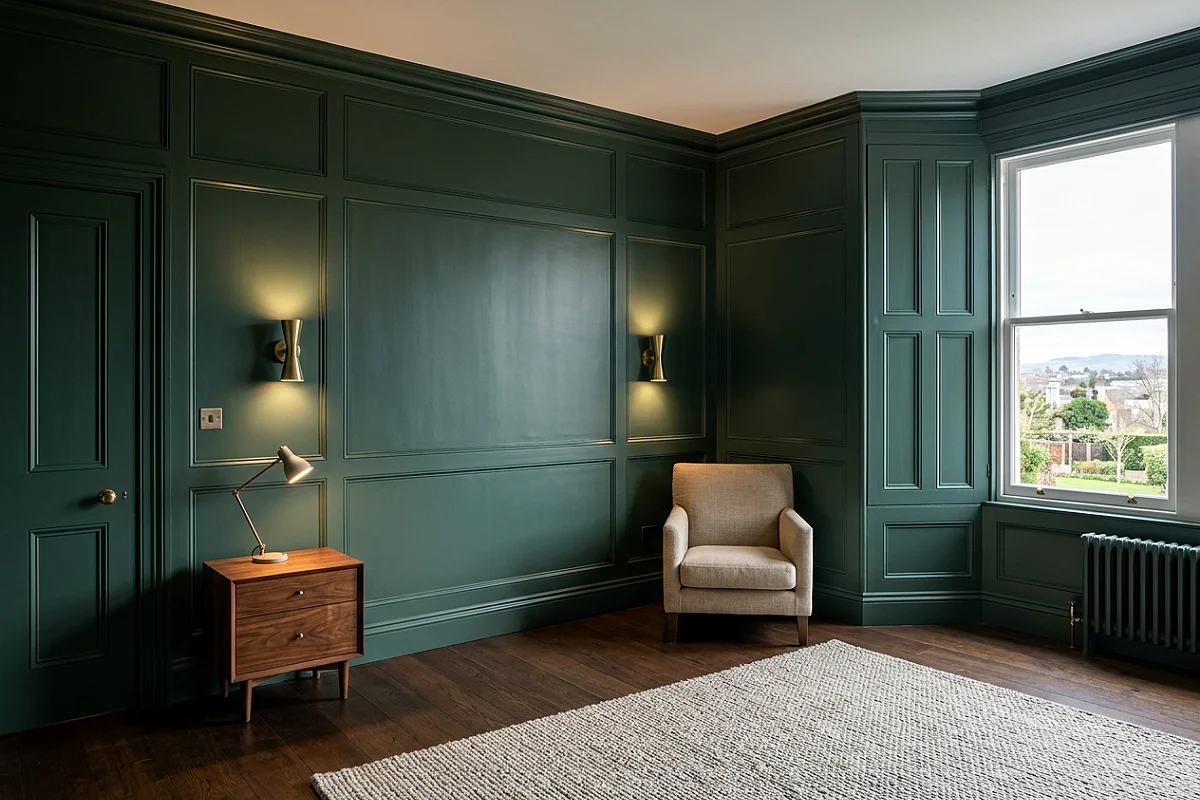
Wood paneling painted a deep, saturated tone — or left in a dark-stained natural finish — brings an architectural weight to a bedroom that no amount of furniture or textile layering can replicate. Tall Shaker-style wainscoting painted in deep charcoal, inky green, or rich plum on the lower two-thirds of the wall, with the upper portion continuing in a matching or slightly deeper version of the same color, creates a visual datum line that makes the room feel like it was designed rather than decorated. Against this backdrop, a simple linen bed in cream or warm white becomes dramatically beautiful through contrast alone. For a renter-friendly version, peel-and-stick paneling in a dark finish installed below a painted chair rail achieves nearly the same result.
Pro Tip
Paint paneling in a satin or eggshell finish rather than matte. In a dark room, a slightly reflective surface catches and diffuses more candlelight and lamp glow than flat paint does, making the paneling itself participate in the ambient lighting rather than simply absorbing it.
Frequently Asked Questions
Will dark walls make my bedroom feel too small?
Not necessarily. Dark walls can make a room feel cozy and immersive rather than cramped, especially when the ceiling and trim are painted in a similar deep tone. Keeping contrast low helps the boundaries visually disappear.
What paint colors work best for a moody dark bedroom?
Warm, deep shades tend to work best, including charcoal, navy, forest green, chocolate brown, and deep plum. Warm undertones keep dark colors feeling rich and inviting rather than cold or flat.
How do I prevent a dark bedroom from feeling depressing?
Focus on warmth through layered lighting, natural materials, and rich textiles. Warm bulbs, wood, linen, velvet, brass, and accents in cognac, burgundy, or muted rose can balance deep walls beautifully.
Is a dark bedroom a good idea for a small room?
Yes. A small bedroom can actually benefit from a dark, monochromatic palette. Using one deep tone across the walls, ceiling, and trim can soften visual boundaries and create a cozy, sophisticated cocoon.
What metal finishes work best in a dark moody bedroom?
Unlacquered brass, aged bronze, blackened steel, and antique finishes pair especially well with dark interiors. Their subtle warmth and texture add character without overpowering the moody atmosphere.
How do I add light without ruining the moody atmosphere?
Use several small, warm light sources instead of one bright overhead fixture. Bedside sconces, table lamps, floor lamps, candles, and dimmable lighting create soft pools of light while preserving the room’s intimate feel.